EVANBattery Preview

DNOOO blank theme is active for local preview.

Top 10 Home Solar Battery Storage Suppliers in the USA for Residential Installers

US Battery Supply Is Easy Until the Order Needs to Repeat

Sourcing one home solar battery storage system in the USA is straightforward — call a distributor, check branch stock, get it on a truck. The friction starts when you need the same battery across 20, 50, or 200 installs and your margin depends on predictable unit cost, matching documentation, and a supplier who can actually repeat the same spec without surprises.

This list covers 10 residential solar battery suppliers with verified US-market access. Each one falls into one of three sourcing models: domestic distributor with branch inventory, integrated OEM platform with a closed ecosystem, or LiFePO4 specialist with open inverter pairing. The profiles are based on official company pages — no claims about unpublished wholesale pricing or real-time branch stock levels.

If you're building a repeat Home Solar Battery Storage program and need to compare convenience against economics, this is the sourcing landscape you're working with.

The Shortlist Criteria That Protect Margin, Permits, and Warranty Exposure

Before comparing supplier names, lock down what you're actually evaluating. A battery that passes inspection, pairs cleanly with your inverter, and ships with complete documentation is worth more than a battery that costs $40 less but creates a truck roll six months later.

LiFePO4 is the default chemistry for residential storage in 2025–2026. Thermal stability, cycle life above 6,000 cycles at 80% DoD, and no thermal runaway risk under normal conditions make it the only chemistry most inspectors and homeowners are comfortable with. Lead-acid still appears in budget off-grid channels, but if you're quoting grid-tied residential backup, LiFePO4 home battery suppliers are where the market has settled.

Here's what to verify before any supplier makes your shortlist:

Criterion What to ask Why it affects your margin
Certifications UL 9540A test report, UL 1973 listing, UN38.3 for imports Failed inspection = delayed commissioning, unpaid install labor
Inverter compatibility Published compatible inverter list or open CAN/RS485 protocol Mismatched comms = truck roll, firmware troubleshooting on your dime
BMS communication Proprietary vs open protocol, firmware update path Locked BMS limits your inverter options on future jobs
Warranty route Who handles RMA — supplier, distributor, or you? Unclear warranty = you absorb the replacement cost and labor
Lead time Branch stock vs production queue vs ocean freight Late battery = delayed project close, financing penalty risk
MOQ and reorder One-off project buy vs account wholesale vs container volume Higher volume commitment = lower unit cost, but ties up capital
Private-label / OEM Custom branding, voltage/capacity changes, enclosure options Your brand on the battery = margin control and customer retention
Landed system cost Battery + inverter pairing + freight + cert paperwork + warranty reserve The real number is never just the battery price

(A note from experience: the single biggest margin killer I see with residential installers isn't the battery price itself — it's the truck roll for a warranty issue that the supplier won't own. Clarify the RMA process before you place the first order, not after the homeowner calls.)
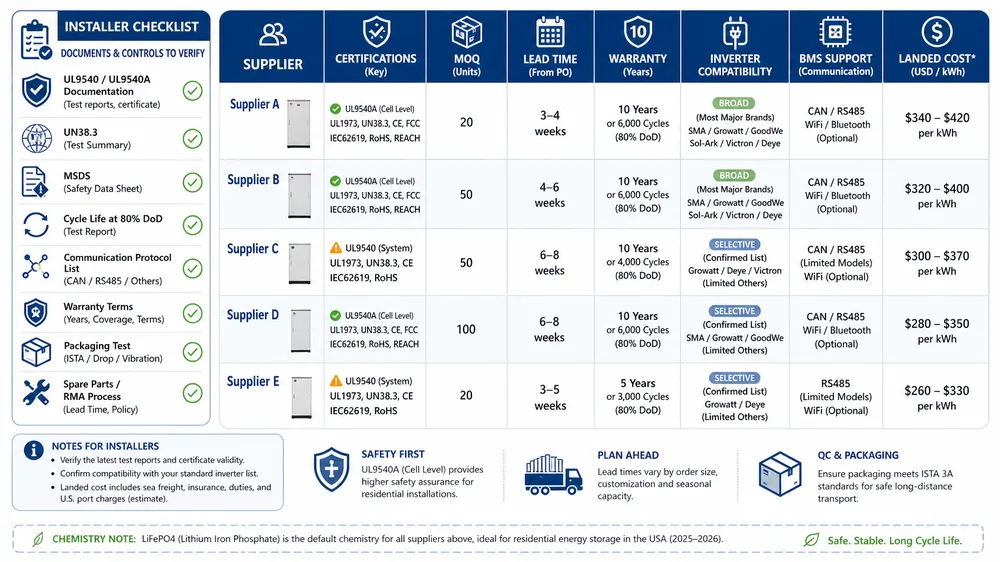
Home solar battery supplier evaluation matrix for residential installers comparing certifications, MOQ, lead time, and inverter compatibility

10 US-Available Home Solar Battery Storage Suppliers to Shortlist

These 10 companies serve the US residential installer market through different sourcing routes. The grouping reflects how you'd actually buy from them — not a popularity ranking.

Domestic Distributor Channels

1. Greentech Renewablesgreentechrenewables.com

  • Supplier type: National solar and storage distributor with branch locations.
  • Best fit: Installers who need same-week product availability from a local branch and prefer account-based purchasing across multiple battery brands.
  • Storage angle: Carries multiple residential battery brands through branch inventory. Product selection varies by location and account status.
  • Commercial strength: Nationwide branch network, installer account programs, logistics support, and multi-brand access under one distributor relationship.
  • Verify before committing: Which battery brands are stocked at your nearest branch, lead time for non-stock items, and whether volume pricing requires a formal account tier.

2. BayWa r.e. Solar Systemssolar-distribution-us.baywa-re.com

  • Supplier type: US solar and energy storage distributor backed by a European parent company.
  • Best fit: Installers who want distributor-level logistics with access to European and US battery brands, particularly in markets where BayWa r.e. maintains warehouse coverage.
  • Storage angle: Distributes residential and commercial energy storage components alongside solar modules and inverters.
  • Commercial strength: Multi-warehouse distribution, project support services, and access to brands that may not have direct US sales teams.
  • Verify before committing: Regional warehouse coverage for your service area, minimum order for free freight, and whether the specific battery SKU you need is a stocked item or special-order.

3. Soligentsoligent.net

  • Supplier type: US wholesale clean energy distributor.
  • Best fit: Installers and EPCs looking for wholesale pricing on storage components with a single-source distributor relationship covering solar, storage, and racking.
  • Storage angle: Lists energy storage as a core product category alongside modules, inverters, and mounting systems.
  • Commercial strength: Wholesale positioning, broad product catalog, and installer-facing purchasing tools.
  • Verify before committing: Actual home battery storage distributors USA inventory depth for residential-scale batteries, account requirements, and whether your preferred battery brand is available through their catalog.

Integrated OEM Platforms

4. Tesla Energytesla.com/powerwall

  • Supplier type: Integrated home battery OEM with a closed ecosystem.
  • Best fit: Installers serving homeowners who specifically request Tesla by name, or projects where the Powerwall's integrated inverter and gateway simplify system design.
  • Storage angle: Powerwall 3 is a fully integrated battery + inverter unit. The ecosystem is closed — you install Tesla's hardware with Tesla's monitoring.
  • Commercial strength: Brand recognition drives homeowner demand, which can shorten your sales cycle. Integrated design reduces component-matching decisions.
  • Verify before committing: Certified installer requirements, allocation and lead time in your region, and whether the closed ecosystem limits your ability to service or expand the system later.

5. Enphase Energyenphase.com

  • Supplier type: Integrated inverter and battery OEM.
  • Best fit: Installers already using Enphase microinverters who want a single-vendor monitoring and warranty path for the full solar-plus-storage system.
  • Storage angle: IQ Battery series uses LFP chemistry in a modular, scalable configuration designed to pair with Enphase microinverter systems.
  • Commercial strength: Tight inverter-battery integration, installer training programs, and a monitoring platform homeowners recognize.
  • Verify before committing: Whether IQ Battery availability matches your project timeline, pricing through your distributor vs direct Enphase channel, and system sizing limits for larger homes.

6. SolarEdge Technologiessolaredge.com

  • Supplier type: Integrated inverter and battery OEM.
  • Best fit: Installers using SolarEdge optimizers and inverters who want to add storage without introducing a third-party battery and the compatibility questions that come with it.
  • Storage angle: SolarEdge Home Battery is a stackable LFP unit designed for the SolarEdge Home ecosystem. DC-coupled architecture.
  • Commercial strength: Single-vendor design tool, warranty path, and monitoring. Stackable capacity lets you size to the home without overselling.
  • Verify before committing: Compatibility with your existing SolarEdge inverter model, installer portal access for ordering, and regional availability of the specific battery capacity you need.

7. FranklinWHfranklinwh.com

  • Supplier type: Whole-home energy management and battery OEM.
  • Best fit: Installers positioning whole-home backup as a premium offering, particularly where the homeowner wants managed energy routing across solar, grid, battery, and generator inputs.
  • Storage angle: aPower battery units with the FranklinWH gateway manage multiple energy sources. The system is designed for full-home backup rather than partial-load shedding.
  • Commercial strength: Premium positioning supports higher install pricing. Installer center with training and support resources.
  • Verify before committing: Gateway requirements, installer certification process, and whether the system's premium price point matches your target customer segment.

8. Generacgenerac.com

  • Supplier type: Backup-power ecosystem supplier expanding into solar storage.
  • Best fit: Installers in markets where Generac's generator brand recognition creates cross-sell opportunities for solar battery backup, or where the dealer network provides local support infrastructure.
  • Storage angle: PWRcell 2 is a modular battery cabinet system. Generac's positioning bridges traditional backup power and solar storage.
  • Commercial strength: Existing dealer/installer network, brand trust in the backup-power segment, and homeowner familiarity with the Generac name for reliability.
  • Verify before committing: PWRcell 2 availability and lead time, dealer program requirements, and whether the modular cabinet sizing fits your typical residential project scope.

LiFePO4 Specialist Suppliers

9. Fortress Powerfortresspower.com

  • Supplier type: LiFePO4 battery specialist focused on residential and commercial storage.
  • Best fit: Installers who want open-architecture LFP batteries that pair with multiple inverter brands, particularly for projects where battery capacity and cycle life are the primary selling points.
  • Storage angle: eForce series — stackable LFP whole-home storage with installer-facing monitoring tools. Designed for inverter-agnostic pairing.
  • Commercial strength: Open compatibility list, LFP-focused engineering, and monitoring/support tools built for the installer rather than the homeowner.
  • Verify before committing: Specific inverter compatibility for your preferred brands, warranty terms and RMA process, and distributor pricing vs direct purchasing options.

10. EG4 Electronicseg4electronics.com

  • Supplier type: LiFePO4 battery and energy storage system supplier.
  • Best fit: Installers and integrators looking for competitively priced LFP batteries — wall-mounted, rack-mounted, and all-in-one ESS units — with open inverter pairing and direct purchasing options.
  • Storage angle: Broad LFP battery catalog covering wall-mount residential units, server-rack batteries, and integrated ESS products. Multiple voltage and capacity configurations.
  • Commercial strength: Competitive hardware pricing, direct sales channel, growing installer community, and a product range that covers budget-conscious residential through light commercial.
  • Verify before committing: Certification status for your jurisdiction (UL listing specifics), warranty support infrastructure, and whether their direct-sales model provides the technical support depth you need for complex installs.
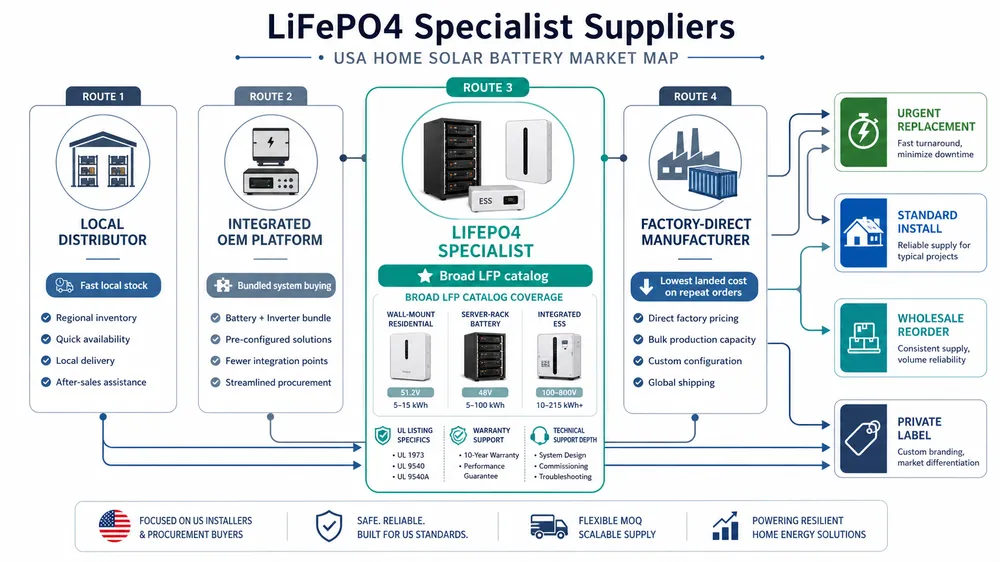
Map-style diagram of home solar battery supplier routes in the USA from distributor inventory to factory-direct sourcing

Where Domestic Convenience Pays for Itself

The 10 suppliers above share one thing: they all have some form of US-market access that lets you buy without managing international freight, customs clearance, or import documentation yourself. That convenience has real value in specific scenarios.

Local distributor stock wins when:

  • You need a replacement battery this week because a unit failed during commissioning and the homeowner's financing clock is ticking.
  • You're installing a platform for the first time and want local technical support during the learning curve.
  • The local inspector is familiar with a specific brand's UL listing and you don't want to introduce documentation they haven't seen before.
  • Your project volume is 1–5 units and the per-unit premium is smaller than the cost of managing an import shipment.

Integrated OEM ecosystems win when:

  • The homeowner specifically requests a brand, and fighting that preference costs you the deal.
  • Single-vendor warranty simplifies your post-install liability.
  • The installer training and certification program gives your team confidence on the first few jobs.

(Worth noting: the convenience premium on domestic battery supply typically runs 25–40% above factory-gate pricing for equivalent LFP specs. On a single install, that's absorbed into the project margin. On 50+ installs per year, it becomes a line item worth examining.)

None of this is a criticism — it's the economics of intermediation. A distributor carries inventory risk, provides credit terms, and handles logistics. That service costs money. The question is whether your order pattern justifies paying for it on every unit.

Where Factory-Direct Sourcing Changes the Battery Math

Once your residential install volume becomes predictable — say 100+ batteries per year of the same configuration — the economics shift. The distributor's convenience premium compounds across every unit, and the services you're paying for (brand discovery, one-off logistics, technical hand-holding) are services you no longer need.

This is where factory-direct solar battery wholesale enters the picture. Not as a replacement for your local distributor on emergency jobs, but as a parallel sourcing channel for your repeat SKUs.

We've been manufacturing solar batteries since 2012 — nothing else, just batteries and BMS systems. Our facility in Zhongshan runs 9,900 m² with 6 production lines and 150 people focused entirely on solar energy storage. Annual capacity is 2,000,000 units. That single-product focus means our automated cell sorting lines, BMS firmware, and pack assembly processes have been refined across 13 years of production runs, not bolted onto a broader electronics operation.

What that translates to for your sourcing program:

  • 100-unit MOQ for standard models — you can test a SKU across 20–30 installs before committing to container volume. Most domestic distributors won't offer custom terms at that scale; most factories won't ship below 500.
  • In-house BMS design with 18+ engineers — if your preferred inverter uses CAN bus at a specific baud rate or requires a particular battery protocol, we match it at the firmware level. US resellers can't customize communication protocols; they sell what the factory programmed.
  • Automated cell sorting ensures capacity matching within ±1.5% across every pack in your batch, so your field performance data stays consistent from install #1 to install #100.
  • Full export documentation in one package: ISO 9001:2015, CE, IEC 62133, UN38.3, MSDS — your customs broker and local AHJ get what they need without chasing paperwork across three vendors.

The wall mounted solar battery format is our most common residential configuration for US-bound orders — compact enclosure, pre-wired BMS, and a form factor that mounts in a garage or utility closet without custom racking. For installers building a private-label program or needing voltage/capacity configurations outside standard catalog options, our OEM ODM solar battery process covers custom branding, enclosure color, capacity variants, and protocol matching under one engineering team.

(For context: our typical US installer buyer starts with 100–200 units of a standard 48V/100Ah wall-mount, validates field performance over 3–4 months, then moves to branded packaging and a 500-unit reorder cycle. The first order tests the product; the second order tests the relationship.)

Match the Supplier Route to the Order Scenario

The right supplier depends on what you're buying, how often, and what you need around the battery itself. Here's the decision logic:

Order scenario Best-fit route Why
Urgent replacement (1–3 units, this week) Domestic distributor (Greentech, BayWa r.e., Soligent) Branch stock, no freight wait, known product
Standard branded residential install Integrated OEM (Tesla, Enphase, SolarEdge, FranklinWH, Generac) Homeowner brand preference, single-vendor warranty, training support
Open inverter pairing, best battery economics LiFePO4 specialist (Fortress Power, EG4) Inverter-agnostic, competitive LFP pricing, flexible system design
Repeat wholesale SKU (100+ units/year) Factory-direct manufacturer (EVANBattery) Lowest landed unit cost, batch consistency, documentation package
Private-label battery program Factory-direct with OEM/ODM (EVANBattery) Your brand, your spec, your margin — no middleman markup
Cost-sensitive bid with predictable demand Compare distributor landed cost vs factory-direct landed cost Run the numbers on both; the breakeven is usually around 50–80 units depending on freight and duties

For home solar battery backup projects where the sizing is standardized across a subdivision or multi-home development, factory-direct sourcing typically delivers 20–35% lower per-unit cost compared to buying the same LFP capacity through a US distributor — assuming you're ordering 100+ units and can plan 6–8 weeks of ocean freight lead time.

If you're evaluating both routes simultaneously, request a quote with your target voltage, capacity, quantity, and inverter model. We'll return a landed-cost estimate so you can compare directly against your current distributor pricing.

Procurement FAQ for Installers Comparing Battery Suppliers

What certifications should a residential installer check before buying home solar batteries?

At minimum: UL 9540A fire safety testing for the installed system, UL 1973 for the battery itself, and FCC Part 15 for electronics. For imported batteries, UN38.3 transport certification and MSDS are required for legal shipping. If your AHJ hasn't seen a specific brand before, having the full test report — not just the certificate — speeds up permit review significantly.

Is LiFePO4 better than lead-acid for residential solar battery storage?

For grid-tied residential backup, LiFePO4 is the standard choice. Cycle life of 6,000+ at 80% depth of discharge, no thermal runaway risk under normal operation, and energy density that fits wall-mount enclosures. Lead-acid (gel or AGM) still makes sense for budget off-grid cabins where upfront cost matters more than cycle life and the system can accommodate the larger footprint. For any installer quoting suburban residential backup, LiFePO4 home battery suppliers are where you should be looking.

Should installers buy through a US distributor or direct from a battery factory?

Both routes have a place. US distributors win on speed, credit terms, and local support — ideal for your first 10–20 installs with a new platform or any emergency replacement. Factory-direct wins on unit economics, customization, and documentation control once your volume is predictable. Most installers doing 100+ residential batteries per year benefit from running both channels: distributor for urgent fills, factory-direct for their primary repeat SKU.

What order volume makes factory-direct solar battery wholesale worth considering?

The practical threshold is around 100 units per order. Below that, the freight cost per unit and the logistics overhead of managing an import shipment eat into the savings. At 100+ units of a standard configuration, factory-direct pricing typically delivers 25–35% below US distributor cost for equivalent LFP specs — enough to meaningfully improve your quote competitiveness or your per-install margin.

Why does BMS communication matter when choosing a home battery supplier?

The BMS talks to your inverter. If the communication protocol doesn't match — wrong CAN ID mapping, incompatible baud rate, missing SOC reporting — the system either won't commission or will throw faults in the field. Integrated OEM platforms solve this by locking you into their inverter. Open-architecture batteries solve it by publishing compatibility lists. Factory-direct manufacturers solve it by matching the BMS firmware to your specific inverter model before the batteries ship. The worst outcome is discovering the mismatch on-site during commissioning.
How Many Autonomy Days Does Your Off-Grid Solar Battery Actually Need

Autonomy days are a cost variable, not a runtime promise

Off grid solar battery storage autonomy comes down to one question: how many days can your battery bank support the daily load when solar input drops below useful levels? The answer changes your container volume, your landed cost, and your inventory risk.

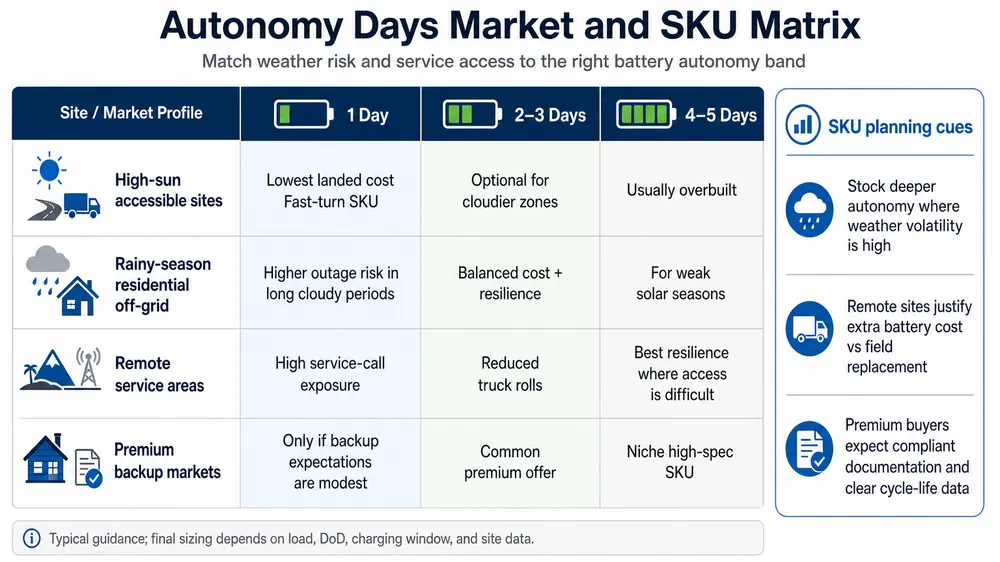
Most residential off-grid projects land around 2-3 days of autonomy. High-sun markets with accessible service routes can work with 1 day. Remote installations or rainy-season regions sometimes justify 4-5 days. But every extra autonomy day adds kWh to the battery bank, cartons to the pallet, and capital to your warehouse.

Here's the distinction that trips up a lot of quotes: autonomy is stored energy, not peak power. Peak load determines your inverter rating and BMS discharge capability. Off grid battery autonomy days determine how much energy sits in reserve. Confuse the two and you'll either oversize the bank or undersize the inverter — both expensive mistakes when you're quoting a 500-unit project.

The formula that turns autonomy into nominal battery capacity

Solar battery days of autonomy calculation is straightforward once you separate the variables. The core relationship:

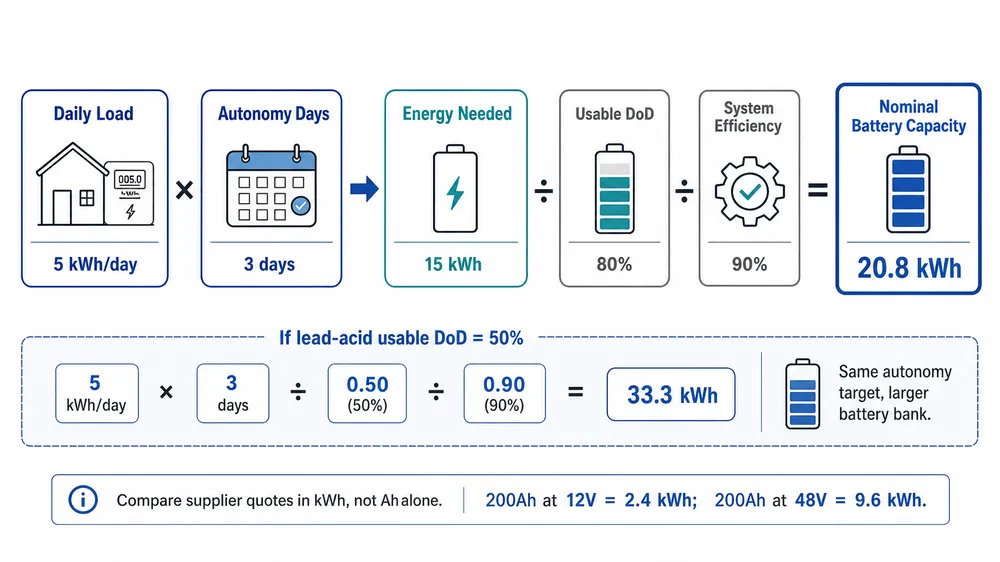
Required nominal battery capacity (kWh) = Daily load (kWh) × Autonomy days ÷ Usable DoD ÷ System efficiency

Each input carries a procurement implication:

Variable What it means Procurement note
Daily load (kWh) Total energy consumed per day by the installation Get this from the project spec, not from peak wattage × 24 hours
Autonomy days Days the bank must cover without meaningful solar recharge Drives total kWh and carton count directly
Usable DoD Percentage of nominal capacity you can actually discharge Varies by chemistry — this is where LiFePO4 and lead-acid diverge sharply
System efficiency Inverter, wiring, and BMS losses (typically 0.85-0.92) Lower efficiency means more nominal kWh to hit the same usable target

A worked example (illustrative numbers only): a residential off-grid system consuming 5 kWh/day, targeting 3 autonomy days, using LiFePO4 at 80% usable DoD, with 90% system efficiency:

5 × 3 ÷ 0.80 ÷ 0.90 = 20.8 kWh nominal battery capacity

That same system with lead-acid at 50% usable DoD: 5 × 3 ÷ 0.50 ÷ 0.90 = 33.3 kWh. The autonomy target is identical. The container volume is not.

One thing I see regularly in supplier quotes: capacity stated only in Ah without specifying voltage. A "200Ah battery" could be 2.4 kWh at 12V or 9.6 kWh at 48V. Convert everything to kWh before comparing offers — it saves confusion downstream and prevents your sales team from quoting the wrong configuration.

Off grid solar battery autonomy formula showing daily load, autonomy days, usable depth of discharge, and nominal battery capacity

LiFePO4 and lead-acid change the real autonomy behind the same label

Nominal capacity on a datasheet is not the capacity you should promise your downstream customer. Off grid battery autonomy days depend on how much of that nominal capacity is actually usable over the battery's service life.

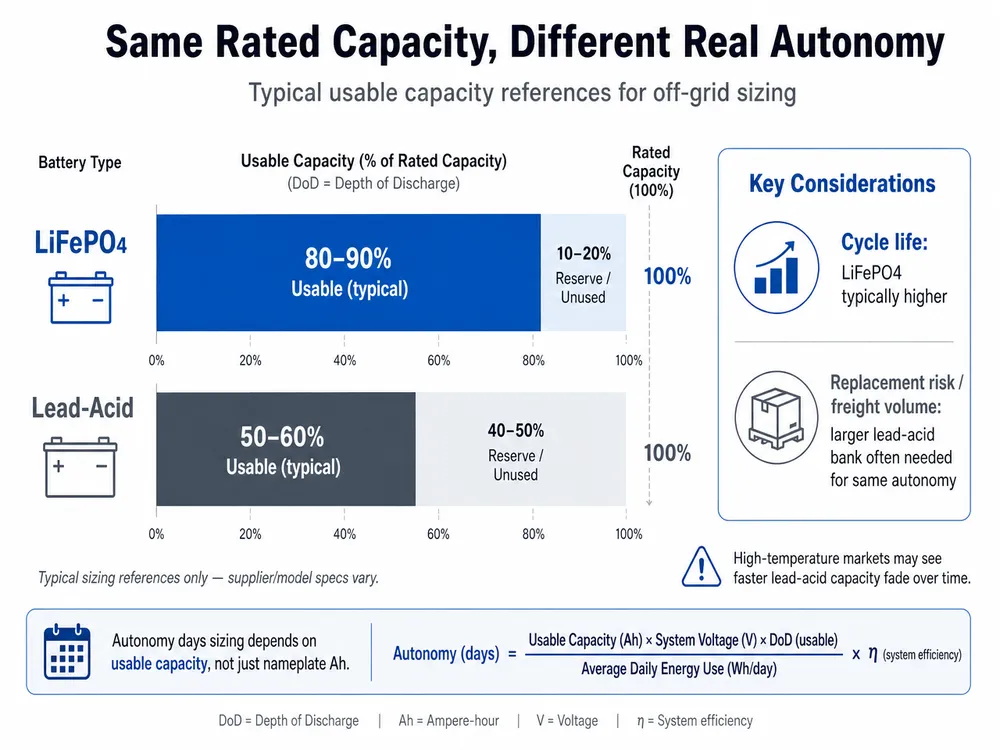
LiFePO4 cells are typically sized with deeper usable discharge — common sizing references use 80% DoD or higher for daily cycling. Lead-acid (gel or AGM) is usually sized more conservatively, often around 50% DoD for reasonable cycle life. These are industry-typical sizing references, not universal guarantees — actual performance depends on the specific cells, BMS settings, and operating temperature.

The commercial translation is direct: for the same autonomy target, LiFePO4 often requires fewer nominal kWh, fewer cartons per pallet, and lower replacement frequency over a 5-year project lifecycle. Lead-acid still fits price-sensitive channels where upfront cost per kWh matters more than total cost of ownership — particularly in markets where the end customer expects a lower entry price and accepts shorter replacement cycles.

We produce both lithium and lead-acid lines, so this isn't a chemistry sales pitch. It's a sizing reality. When you're calculating autonomy days for a LiFePO4 off grid battery bank versus a lead-acid bank, the formula is the same — but the DoD input changes your total order volume by 30-60%. That difference shows up in your freight invoice and your warehouse footprint.

(Worth noting: lead-acid capacity also degrades faster in high-temperature environments. If your market is tropical, factor in capacity fade when projecting year-3 autonomy performance — not just day-1 specs.)

For specific voltage and capacity configurations across both chemistries, see our Off Grid Solar Battery Storage product range.

LiFePO4 and lead-acid solar battery usable capacity comparison for off grid autonomy sizing

Regional weather risk decides whether 1 day or 4 days makes commercial sense

Off grid battery autonomy days aren't a universal number — they're a market-specific variable. The same distributor might stock 1-day economy SKUs for one region and 3-day standard SKUs for another. Climate, service access, and end-customer expectations all shift the calculation.

High-sun, service-accessible markets (parts of the Middle East, North Africa, inland Australia): Solar irradiance is consistent, service technicians can reach sites within a day, and extended cloudy periods are rare. 1-day autonomy works for many residential installations here. Your landed cost stays low, container utilization stays high, and replacement logistics are manageable.

Rainy-season markets (Southeast Asia, West Africa, parts of South America): Consecutive low-irradiance days are normal for 2-4 months per year. Off grid solar battery storage autonomy days for residential projects in these regions typically need 2-3 days minimum. Under-specifying here generates warranty claims and damages your brand with installers.

Remote, service-limited sites (rural sub-Saharan Africa, island installations, mountain communities): When a service call costs more than the battery itself, you size for resilience. 3-5 days of autonomy reduces truck rolls and protects your distributor's reputation. The extra battery cost is cheaper than the logistics of a field replacement.

Premium backup markets (European off-grid cabins, high-end residential): Documentation, consistent labeling, and certified test reports often matter as much as raw autonomy days. Buyers here expect IEC 62133 compliance, clear cycle-life data at stated DoD, and system integration documentation. The autonomy target might be modest (2 days), but the quality evidence bar is higher.

The point for your SKU planning: don't stock a single autonomy tier and try to sell it everywhere. Match the tier to the market's weather risk and service economics.

Matrix matching off grid battery autonomy days to market climate conditions and wholesale SKU strategy

Rated autonomy depends on cell matching and BMS discipline

A battery bank's autonomy rating is only as reliable as the weakest cell in the pack. If one cell in a series string has 5% less capacity than its neighbors, the BMS will trigger low-voltage cutoff based on that cell — and your customer loses usable autonomy they paid for.

This is why off grid solar battery sizing autonomy starts at the cell level, not the system level. Our production sequence addresses this directly: incoming cell inspection, automated sorting by measured capacity and internal resistance, pack assembly with cells matched within 20mV and 5 milliohm tolerance, BMS integration, charge/discharge testing, aging, and final inspection before packing.

The matching tolerance matters more than most spec sheets suggest. A pack with loosely matched cells might test fine on day one but diverge over 500 cycles as weaker cells degrade faster. Tight initial matching — the kind that requires automated sorting equipment, not manual selection — keeps the pack balanced longer, which means your rated autonomy holds closer to its original value through year 3 and year 4.

BMS programming connects directly to field reliability in off-grid applications. We set protection thresholds for over-discharge, over-charge, over-temperature, and cell imbalance based on the target market's operating conditions. A battery destined for a tropical West African installation gets different temperature protection parameters than one shipping to a European mountain cabin. (This is one of those details that separates a configured product from a generic one — and it shows up in your warranty claim rate.)

Full lifecycle testing — capacity verification, cycle life validation, high/low temperature performance, and safety testing — confirms that the rated autonomy on the datasheet reflects real-world discharge behavior, not just a calculation from cell datasheets.

Convert autonomy targets into wholesale voltage and capacity SKUs

Once you know your target autonomy days and daily load range, the next step is mapping that to orderable configurations. Off grid solar battery sizing autonomy translates into specific voltage platforms and capacity tiers.

12V systems suit smaller loads — lighting, phone charging, basic appliances. Common for entry-level off-grid kits in price-sensitive markets. A 12V 100Ah LiFePO4 pack delivers roughly 1.2 kWh usable at 80% DoD — enough for about 1 day of autonomy on a 1 kWh daily load.

24V systems handle mid-range residential loads. Lower current for the same power means smaller cable cross-sections and less voltage drop over distance. Useful for installations where the battery bank sits away from the main load center.

48V systems are the standard for larger residential and small commercial off-grid projects. Higher voltage means lower current at the same power level, which reduces BMS stress, improves round-trip efficiency, and allows longer cable runs. A 48V 200Ah (51.2V nominal) LiFePO4 bank provides roughly 8.2 kWh usable — covering 2-3 days of autonomy for a typical 3 kWh/day household.

For distributors testing a new market, an autonomy ladder approach works well:

  • Economy tier (1-day autonomy): 12V or 24V packs, lower capacity, lowest landed cost per unit. Tests market acceptance before committing to container volumes.
  • Standard tier (2-3 days): 48V packs in the 100-200Ah range. Covers the majority of residential off-grid demand in most regions.
  • Extended tier (4-5 days): Higher-capacity 48V configurations or parallel bank setups. Targets remote sites and premium installations.

Standard models start at 100-unit MOQ — practical for testing an autonomy-tier SKU in a new market without overcommitting warehouse space. Custom voltage and capacity configurations (say, 25.6V 150Ah for a specific project spec) are available on OEM/ODM terms with adjusted minimums.

For broader residential storage catalog planning, see Home Solar Battery Storage. For deeper calculation methodology on bank sizing, see off-grid solar battery storage sizing.

The sourcing mistakes that make autonomy quotes unreliable

I've reviewed enough distributor quotes to know where solar battery days of autonomy calculation goes wrong. These are the errors that lead to oversized orders, undersized installations, or warranty exposure:

Using peak load as daily energy. A 3 kW peak load does not mean 3 kWh per hour × 24 hours. Daily energy consumption is the integral of actual usage over time — usually far less than peak × hours. Get the load profile from the project engineer, not from the inverter nameplate.

Ignoring voltage when comparing Ah. Two suppliers both quote "200Ah." One is 12V (2.4 kWh), the other is 48V (9.6 kWh). If your comparison spreadsheet lists only Ah, you'll misjudge capacity by 4x.

Applying lead-acid DoD assumptions to lithium (or the reverse). Sizing a LiFePO4 bank at 50% DoD wastes capacity and money. Sizing a lead-acid bank at 80% DoD destroys cycle life. Match the DoD assumption to the chemistry and confirm it with the supplier's cycle-life data at that DoD.

Copying DIY homeowner formulas into wholesale catalogs. Consumer guides often add generous safety margins because the end user can't easily service the system. Those margins compound when you're ordering 500 units — suddenly you're carrying 30% more inventory than the market needs.

Adding autonomy days without checking container impact. Going from 2 days to 3 days adds 50% more battery kWh. On a 20GP container of 48V 100Ah packs, that might mean a second container — doubling your freight cost for a single project.

Before placing an order, confirm these inputs with your supplier: load profile (kWh/day, not just peak watts), inverter voltage compatibility, peak discharge current requirement, acceptable DoD with supporting cycle-life data, operating temperature range for the destination market, and shipping documentation (UN38.3, MSDS for lithium). If the market requires CE or IEC 62133, confirm certification scope covers the specific model you're ordering.

If you have a project load profile and target autonomy ready for sizing, you can request a quote with those inputs for a specific configuration recommendation.

FAQ: autonomy quotes and project sizing

How many days of autonomy should an off-grid solar battery system have?

There's no single correct number. 2-3 days covers most residential off-grid projects in moderate climates. 1 day works for high-sun regions with reliable service access. 4-5 days suits remote installations where a service visit costs more than the battery. The right number balances weather risk, service logistics, and your landed cost per unit.

How do you calculate solar battery days of autonomy?

Required nominal capacity (kWh) = daily load (kWh) × autonomy days ÷ usable DoD ÷ system efficiency. The critical step most people skip: converting the result to kWh (not just Ah) so you can compare across voltage platforms and suppliers on equal terms.

Is LiFePO4 sized with fewer nominal kWh than lead-acid for the same autonomy?

Yes, because LiFePO4 typically allows deeper usable discharge. At common sizing references (80% DoD for LiFePO4 vs 50% for lead-acid), you need roughly 38% less nominal kWh with lithium for the same usable energy. That translates directly to fewer cartons, less freight, and less warehouse space.

Does adding more solar panels reduce the battery autonomy requirement?

More panel capacity shortens recharge time on partial-sun days, which can justify a lower autonomy target in some designs. But panels don't help during consecutive zero-sun days — that's pure battery territory. In rainy-season markets, oversizing panels helps but doesn't eliminate the need for adequate battery reserve.

What autonomy days should distributors stock for Africa or Southeast Asia?

For sub-Saharan Africa, 2-3 days is a practical baseline for most residential off-grid — service access is limited and rainy seasons are real. Southeast Asia varies: urban fringe installations might work with 1-2 days, while rural island sites need 3+ days. Stock your standard tier at 2-3 days and offer extended configurations on project-specific orders rather than carrying high-autonomy inventory speculatively.

When does a 48V off-grid battery bank make more sense than 12V or 24V?

Once daily load exceeds roughly 2-3 kWh, 48V becomes the practical choice. Lower current at the same power means smaller cables, less voltage drop, reduced BMS thermal stress, and better round-trip efficiency. For project contractors quoting systems above 5 kWh usable capacity, 48V is essentially standard — and it simplifies your SKU planning because one platform covers the majority of mid-to-large residential demand.

Wall-Mounted vs Floor-Standing Solar Battery for Tight Residential Spaces

The Verdict Buyers Need Before Choosing a Residential Battery Form Factor

Your residential storage customers want compact installs. That pressure flows upstream to you as a sourcing decision: do you stock wall-mounted SKUs, floor-standing cabinets, or both? The answer depends less on the battery itself and more on the wall behind it, the installer in front of it, and the warranty exposure sitting between you and your end customer.

Here is the short version. A wall-mounted solar battery wins tight, premium retrofit spaces — but only when the wall structure, bracket specification, and airflow clearance are confirmed before the installer arrives. A floor-standing solar battery storage unit wins when capacity requirements are higher, wall conditions are uncertain, and installer speed matters more than visible floor space. If you serve mixed residential retrofit markets through your Home Solar Battery Storage program, carrying both form factors under one supplier and one BMS platform is the lowest-risk path.

The rest of this article breaks down the commercial variables behind that verdict — weight-per-kWh, structural load, thermal clearance, labor time, expansion planning, landed cost, and scenario-specific winners — so you can build your SKU plan with confidence.

Weight, Footprint, and Capacity Must Be Compared Together

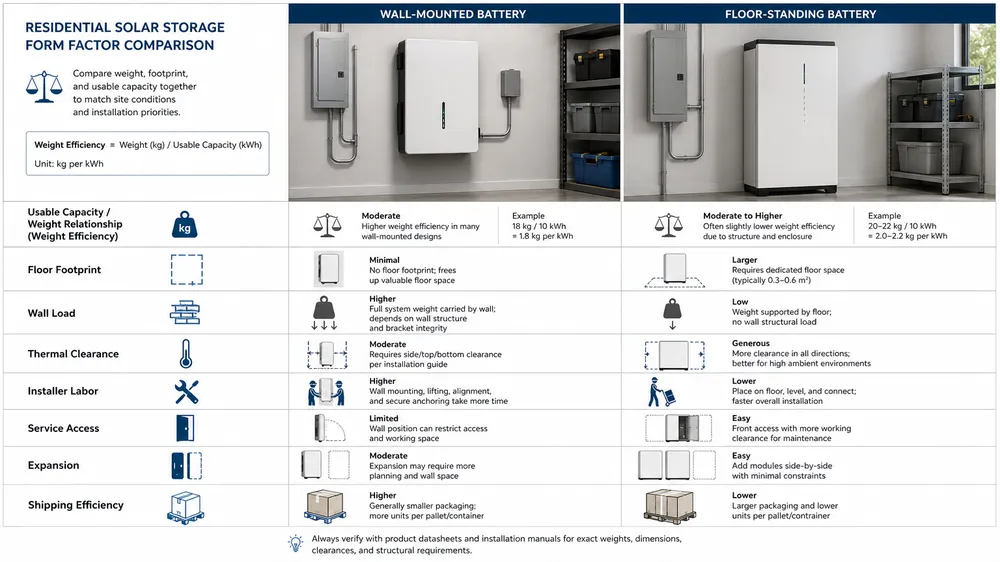
Buyers often start with footprint alone. A space saving solar battery sounds like an obvious win for tight garages and utility closets. But footprint is only one variable in a three-way relationship with weight and usable capacity. A slim wall mount solar battery residential unit that weighs 52 kg on a bracket rated for 45 kg is not a space saver — it is a liability.

Criterion Wall-Mounted Floor-Standing
Typical capacity range (48V/51.2V) 5–10 kWh per unit 5–15+ kWh per unit or stack
Installed weight (pack + bracket/cabinet) 35–65 kg typical 45–120+ kg typical
Weight per kWh Higher bracket load sensitivity More tolerant of heavier cells
Floor footprint Near zero (wall area used) 300–600 mm depth, 400–600 mm width typical
Enclosure depth 150–220 mm typical 300–500 mm typical
Handling during install Often one-person if under 45 kg; two-person above Usually two-person or dolly
Service clearance needed Side + top + bottom gaps Front access + rear/side gaps

The key planning number is weight per kWh relative to your bracket and wall specification. A 10 kWh wall-mounted pack at 5.5 kg/kWh puts 55 kg on the bracket before you add the enclosure and BMS board weight. That is the threshold where many residential walls and standard mounting hardware start to need engineering review.

For your Wall Mounted Solar Battery SKU planning, confirm the finished pack weight against the bracket rating and the wall substrate before promising "fits any tight space" in your sales materials.

Wall-mounted and floor-standing solar battery comparison matrix showing footprint, weight, clearance, and installation risk.

Wall Load and Bracket Specification Decide Whether Wall-Mount Protects Margin

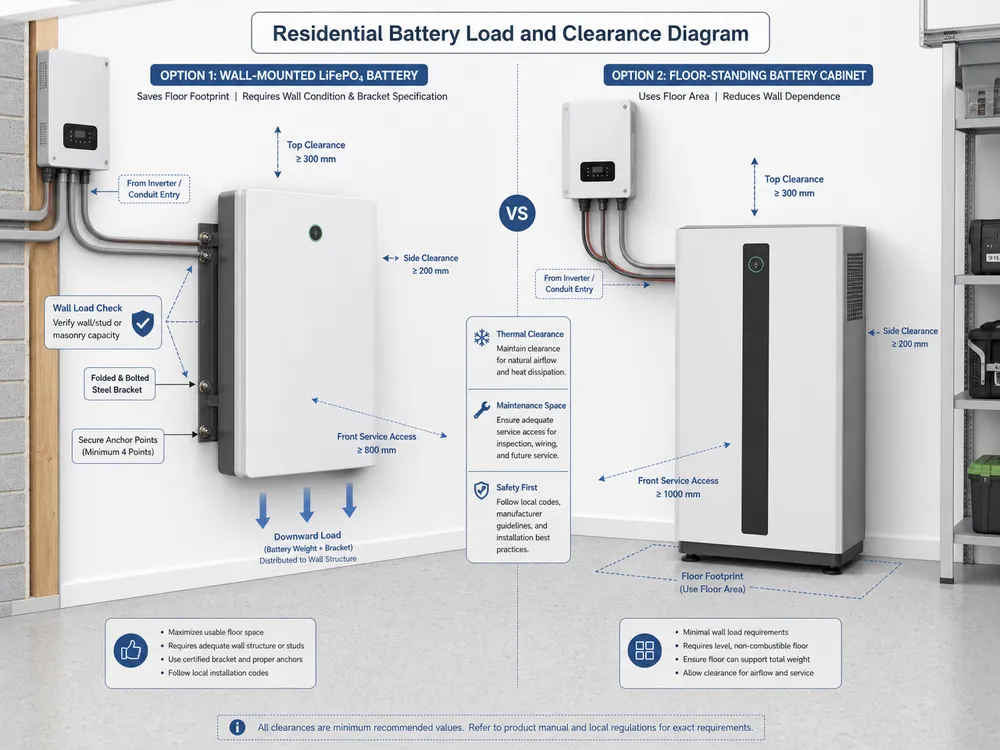
This is where most failed wall mount solar battery residential installations start — not with the battery, but with assumptions about the wall. We see it regularly: a distributor promotes a compact wall-mounted unit, the installer arrives, discovers the wall is lightweight block or aged plaster over timber frame, and the job stalls. The callback, the rescheduling, the possible return freight — that erases whatever margin the compact form factor was supposed to protect.

What you should verify before committing to wall-mounted SKUs for a market:

  • Finished pack weight including enclosure, BMS, wiring harness, and any integrated disconnect. Not just cell weight.
  • Bracket material and gauge — we use 3 mm cold-rolled steel brackets for our heavier residential packs. Thinner stamped brackets flex under sustained load and vibration.
  • Anchor type matched to wall substrate — expansion bolts for solid concrete, toggle bolts or specialized anchors for hollow block, through-bolts with backing plates for timber frame. Each substrate has a different safe pull-out rating.
  • Cumulative load if multiple units are stacked vertically — two 50 kg units on one wall section doubles the point load on the lower anchors.
  • Anti-vibration consideration — residential walls transmit door slams, HVAC vibration, and seismic micro-movement. Bracket design should include rubber isolation pads or lock washers at minimum.

(We switched from welded bracket tabs to folded-and-bolted bracket assemblies in 2021 after field reports of weld fatigue on units installed near garage doors — the repeated vibration from the door motor was enough to crack thin welds over 18 months.)

The commercial risk is straightforward: a failed wall installation costs you the installer's return trip, possible wall repair, customer confidence, and sometimes the sale itself. If your target market has mixed or older housing stock, either confirm wall conditions in your installer documentation or default to floor-standing for uncertain substrates.

For detailed installation planning, see our guide on Wall-Mounted Solar Battery Installation.

Residential solar battery diagram showing wall load checks, mounting bracket position, floor footprint, and thermal clearance zones.

Thermal Clearance and Service Access Are Warranty Variables

A space saving solar battery claim only holds if the unit can actually breathe in the space you put it. Both form factors need clearance — the difference is where and how much.

Wall-mounted clearance planning:

  • Minimum 100–150 mm top clearance for convective airflow (heat rises along the wall surface behind and above the unit).
  • 50–100 mm side clearance to avoid trapping heat between the enclosure and adjacent walls or cabinets.
  • Bottom clearance for cable entry, disconnect access, and drip protection.
  • The wall surface itself becomes a heat sink or insulator depending on material — concrete dissipates; insulated drywall traps.

Floor-standing solar battery storage clearance planning:

  • Front access is critical for BMS status LEDs, communication ports, breaker/disconnect, and terminal connections.
  • Rear clearance from the wall prevents heat buildup against the cabinet back panel.
  • Side clearance matters if the unit uses side-panel ventilation slots.
  • Floor surface should be level, dry, and away from water heaters, washing machines, or HVAC condensate lines.

The warranty consequence is real. Thermal derating — where the BMS reduces charge/discharge current because internal temperature exceeds safe limits — is the most common performance complaint in tight residential installs. It is not a defect. It is the BMS doing its job because the installer did not leave enough clearance. But your customer does not see it that way; they see reduced performance and call you.

(We include minimum clearance diagrams in every product datasheet now. It added one page to the document but cut our thermal-related support tickets by roughly a third across European distributor accounts.)

Plan ventilation and wiring layout before promising "fits any tight space" in your marketing. The certification inspector will check it even if the installer does not.

Capacity Expansion and BMS Consistency Change the SKU Strategy

Form factor is not just a one-time installation decision — it shapes your buyer's upgrade path and your own SKU architecture.

Wall-mounted expansion limits: Wall area is finite. A typical residential utility wall might support one or two wall-mounted units before you run out of structurally suitable mounting space. Cumulative weight on a single wall section compounds the load concern. For markets where homeowners commonly start at 5 kWh and expand to 10–15 kWh over time, wall-mounted units can hit a ceiling.

Floor-standing expansion advantages: Stackable floor-standing modules or larger single-cabinet systems handle the 10–20 kWh range more naturally. Adding capacity means adding another module to the stack or swapping to a larger cabinet — no wall assessment, no new anchors, no structural questions.

BMS consistency across form factors: This is where single-supplier sourcing pays off. We design the BMS in-house for both our wall-mounted and floor-standing residential lines. Same protection parameters — over-voltage, under-voltage, over-current, over-temperature, short-circuit, and cell balancing logic — regardless of whether the pack sits on a bracket or on the floor. Same communication protocol to the inverter. Same installer configuration interface.

For your distribution business, that means one training program for installers, one set of inverter compatibility documentation, and one warranty framework across both SKUs. When a customer upgrades from a wall-mounted 5 kWh unit to a floor-standing 10 kWh system, the inverter handshake and monitoring platform stay the same.

Container Loading and Landed Cost Can Reverse the Obvious Choice

Unit price on the proforma invoice is not your landed cost. Packaging, pallet configuration, container utilization, and damage risk during transit all factor into what you actually pay per kWh delivered to your warehouse.

Wall-mounted units — shipping considerations:

  • Slim carton profile can pack efficiently in rows, but brackets and mounting hardware need internal protection (foam inserts, corner guards) to prevent enclosure dents and terminal damage.
  • Screen or LED panel faces need face-down or face-protected orientation.
  • Lighter individual cartons mean more units per layer, but stacking height is limited by bracket protrusion and carton crush strength.

Floor-standing solar battery storage — shipping considerations:

  • Deeper cabinet dimensions reduce units per container row, but heavier units palletize more stably.
  • Stackable modules often ship as individual units and assemble on-site, which can improve packing density versus shipping a pre-assembled tall cabinet.
  • Heavier gross weight per carton means fewer units before hitting container weight limits (especially relevant for 20GP containers on weight-sensitive routes).

Mixed-SKU container planning: If you order both wall-mounted and floor-standing units from the same supplier, container space can be optimized by mixing slim wall-mount cartons into gaps around floor-standing pallets. We run this calculation for buyers regularly — 6 production lines and shared export documentation mean your mixed order ships as one consolidated container, not two half-empty ones.

(For Southeast Asian and African routes where 20GP is standard and weight limits are strict, we often recommend splitting heavier floor-standing units across two shipments rather than overloading one container. The freight savings from avoiding overweight surcharges usually exceed the second-shipment cost.)

Your landed cost comparison should include packaging material, pallet configuration, container utilization rate, and damage claim history — not just FOB unit price.

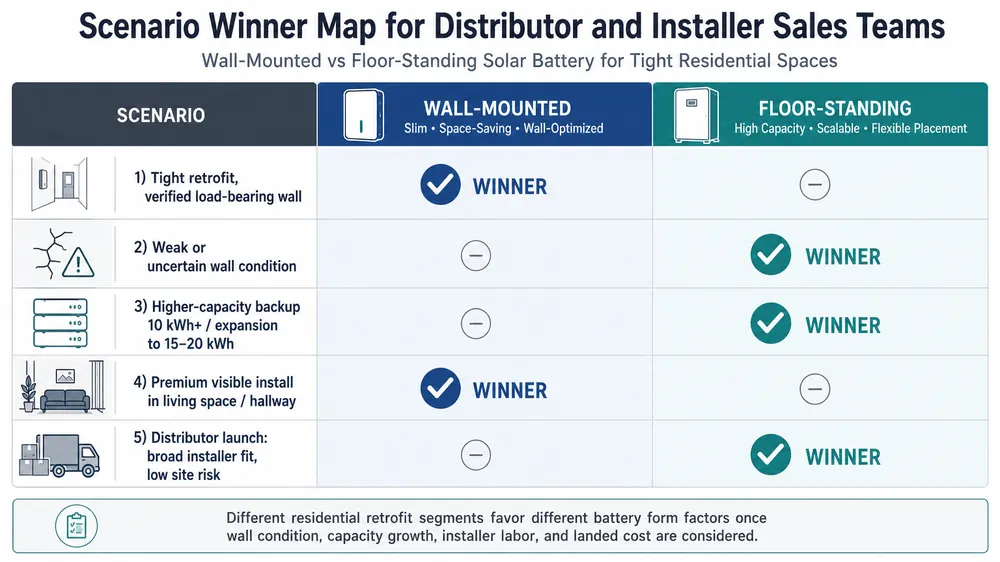
Scenario Winner Map for Distributor and Installer Sales Teams

Stop thinking about wall-mounted vs floor-standing solar battery as a product preference. Think about it as a market-segment decision. Each residential retrofit scenario has a winner based on commercial logic, not aesthetics.

Scenario 1: Narrow garage or compact utility room with verified load-bearing concrete or brick wall. Winner: Wall-mounted. The installer confirms the wall, mounts the bracket, and the homeowner keeps their floor space. Your margin is protected because the install goes smoothly and the unit performs within thermal spec. This is the premium urban retrofit segment where visible floor space is a selling point your installers can use to close deals.

Scenario 2: Older housing stock with lightweight block, timber frame, or unknown wall composition. Winner: Floor-standing. Unless the installer is prepared to assess and potentially reinforce the wall (adding labor cost and liability), a floor-standing cabinet eliminates the structural question entirely. Fewer callbacks, fewer warranty arguments about bracket failure.

Scenario 3: Higher-capacity backup package — 10 kWh and above, or planned expansion to 15–20 kWh. Winner: Floor-standing. Stackable modules or larger cabinets handle the weight and volume without multiplying wall-load concerns. Your upsell path from 5 kWh to 15 kWh stays clean.

Scenario 4: Premium new-build or architect-specified project where the battery is visible in a living space or hallway. Winner: Wall-mounted. The slim profile and clean wall integration justify the extra bracket specification work. These projects typically have known wall construction and professional installation teams.

Scenario 5: Distributor launching a residential storage line across mixed housing types in a new market. Winner: Carry both. Matched BMS logic, shared inverter compatibility, and one supplier relationship. Your installers learn one system, your support team handles one documentation set, and your container orders consolidate under one purchase order.

Scenario winner map comparing wall-mounted and floor-standing solar battery choices for residential retrofit markets.

Supplier Validation Checklist Before Adding Either SKU

Before you add a wall mount solar battery residential unit or a floor-standing solar battery storage cabinet to your catalog, verify these items in the supplier's documentation and sample:

Technical documentation:

  • Complete datasheet with net weight, gross weight (packed), and bracket/hardware weight listed separately.
  • Bracket engineering drawing with material specification, gauge, and maximum rated load.
  • Enclosure dimensions including protrusions (terminals, cable glands, ventilation grilles).
  • Minimum clearance diagram — top, sides, bottom, and front service access.
  • BMS protection function list: OVP, UVP, OCP, OTP, short-circuit, cell balancing method, and communication protocol (CAN, RS485, or proprietary).

Compliance and certification:

  • UN38.3 transport test report (mandatory for lithium battery shipping).
  • IEC 62133 safety test report.
  • CE declaration of conformity for your target market.
  • MSDS for customs and freight documentation.
  • ISO 9001:2015 manufacturing quality system certificate.

Sourcing and production:

  • MOQ for standard models (ours starts at 100 units).
  • OEM/ODM lead time and minimum order for custom bracket, enclosure color, or capacity configuration.
  • Cell sorting and matching method — automated sorting ensures consistent capacity and internal resistance across packs in your batch.
  • Packing method, carton dimensions, and pallet configuration for container planning.

If your supplier cannot provide bracket drawings, clearance diagrams, and BMS protocol documentation alongside the battery datasheet, you are missing the information your installers need to avoid field problems. Send your project specifications — voltage, capacity, preferred form factor, target market, and expected volume — through a Request Quote with those details, and the engineering team can confirm feasibility and provide complete technical packages.

FAQ: Form-Factor Selection for Residential Solar Battery Sourcing

Is a wall-mounted solar battery always better for small residential spaces?

No. "Small space" does not automatically mean "wall-mount." If the wall cannot support the pack weight, or if clearance around the unit is too tight for proper airflow, a slim floor-standing cabinet with front access may actually fit better and install faster. The decision depends on wall substrate, pack weight, and available clearance — not room size alone.

How heavy can a wall mount LiFePO4 battery be before floor-standing is safer?

There is no universal cutoff, but in practice, residential wall-mounted packs above 50–55 kg start requiring engineered bracket solutions and verified wall substrates (solid concrete or reinforced masonry). Above that range, the bracket cost, anchor specification, and installation liability often make floor-standing the more commercially sensible choice — unless the project specifically requires wall mounting and the structure is confirmed.

Does floor-standing solar battery storage need more ventilation clearance than wall-mounted?

Not necessarily more, but in different locations. Floor-standing units need rear and side clearance from walls, plus front clearance for service access. Wall-mounted units need top clearance for rising heat and side clearance from adjacent surfaces. Total clearance volume is comparable; the geometry is different. Check the manufacturer's clearance diagram for each specific model.

Which form factor is better for installers trying to reduce labor time?

Floor-standing is generally faster to deploy when wall conditions are unknown. No wall assessment, no anchor drilling, no bracket leveling — place, level, connect. Wall-mounted installs are fast when the wall is pre-verified and the bracket template is provided, but they add steps (and risk) when the installer has to assess the wall on-site.

Can distributors source wall-mounted and floor-standing batteries with the same BMS settings?

Yes, if the manufacturer designs the BMS in-house for both form factors. We use the same BMS platform across our wall-mounted and floor-standing residential lines — same protection parameters, same communication protocol, same inverter compatibility list. That means one installer training program and one technical support framework for your entire residential storage catalog.

What should be checked before quoting a space saving solar battery project?

Confirm three things before quoting: (1) the actual wall substrate and load capacity at the proposed mounting location, (2) the available clearance envelope including cable routing space, and (3) whether the homeowner's capacity target can be met within the wall area and weight limits available. If any of those three are uncertain, quote the floor-standing option as the primary and wall-mounted as the conditional alternative.