EVANBattery Preview

DNOOO blank theme is active for local preview.

AGM vs VRLA Solar Battery Differences That Affect Bulk Sourcing and Field Performance

The First Sourcing Risk Is the Wrong Comparison

If you're comparing "AGM vs VRLA solar battery," you're already working from a flawed premise — and that wording on an RFQ can cost you money before a single unit ships.

AGM is not the opposite of VRLA. AGM (Absorbed Glass Mat) is one construction method inside the VRLA (Valve-Regulated Lead-Acid) family. Gel is the other. Both are sealed, both are valve-regulated, both qualify as maintenance-free solar batteries. The vrla agm difference is not category vs category — it's parent vs child.

The commercially useful comparison is AGM VRLA vs gel VRLA. When a supplier quotes you "VRLA battery" without specifying the electrolyte design, you don't know which one you're getting. That ambiguity creates charge-profile mismatches, shortened field life, and warranty claims that fall into a gray zone nobody wants to arbitrate.

Here's the quick verdict: specify AGM VRLA or gel VRLA on every purchase order. Never accept a generic "VRLA" or "sealed lead-acid" label for bulk solar battery procurement. The construction determines the charge voltage, the cycling behavior, the heat tolerance, and ultimately whether your installed batteries last 4 years or 7 in the field.

We've shipped both types across Africa, Southeast Asia, and the Middle East since 2010. The failures we see almost always trace back to one root cause: the buyer didn't lock the exact battery construction at the RFQ stage, and the charge controller settings didn't match what arrived.

Classification Matrix for Sealed Lead Acid Battery Types

Before you can write a correct specification, you need to see where each sealed lead acid battery type sits in the family tree. This table maps the relationship and flags the buyer-side consequence of each classification.

Battery Type Sealed? Electrolyte Design Maintenance Charge Profile Buyer Consequence
Flooded lead-acid No Free liquid electrolyte Requires water top-up Standard Low unit cost, high maintenance labor, not suitable for sealed enclosures
AGM VRLA Yes Electrolyte absorbed in glass mat separators Maintenance-free AGM-specific voltage window Fast recharge, good high-current behavior, moderate heat tolerance
Gel VRLA Yes Silica-gel immobilized electrolyte Maintenance-free Gel-specific voltage window (lower) Better deep-cycle and heat performance, slower charge acceptance
Generic "VRLA" or "sealed lead-acid" quote Yes Unspecified Claimed maintenance-free Unknown until you ask You cannot set charge controller correctly; warranty terms are unenforceable

The critical point: when a supplier labels something "maintenance free solar battery," that tells you it's sealed — but it doesn't tell you whether the electrolyte is absorbed in glass mat or immobilized in gel. Those two designs need different charge voltages. Install an AGM battery on gel charge settings and you'll undercharge it. Install a gel battery on AGM charge settings and you'll overcharge it, accelerating dry-out and cutting years off the service life.

(We test every batch at both the AGM and gel charge profiles during QC — it's the fastest way to confirm the electrolyte design matches the label on the carton.)

For deeper specification detail on AGM construction and its solar cycling characteristics, see our AGM Solar Battery page.

The Specification Table Buyers Should Actually Compare

This is the head-to-head comparison that belongs in your sourcing file. We're comparing AGM VRLA, gel VRLA, and what happens when you accept a vague VRLA quote without locking the construction.

Specification AGM VRLA Gel VRLA Vague "VRLA" Quote
Recommended DOD 30–50% for optimal cycle life 50–60% achievable with correct charging Unknown — you're guessing
Cycle life at 50% DOD Typically 400–600 cycles (model-dependent) Typically 600–1000 cycles (model-dependent) Cannot verify without construction disclosure
Charge acceptance Higher — recovers faster from discharge Lower — requires slower, controlled charging Mismatched controller settings likely
Float charge voltage (12V) 13.5–13.8V typical 13.5–13.7V typical (narrower window) Wrong setting guaranteed if type unknown
Cycle charge voltage (12V) 14.4–14.7V typical 14.0–14.2V typical Overcharge or undercharge risk
Operating temperature -20°C to +50°C typical -20°C to +55°C typical, better hot-climate stability Unverified thermal rating
Internal resistance Lower — better for high-current loads Higher — less suited to surge discharge Unpredictable
Warranty claim exposure Clear if AGM spec is locked Clear if gel spec is locked Supplier can dispute any claim
MOQ and reorder consistency Standard SKU, easier to stock May require application-specific selection Substitution risk on repeat orders

Every row in this table translates to a commercial decision. Cycle life at 50% DOD determines your warranty reserve calculation. Charge voltage determines whether you need to specify controller settings to your installer network. MOQ consistency determines whether your second container matches your first.

The vrla agm difference that matters most for your margin isn't the chemistry lecture — it's the voltage window. A 0.5V error in charge setting doesn't show up in month one. It shows up in month 18 when capacity drops below usable threshold and your customer calls asking for a replacement under warranty.
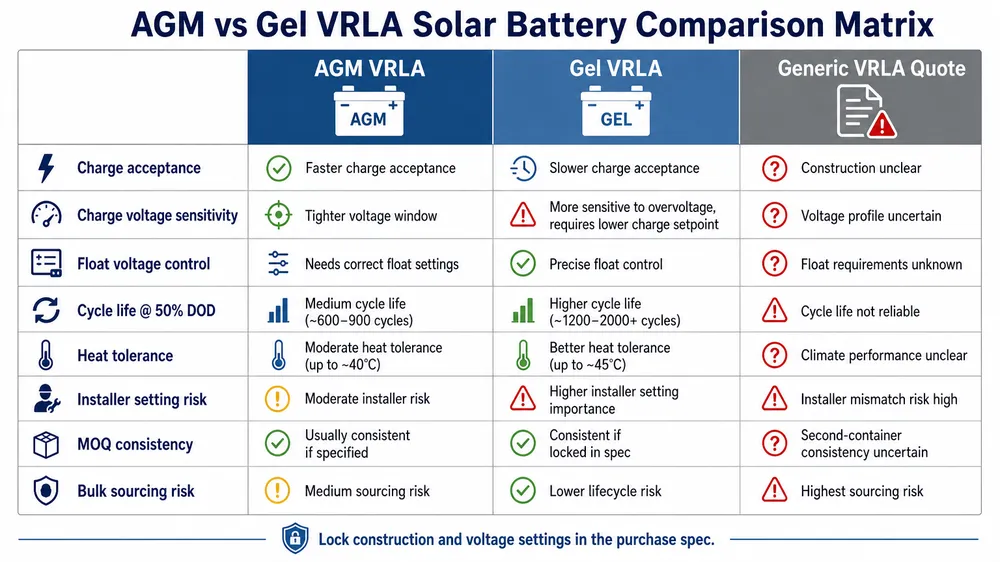
AGM and gel VRLA solar battery comparison matrix for bulk sourcing decisions

Hidden Costs Start When the Quote Says Only "VRLA"

The expensive mistake in agm battery vs vrla battery sourcing isn't choosing the wrong type. It's accepting a quote that doesn't specify the type at all.

Here's how that plays out in practice. You receive a quote for "12V 100Ah VRLA solar battery." Price looks competitive. You order a container. The batteries arrive, you distribute them to your installer network, and the installers connect them to solar charge controllers programmed for AGM charging — because that's what your previous supplier shipped.

But this batch is gel. The charge voltage is 0.5V too high. Nothing fails immediately. Six months later, electrolyte loss accelerates. At 14 months, capacity has dropped 30%. Your end customers start reporting systems that can't hold overnight load. Now you're facing:

  • Replacement freight: shipping new units to remote installation sites costs 3–5× the original per-unit logistics
  • Distributor warranty reserve: you need to set aside margin for claims you can't push back to the supplier (because the PO said "VRLA," and technically gel is VRLA)
  • Installer labor: every site visit to swap a battery costs your channel partner money and patience
  • Lost repeat orders: the distributor who bought 500 units won't reorder if their field failure rate exceeds 8%
  • Project penalty risk: if you're supplying into a tender-based solar program, early battery failure triggers contractual penalties

We run independent QC on every production batch — cycling verification at rated DOD and 55°C thermal soak testing — specifically because we've seen what happens downstream when a factory ships batteries that technically meet the label but don't match the application. Our QC reports travel with the shipment, so you have documentation that matches your charge controller specification before the container loads.

(The 55°C soak isn't arbitrary — it simulates a sealed battery cabinet in direct sun across equatorial Africa. If the battery holds capacity after 72 hours at that temperature, it'll handle the field.)

Climate Decides Whether AGM Protects Margin or Gel Protects Field Life

The maintenance free solar battery that works in Germany won't necessarily survive in Nigeria. Climate is the single largest variable in sealed lead-acid battery life, and it's where the AGM vs gel VRLA decision becomes non-negotiable.

Tropical and equatorial climates (West Africa, Southeast Asia, Central America): Ambient temperatures regularly exceed 40°C. Battery cabinets in direct sun can reach 55–60°C internally. At these temperatures, AGM batteries lose electrolyte faster because the absorbed glass mat has less thermal buffering than gel. Gel VRLA handles sustained heat better — the silica matrix slows evaporation and maintains ionic conductivity longer. If your market is daily-cycle off-grid solar in hot climates, gel VRLA typically delivers 30–40% more usable cycles before capacity drops below 80%.

Desert and arid climates (Middle East, North Africa, Australian outback): Extreme daytime heat combined with rapid nighttime cooling creates thermal cycling stress. Gel's advantage holds here, but only if the charge voltage is set correctly. We've seen gel batteries fail faster than AGM in desert installations where the charge controller was left on factory-default AGM settings — the overcharge accelerated dry-out instead of preventing it.

Temperate climates (Europe, northern China, parts of South America): Temperature stays within 10–35°C for most of the year. AGM VRLA performs well here because the thermal stress is manageable and the faster charge acceptance means the battery recovers fully during shorter winter daylight hours. For residential backup and hybrid solar systems in temperate zones, AGM is usually the stronger commercial choice — lower unit cost, faster recharge, and adequate cycle life for moderate DOD applications.

The wrong voltage window accelerates failure in any climate. But in hot climates, the penalty is 2–3× worse because heat and overcharge compound each other. If you're building inventory for tropical markets, specify Gel Solar Battery construction and confirm the charge profile with your controller supplier before you commit to volume.

Container Loading and Documentation Need the Exact Battery Declaration

Sealed lead acid battery types share the same basic shipping classification — non-spillable, sealed lead-acid — but your export documentation still needs to declare the exact construction. This isn't about regulatory drama. It's about preventing delays that cost you warehouse days and demurrage fees.

Container planning realities: AGM and gel VRLA batteries in the same voltage and capacity class typically share similar case dimensions and weight. The container loading calculation depends more on carton reinforcement, pallet configuration, and SKU mix than on whether the electrolyte is glass-mat or gel. A standard 20GP container holds approximately 800–1,200 units of 12V 100Ah batteries depending on pallet arrangement and carton stacking strength. We provide pallet loading diagrams with every bulk quote so you can verify fit before booking freight.

Documentation that matters: MSDS (Material Safety Data Sheet) is required for all sealed lead-acid shipments. The MSDS must correctly identify the battery construction — AGM or gel — because the electrolyte composition differs. CE marking, IEC 62133 testing, and ISO 9001:2015 process certification apply to both types equally. UN38.3 transport testing is primarily relevant if you're shipping lithium batteries or mixed lithium/lead-acid containers; standalone AGM or gel VRLA shipments under IATA/IMDG classify as non-spillable sealed lead-acid and follow a simpler documentation path.

(One note on customs: some import markets apply different HS codes to "accumulators" based on declared chemistry and application. Getting the battery type wrong on the commercial invoice doesn't usually change the duty rate, but it can trigger a customs query that holds your container for 5–10 days while you provide clarification documents.)

We handle export documentation for both AGM and gel VRLA shipments across our standard markets — Europe, Africa, Southeast Asia, South America, and the Middle East. The paperwork package includes MSDS, test reports, and packing declarations matched to the exact battery type in the container.

Scenario Winner Map for Bulk Buyers

Stop comparing specs in the abstract. Here's which sealed battery type wins for each real sourcing scenario, and why.

Buyer Scenario Winner Commercial Reason
Temperate residential backup inventory AGM VRLA Faster recharge during short winter days, lower unit cost, broad compatibility with standard charge controllers. Easier to stock as a general-purpose sealed battery SKU.
Tropical daily-cycle off-grid solar Gel VRLA Superior heat tolerance and deeper cycling capability. 30–40% more usable cycles at 50% DOD in sustained heat. Fewer field replacements protect your warranty reserve.
Telecom float backup (occasional discharge) AGM VRLA (unless heat dominates) Float profile suits AGM's faster recovery. But if the telecom cabinet sits in unshaded equatorial sun, gel's thermal stability wins. Ask about the installation environment before specifying.
Price-sensitive solar home system resale Depends on controller quality If the end-user's charge controller has adjustable voltage settings and the installer configures it correctly, gel delivers better lifecycle value. If controllers are fixed-setting and cheap, AGM's tolerance for slight overcharge makes it the safer bet for your warranty exposure.
Mixed distributor catalog Stock both, segment clearly Carry AGM as your standard maintenance-free solar battery SKU for temperate and moderate-climate accounts. Position gel as the hot-climate and deep-cycle upgrade at a justified price premium. Clear segmentation prevents your sales team from quoting the wrong type.

The market framing matters. If you're building distribution in West Africa or Southeast Asia, gel VRLA should be your lead SKU for daily-cycle solar. If you're supplying European residential backup or South American hybrid systems, AGM VRLA is usually the volume play. Middle East splits by application — telecom float goes AGM, rural solar goes gel.
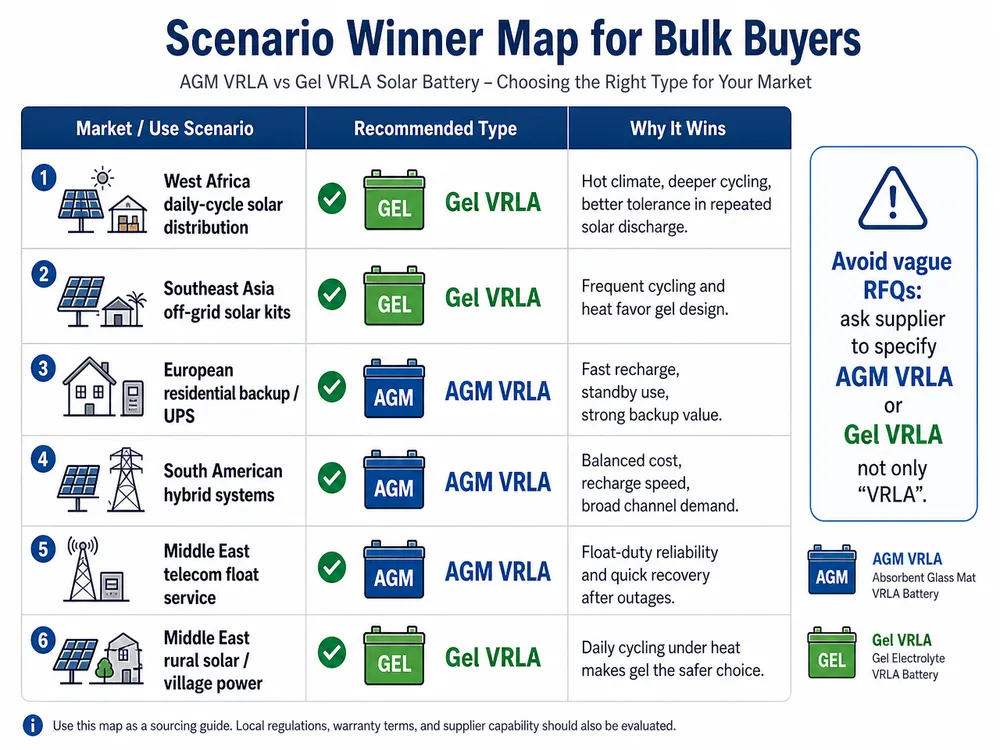
Scenario winner map for AGM and gel VRLA solar batteries in different solar markets

RFQ Checks That Prevent AGM and VRLA Specification Substitution

Before you place a bulk order for either type, your RFQ should lock these parameters. If a supplier can't answer them clearly, the quote isn't ready for a purchase order.

Request in writing:

  • Exact construction: "AGM VRLA" or "gel VRLA" — not "VRLA," not "sealed lead-acid," not "maintenance-free"
  • Voltage and Ah rating: nominal voltage, rated capacity at C10 or C20 discharge rate, and which rate the Ah figure refers to
  • DOD and cycle-life test conditions: cycle count at what DOD percentage, at what temperature, per what test standard (IEC 61427 for solar cycling is the reference)
  • Charge voltage ranges: float voltage and cycle voltage for the specific model, not generic "lead-acid" ranges
  • Operating temperature range: rated minimum and maximum, and whether cycle-life data was tested at 25°C only or includes elevated-temperature verification
  • Carton and pallet loading data: units per carton, cartons per pallet, pallets per 20GP, gross weight per pallet
  • MSDS and export documents: confirm availability before order, not after production
  • Sample policy and MOQ: EVANBattery standard MOQ is 100 units for standard models — low enough to validate a new SKU in your market before committing to container volume

If you need custom voltage configurations, capacity ratings, or private-label packaging, that falls under OEM ODM Solar Battery programs. We handle custom specs from 50Ah residential units through rack-mounted commercial storage — the MOQ adjusts based on customization scope.

The point of this checklist isn't bureaucracy. It's that every line item you lock at the RFQ stage is one fewer argument during warranty arbitration. When the agm battery vs vrla battery construction is specified on the PO, the charge profile is documented, and the test conditions are referenced, there's no gray zone left for either party.

For buyers ready to submit specifications, you can send your voltage, capacity, climate zone, and volume requirements through our Request Quote page.

Buyer Questions That Change the Final Battery Type

Is AGM the same as VRLA battery?

No. AGM is one type of VRLA battery. VRLA is the sealed, valve-regulated lead-acid category. AGM (glass mat electrolyte absorption) and gel (silica-gel electrolyte immobilization) are the two construction methods within that category. When someone quotes you "VRLA" without specifying AGM or gel, you don't have enough information to set charge parameters or predict field life.

Which sealed lead acid battery type is better for off-grid solar?

For daily-cycle off-grid solar in hot climates, gel VRLA typically delivers more usable cycles and better heat tolerance. For moderate-climate backup systems with shallow cycling, AGM VRLA offers faster recharge and lower unit cost. The deciding factors are your installation climate, daily depth of discharge, and charge controller voltage settings.

Does AGM or gel VRLA last longer at 50% DOD?

Gel VRLA generally achieves higher cycle counts at 50% DOD — typically 600–1000 cycles versus 400–600 for AGM, though exact numbers are model-specific. The trade-off is charge speed: gel requires slower, more precisely controlled charging. If your charge infrastructure can't maintain the correct gel voltage window, AGM may deliver better real-world longevity despite lower lab ratings.

Can AGM and gel VRLA use the same solar charge controller settings?

No. AGM typically requires 14.4–14.7V cycle charge and 13.5–13.8V float (for 12V systems). Gel requires 14.0–14.2V cycle charge and 13.5–13.7V float. Using AGM settings on a gel battery causes overcharge and accelerated electrolyte loss. Using gel settings on an AGM battery causes chronic undercharge and sulfation. Your charge controller must be programmed for the exact battery type installed.

What documents are needed for sealed lead-acid solar battery import?

At minimum: MSDS identifying the exact battery chemistry and construction, CE or relevant market certification, IEC 62133 safety test report, commercial invoice with correct HS code and battery type declaration, and packing list with weight and dimensions. For lithium batteries or mixed shipments, UN38.3 transport certification is additionally required. For standalone sealed lead-acid (AGM or gel), the non-spillable battery classification under IATA/IMDG DGR applies.

What should be checked before bulk ordering maintenance-free solar batteries?

Confirm the exact construction (AGM or gel), verify the charge voltage specification matches your deployed controllers, request cycle-life test data at your intended DOD and operating temperature, confirm MSDS and export documentation availability, and validate MOQ and lead time for your order size. If the supplier cannot specify whether the battery is AGM or gel construction, treat that as a disqualifying response — you cannot manage field performance or warranty terms without that information.
Top 10 Gel Solar Battery Suppliers in the UAE for Desert Climate Storage Projects

UAE Gel Battery Sourcing Starts With Heat, Not the Supplier Name

Your gel solar battery will spend its service life inside a rooftop cabinet, a ground-mounted enclosure, or a telecom shelter where ambient air regularly exceeds 45°C. The supplier name on the invoice matters less than what happens to the electrolyte at that temperature over 1,500 charge-discharge cycles.

Gel chemistry handles desert heat better than flooded lead-acid — the immobilized electrolyte resists stratification and reduces water loss. But "handles better" is not the same as "immune." Field failures we see from Middle East returns almost always trace back to three causes: charge voltage set too high for gel (above 14.1V on a 12V block at 25°C without temperature compensation), batteries sitting in a warehouse for 8-12 months before installation without maintenance charge, or cabinets with zero ventilation pushing internal temperatures past 60°C.

This article is a sourcing shortlist — 10 verified UAE-accessible gel solar battery suppliers — followed by the evaluation criteria and trade-off logic you need to protect project margin and reduce field replacement risk.

How This Top 10 Shortlist Was Verified

Every supplier on this list has an official company website with a publicly visible gel battery or VRLA solar battery product page. We did not pull names from a single directory or marketplace listing and call it research.

Verification method:

  • Each company was confirmed through its official domain, not just a third-party mention
  • Inclusion required visible evidence of gel, VRLA gel, or deep-cycle gel battery products
  • Solar, off-grid, UPS, or energy storage application relevance was checked
  • UAE presence was confirmed through Dubai office, Jebel Ali warehouse, showroom, or UAE-wide distribution statements

What this list does not claim:

  • It does not rank suppliers by factory capability or product quality — that requires your own RFQ and sample testing
  • It does not guarantee current stock availability, pricing, or lead times
  • It does not replace your due diligence on datasheets, warranty terms, and production dates

Before issuing a PO to any supplier on this list, request: current production date on the battery label, full datasheet with charge-voltage window, cycle-life data at elevated temperature, and written warranty terms including the claim process for UAE-installed units.

Desert-Climate Checks That Separate Project-Grade Gel Batteries From Shelf Stock

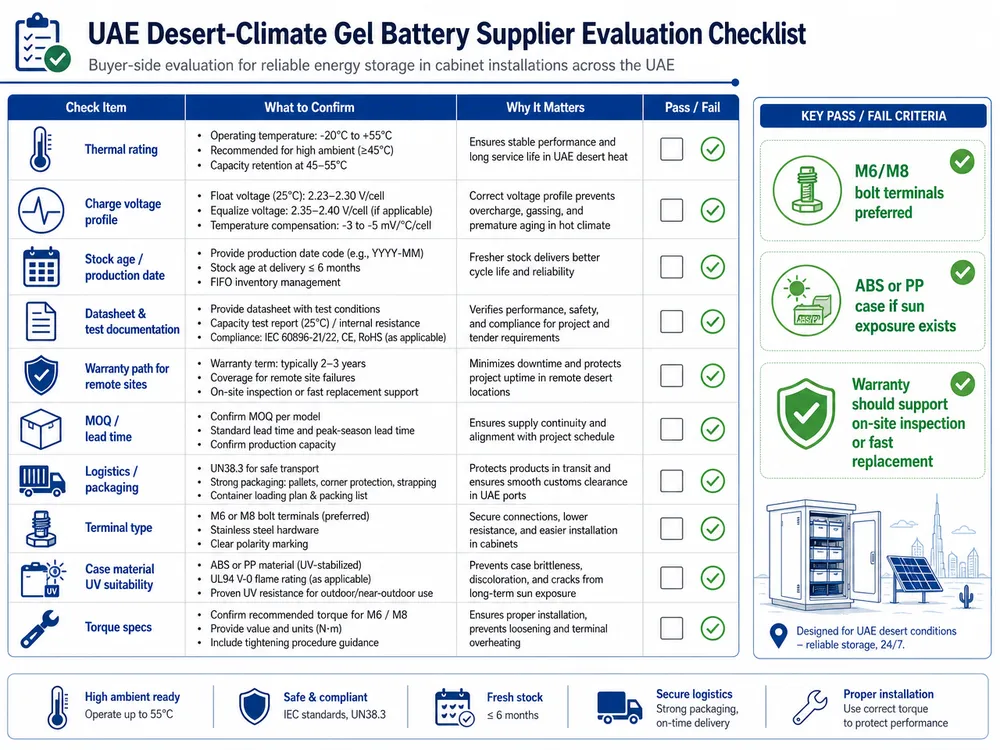
A gel battery rated for "wide temperature range" on a generic datasheet is not the same as a battery verified for continuous float service at 50°C ambient. Here is what to check — and what to ask — before you commit volume to any VRLA gel battery supplier in the UAE.

Operating temperature and capacity derating

Published operating range should show the upper limit explicitly. A battery rated -20°C to +60°C tells you the casing survives. What you actually need is the capacity correction curve: at 40°C, most gel batteries deliver 102-105% of rated Ah. At 55°C, capacity may look fine short-term, but calendar life drops by roughly 50% for every 10°C above 25°C reference. Ask for the Arrhenius-based life projection, not just the operating range.

Charge-voltage window for gel chemistry

Gel electrolyte is less tolerant of overcharge than AGM. Float voltage for a 12V gel block should sit between 13.5V and 13.8V at 25°C. Cyclic charge voltage: 14.0-14.4V maximum. If your charge controller does not have a dedicated "gel" setting with temperature compensation (-3mV/°C/cell is typical), you will cook the electrolyte and see premature dry-out within 18 months. (We've seen entire telecom sites in Saudi Arabia lose 40% of battery capacity in year two because the rectifier was set to AGM voltage profiles.)

Stock age and pre-delivery recharge

Lead-acid batteries self-discharge. A gel battery stored at 30°C+ loses roughly 3-5% capacity per month without maintenance charge. If your supplier delivers batteries manufactured 9 months ago and stored in a non-climate-controlled Jebel Ali warehouse, you are starting with degraded capacity on day one. Ask for the production date stamped on the case and confirm whether the supplier performs pre-delivery voltage checks.

Terminal type, torque, and container material

For desert cabinet installations, specify: bolt terminal (M6 or M8) rather than push-on tabs, ABS or PP case material rated for UV if any sun exposure exists, and proper torque specs to prevent thermal-cycling looseness. These details matter more than they appear on paper — a loose terminal connection in a 55°C cabinet creates resistance heating that accelerates corrosion.

Warranty path for remote sites

A 3-year warranty means nothing if the claim process requires shipping a 30kg battery back to a Dubai office. Confirm: on-site inspection option, replacement timeline, and whether warranty covers capacity fade below 80% or only total failure. For 12V gel solar battery specifications, voltage and terminal details are covered in depth separately.

Desert climate gel solar battery supplier evaluation checklist for UAE projects

Top 10 Gel Solar Battery Suppliers in the UAE — Sourcing Shortlist

The following 10 companies have verified gel battery or VRLA solar battery product pages and UAE market presence. This is a discovery shortlist, not a quality ranking.

1. Radiant Solar DMCC

Location signal: Dubai (DMCC registered) Product evidence: Solar batteries page lists deep-cycle gel VRLA options in 12V and 2V configurations with published operating range of -25°C to +60°C. Best fit: Project contractors sourcing gel batteries alongside solar panel and inverter packages. What to ask: Specific gel battery brand/manufacturer behind the listing, current stock production dates, and whether they hold inventory or order per project.

2. Maxima Solar

Location signal: Dubai solar battery retailer/distributor Product evidence: Battery page lists Digital Solar Gel and OPzV 2V GEL batteries for solar PV and UPS applications. Best fit: Buyers who want to inspect product locally and need smaller quantities with Dubai pickup or delivery. What to ask: OPzV gel cell availability in 2V/1000Ah+ configurations for larger storage banks, lead time on non-stock capacities, and bulk pricing structure.

3. Aurra Energy

Location signal: Dubai-based, claims UAE-wide supply coverage Product evidence: Official page lists GEL batteries and VRLA AGM batteries for solar energy systems and deep-cycle applications. Best fit: Buyers needing a local distributor with both gel and AGM options for comparison testing across UAE emirates. What to ask: Which manufacturer's cells they distribute, whether datasheets include temperature-corrected cycle-life data, and minimum order for project pricing.

4. PAS Solar (PAS International Trading LLC)

Location signal: Dubai showroom, UAE solar equipment distributor Product evidence: Official page lists RITAR GEL and lead-acid batteries with after-sales support context and bulk buying references. Best fit: Buyers who want a recognized brand (RITAR) with local showroom access and after-sales support infrastructure. What to ask: RITAR gel model availability for 12V 100Ah-250Ah solar deep-cycle, warranty claim process through PAS vs. direct with RITAR, and project volume discounts.

5. NBS Groups

Location signal: UAE online solar battery supplier Product evidence: Collection page lists multiple solar deep-cycle gel batteries from NBS, Samsun, Su-mak, and Sunride brands. Best fit: Buyers comparing multiple gel battery brands through a single UAE channel, especially for smaller orders or quick online price checks. What to ask: Which brands carry full datasheets with gel-specific charge profiles, stock rotation policy, and whether they support project-volume RFQs beyond retail pricing.

6. Magnizon Power Systems

Location signal: JAFZA (Jebel Ali Free Zone) Dubai regional office Product evidence: Official page lists MG Series deep-cycle GEL batteries for solar and backup applications. Best fit: Buyers who value Jebel Ali proximity for logistics and want a branded gel battery line with regional office support. What to ask: MG Series gel battery cycle-life data at 40°C+, container-load pricing, and whether JAFZA stock is held or made-to-order.

7. Naif Falcon Trading

Location signal: Dubai/Jebel Ali warehousing, B2B solar distributor Product evidence: Official page states gel and AGM battery distribution for B2B solar customers with warehousing capability. Best fit: B2B buyers needing Jebel Ali warehouse access for staged project deliveries or re-export to other Gulf states. What to ask: Gel battery brands carried, MOQ for project pricing, warehouse storage conditions (climate-controlled or ambient), and re-export documentation support.

8. Al Nisba Trading LLC

Location signal: UAE branches including Dubai/Jebel Ali Product evidence: Official page lists VRLA batteries, gel batteries, solar applications, and deep-cycle use cases. Best fit: Buyers sourcing VRLA gel batteries across multiple UAE locations who need branch-level support. What to ask: Gel-specific product range vs. general VRLA, available capacities for solar deep-cycle duty, and whether they provide installation-site delivery with production date verification.

9. ARD UR Batteries Trading LLC

Location signal: Dubai, Al Hamriyah Port area Product evidence: Official page lists Wallington High Power Gel Battery with Dubai contact details. Best fit: Buyers in the Sharjah/Dubai corridor looking for a local battery trading company with gel product access. What to ask: Full gel battery range beyond the listed model, datasheet availability, bulk order lead time, and whether they handle project-scale quantities or primarily retail/small-trade.

10. AMPS Middle East / Eastman World

Location signal: UAE/Dubai office, battery brand/distributor Product evidence: Official page lists deep-cycle gel batteries for solar backup use with UAE office details. Best fit: Buyers who want a branded gel battery line with Middle East regional office support and potential multi-country distribution. What to ask: Eastman gel battery thermal performance data, UAE stock depth, container-load pricing for repeat orders, and warranty administration through the Dubai office.

Common thread across all 10: Most of these suppliers operate as distributors, brand agents, or trading companies rather than battery manufacturers. That is normal for the UAE market — it is a trading hub, not a cell production base. The practical implication: your supplier's value is in stock access, local support, and logistics convenience. The battery's quality still traces back to whoever manufactured the cells.

Where UAE Local Supply Protects Schedule and After-Sales Risk

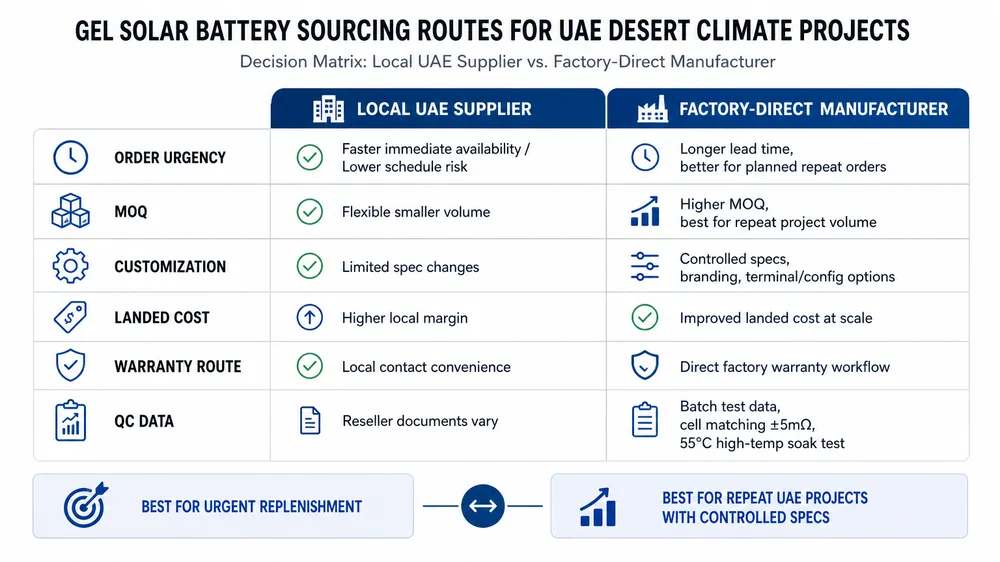
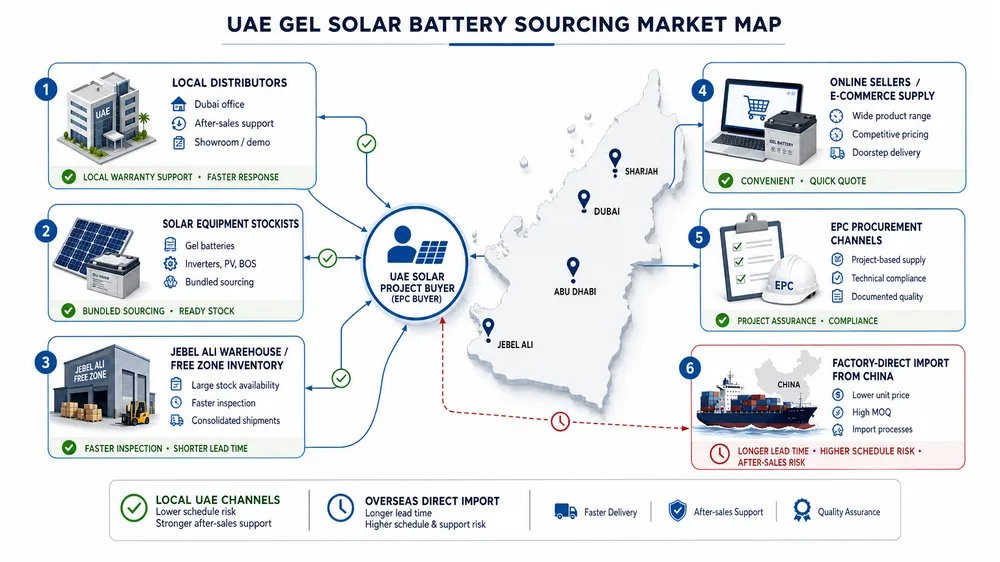
Local gel battery suppliers in Dubai serve a real function that factory-direct import cannot replicate for every scenario.

When local supply is the right answer:

  • Emergency replacement: A telecom tower battery bank fails in July. You need 20 units delivered to a site in Ras Al Khaimah within 48 hours. No import route solves this.
  • Pilot system validation: You are testing a new 5kW off-grid configuration and need 4 gel batteries to validate the charge controller settings before committing to a 200-unit project order.
  • Showroom inspection: Your client wants to see and touch the product before approving the specification. A Dubai showroom visit closes the deal faster than a factory video call.
  • Mixed-component procurement: You are sourcing panels, inverters, racking, and batteries for a single EPC package. A local solar distributor who bundles everything simplifies your procurement paperwork.
  • Warranty proximity: If a battery fails at month 14, a local distributor with a Dubai office can inspect, approve, and replace faster than an international claim process.
Scenario Best supply route Why
Emergency replacement (< 72 hours) UAE stockist with warehouse inventory Speed overrides cost
Pilot / trial system (4-20 units) Local distributor or low-MOQ factory trial Validation before commitment
Repeat project supply (100-500+ units) Compare factory-direct landed cost Economics shift at volume
Private-label program Factory-direct Customization requires manufacturer access
Full EPC package Local solar distributor Single-source convenience
UAE gel solar battery supplier market map showing distributors, stockists, online sellers, and factory-direct import

Where Local Convenience Can Reduce Project Margin

The 10 suppliers above provide genuine value — but that value has a cost structure you should understand before locking in repeat orders.

Distributor markup layers:

Most UAE gel battery suppliers purchase from Chinese or Indian manufacturers at FOB price, add freight, import duty (5% on HS 8507.20 for lead-acid accumulators), warehousing, and their own margin. By the time the battery reaches your project site, the landed cost typically carries 25-45% above the original factory gate price. That range is not a criticism — it covers real services (stock holding, local support, credit terms). But on a 500-unit repeat order, that margin layer compounds into serious money.

Stock age risk:

A distributor holding 200 gel batteries in a Jebel Ali warehouse needs to move them. If demand is slower than expected, those batteries sit. Every month at 35°C+ ambient storage costs capacity. You may receive batteries with a production date 6-10 months old — still within "acceptable" range on paper, but already carrying measurable sulfation. (We test incoming cells at our factory and reject anything over 60 days from production for premium orders. The difference in initial capacity between a 30-day-old cell and a 9-month-old cell stored at 35°C is measurable on the first discharge.)

Limited customization:

Local distributors stock what sells in volume: 12V 100Ah, 12V 150Ah, 12V 200Ah. If your project needs 12V 250Ah with specific terminal orientation, a custom label for your brand, or a non-standard case dimension for an existing cabinet, the local channel cannot help. You are buying what they have, not what you need.

Cost-per-cycle calculation inputs:

Before committing to any supply route, calculate:

  • Unit price (AED or USD)
  • Battery weight (affects freight per Wh)
  • Cycle-life assumption at your actual installation temperature (not 25°C lab data)
  • Freight cost per unit to project site
  • Import duty and VAT on CIF value
  • Warranty reserve (cost of one replacement per X units over project life)
  • Installation labor for replacement if early failure occurs

The cheapest unit price is not the cheapest project cost. A battery that costs 15% less but delivers 30% fewer cycles at 50°C ambient is the more expensive choice.

Factory-Direct Import Fits Repeat UAE Projects With Controlled Specs

For buyers placing repeat orders of 100+ units per project — solar street lighting, telecom backup, off-grid residential, or containerized storage — factory-direct sourcing from a gel battery manufacturer changes the economics.

We have been manufacturing gel solar batteries since 2012. Our 9,900 m² factory in Zhongshan runs 6 production lines with 150 staff and produces 2,000,000 battery units annually. The Middle East is not a new market for us — we have been shipping gel batteries to Gulf and African buyers for over a decade, so the logistics path, documentation requirements, and climate-specific testing are already built into our production workflow.

What factory-direct access gives you that a distributor cannot:

Our automated cell sorting lines match internal resistance within ±5mΩ across every battery in your batch. Consistent cell matching means consistent field performance — you do not get one battery lasting 6 years and another failing at 3 in the same installation. For UAE projects specifically, we run a 55°C high-temperature soak test on gel production batches destined for Middle East and African markets. This is not a standard test that every factory performs — it adds time to the QC cycle, but it catches electrolyte migration issues and seal integrity problems before the battery ships.

Our engineering team (18+ engineers across lithium and lead-acid divisions) can adjust voltage configurations, capacity ratings, terminal types, and case dimensions for your project requirements. MOQ starts at 100 units for standard models — low enough for a project contractor to test a new supplier without committing to a full container. OEM labeling and custom BMS configurations are available for distributors building their own brand in the Gulf market.

Certifications: ISO 9001:2015, CE, IEC 62133, MSDS documentation, and non-spillable lead-acid transport declarations. For gel solar battery sourcing at the category level, or deep cycle gel solar battery specifications for project-cycle duty, those pages cover the technical range in detail.

Local UAE supplier versus factory-direct gel solar battery sourcing route comparison

China-to-UAE Logistics and Compliance Checks Before Bid Submission

If you are pricing a factory-direct gel battery import into your project bid, these are the line items to confirm before you submit numbers.

Packaging and loading:

Gel lead-acid batteries are heavy. A 12V 200Ah gel block weighs approximately 55-65kg depending on plate design. Carton packaging must include foam corner protection and pallet strapping rated for the weight. A standard 20GP container holds roughly 400-500 units of 12V 200Ah gel batteries depending on pallet configuration — confirm exact loading plans with your freight forwarder before finalizing quantity per shipment.

Jebel Ali clearance timeline:

Standard clearance for non-hazardous goods through Jebel Ali runs 3-7 working days assuming documentation is complete. Gel VRLA batteries classified as non-spillable lead-acid are not Class 9 dangerous goods for sea freight (unlike lithium batteries). However, your broker should confirm the current UAE customs treatment and any additional inspection requirements.

Import duty and VAT:

HS code 8507.20 covers lead-acid accumulators. UAE import duty is typically 5% on CIF value. VAT at 5% applies on top. Confirm current rates through the UAE Federal Customs Authority or your licensed broker — rates and exemptions can shift. Factor both into your landed cost calculation before comparing against local distributor pricing.

Documentation for gel lead-acid (not lithium):

Gel VRLA batteries require: MSDS (Material Safety Data Sheet), non-spillable battery declaration per IATA/IMDG standards, and commercial invoice with correct HS code. UN38.3 testing is a lithium battery requirement — it does not apply to standard gel lead-acid shipments unless your order includes mixed lithium products. Do not let a freight forwarder charge you for lithium-class documentation on a pure gel lead-acid shipment.

Freight cost volatility:

Sea freight rates between South China and Jebel Ali fluctuate. Budget a range rather than a fixed number, and confirm spot rates at order confirmation rather than at quotation stage. For gel solar battery lifespan considerations and how they affect warranty reserve calculations, that analysis is covered separately.

Which Sourcing Route Fits Your UAE Project Volume

Your decision is not "local vs. import" as a binary. It is "which route fits this specific order's constraints."

Emergency replacement or urgent small batch (< 50 units, needed within 1-2 weeks): Use a UAE stockist from the list above. Pay the convenience premium. Your project timeline is worth more than the per-unit savings.

Pilot system or new-supplier trial (20-100 units): Either route works. A local supplier gives you faster access for validation. A factory trial order (our MOQ starts at 100 units for standard gel models) lets you test the actual production quality and thermal performance data before scaling.

Repeat project procurement (100-500+ units per order, multiple times per year): This is where factory-direct economics become compelling. At 200+ units per order, the distributor margin you eliminate typically exceeds the freight and import duty combined. You also gain specification control — exact voltage, capacity, terminal configuration, and labeling matched to your project requirements.

Private-label distribution program: Factory-direct is the only viable route. No local distributor will relabel another brand's product for your distribution business. You need manufacturer access for custom branding, packaging, and potentially adjusted BMS parameters.

Full EPC solar package (panels + inverters + batteries + racking): If your client expects a single-source package with unified warranty, a local solar distributor may simplify your procurement. But if batteries represent a significant cost line and you are deploying the same configuration across multiple sites, splitting the battery procurement to factory-direct while sourcing other components locally can improve your overall project margin.

For buyers ready to compare factory-direct pricing against their current local supply cost, a quote request with your voltage, Ah capacity, quantity, and installation temperature range gives us enough to return a landed-cost comparison within 48 hours.

FAQ for UAE Gel Solar Battery Procurement

Can gel solar batteries operate in UAE ambient temperatures above 45°C?

Yes — gel batteries tolerate high ambient temperatures better than flooded lead-acid because the immobilized electrolyte resists evaporation and stratification. However, continuous operation above 40°C accelerates calendar aging. At 50°C ambient, expect roughly 50% reduction in design life compared to 25°C reference conditions. The battery will function, but your replacement cycle shortens. Specify batteries with published high-temperature cycle data, not just an operating range claim.

What charge-voltage data should a supplier provide for VRLA gel batteries?

At minimum: float voltage at 25°C (typically 13.5-13.8V for a 12V block), cyclic charge voltage (14.0-14.4V), temperature compensation coefficient (standard is -3mV/°C/cell or approximately -18mV/°C for a 12V 6-cell battery), and maximum charge current as a percentage of C10 capacity. If a supplier cannot provide these four numbers from the manufacturer's datasheet, they likely do not have direct access to the factory's technical team.

How can you check whether a local gel battery stock batch is fresh?

Check the production date code stamped or printed on the battery case — usually on the top label or side sticker. Calculate months since production. For gel batteries stored at UAE ambient warehouse temperatures (30-40°C), anything beyond 6 months from production should be voltage-tested before acceptance. Request the open-circuit voltage reading: a fully charged 12V gel battery should read 12.8-13.0V. Below 12.6V after claimed full charge suggests sulfation from extended storage.

Is a local UAE distributor or factory-direct supplier better for 100-500 unit orders?

At 100 units, the decision is close — local supply saves you import logistics complexity, but factory-direct starts showing cost advantage. At 200+ units, factory-direct typically wins on landed cost, specification control, and production freshness (batteries ship within weeks of manufacture rather than sitting in warehouse stock). The break-even depends on your specific freight lane cost and whether you need custom specifications that local stock cannot provide.

What documents should you request before importing gel lead-acid batteries into the UAE?

MSDS (Material Safety Data Sheet), non-spillable lead-acid battery declaration per IATA/IMDG packing instruction, commercial invoice with HS code 8507.20, packing list with battery weights, and CE or IEC test reports if your project requires them. Do not confuse gel lead-acid documentation with lithium battery requirements — UN38.3 testing certificates are for lithium cells only and do not apply to gel VRLA shipments.

Gel vs Lithium Solar Battery for Off-Grid Projects and Which Offers Lower Total Cost

The Cost Verdict Before the Specification Table

Most buyers comparing gel vs lithium solar battery start with unit price — and that is exactly where the wrong decision gets made. A gel battery costs less per unit, but it delivers fewer usable kWh per cycle, needs replacement sooner, and ships heavier. A LiFePO4 solar battery costs more upfront but usually delivers a lower cost per usable kWh over a 10-year off-grid program.

Here is the short verdict: LiFePO4 wins the total cost calculation for high-cycle off-grid systems — telecom towers, commercial microgrids, daily-cycling solar home systems. Gel solar battery still wins where budgets are tight, cycling is moderate (fewer than 300 deep cycles per year), charge voltage is controlled, and the project runs on existing lead-acid infrastructure with simple replacement logistics.

We manufacture both chemistries under one roof — gel and LiFePO4, same factory, same QC team, same shipping lane. That means the recommendation here is based on project economics, not on which catalog line we want to push.

Buyer Criteria That Actually Move the Off-Grid Budget

When you compare gel battery vs lithium battery solar, ignore the chemistry lesson and focus on what changes your landed cost and warranty exposure. The table below covers the criteria that actually shift budget decisions for off-grid projects.

Criteria Gel Solar Battery LiFePO4 Solar Battery
Upfront unit cost Lower (typically 40-55% of LiFePO4 price) Higher initial investment
Usable DOD for long life 50% recommended — deeper discharge shortens life fast 80-90% usable under BMS protection
Cycle life at recommended DOD 800-1,200 cycles at 50% DOD 3,500-6,000 cycles at 80% DOD
Weight per usable kWh Heavier — more freight cost per usable energy ~60% lighter per usable kWh
Hot-climate tolerance Proven if charge voltage is correct; dry-out risk if not Needs quality BMS with temperature cutoff
BMS dependency None — simpler system integration Required — adds cost but enables deeper DOD safely
Replacement interval (daily cycling) Every 2-4 years Every 8-12 years
Container loading (usable energy shipped) Lower energy density per pallet More usable kWh per 20GP

The decisive differences are in bold. Nominal capacity is not sellable project value — usable capacity after DOD discipline is. A 200Ah gel battery at 50% DOD gives you 100Ah of working energy. A 100Ah LiFePO4 at 80% DOD gives you 80Ah from a pack that weighs half as much and lasts three to five times longer.

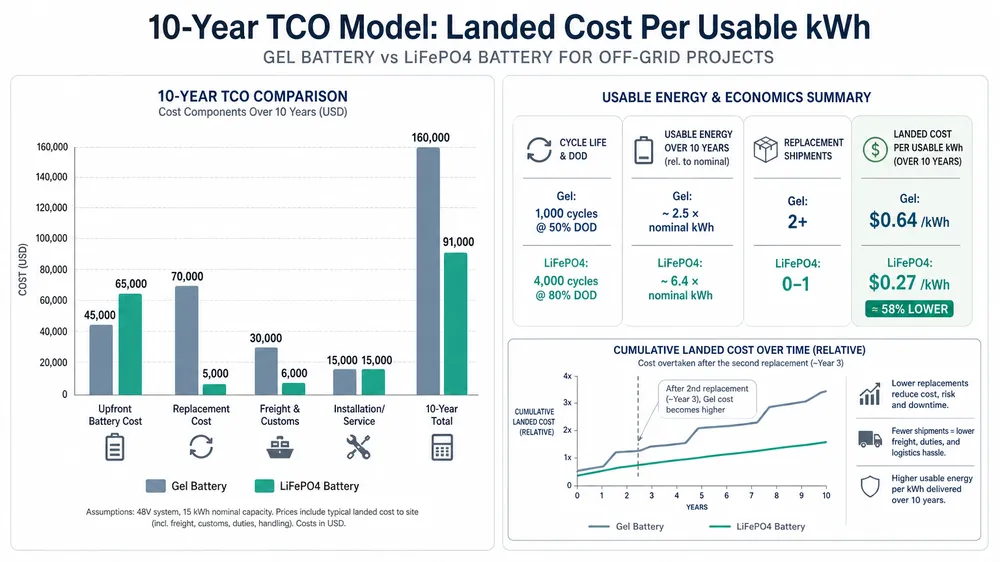
10-Year TCO Model: Landed Cost Per Usable kWh

This is where the gel solar battery cost per cycle comparison gets real. Below is a model structure for a typical off-grid installation requiring 5 kWh of daily usable energy. The numbers are quote-based assumptions — recalculate with your actual supplier pricing, but the formula structure holds.

Model assumptions:

  • Daily cycling, 365 days/year
  • 10-year project life
  • Gel DOD: 50% | LiFePO4 DOD: 80%
  • Gel cycle life: 1,000 cycles at 50% DOD | LiFePO4: 4,000 cycles at 80% DOD
Cost Line Gel Option LiFePO4 Option
Nominal capacity needed 10 kWh (to get 5 kWh usable at 50% DOD) 6.25 kWh (to get 5 kWh usable at 80% DOD)
Replacement rounds in 10 years 3-4 replacements (1,000 cycles ÷ 365 = ~2.7 years per set) 0-1 replacement (4,000 cycles ÷ 365 = ~10.9 years)
Total battery sets purchased 4 sets 1 set
Freight weight (per set, approximate) ~300 kg for 10 kWh gel ~65 kg for 6.25 kWh LiFePO4
Total freight weight over 10 years ~1,200 kg ~65-130 kg
Field service / replacement labor 3-4 site visits 0-1 site visit
Charger/BMS cost Minimal — standard charge controller BMS included in pack + compatible inverter

The lithium solar battery total cost of ownership drops below gel once you count the second replacement shipment. For projects cycling daily in Africa, Southeast Asia, or the Middle East, that second shipment usually arrives within 3 years — and it carries the same freight, customs, and installation cost as the first.

When does gel still win this math? Short-duration programs (under 3 years), seasonal or weekend-only cycling, and projects where the retail price ceiling is so tight that the first-purchase cost is the only cost the buyer can finance. (We see this often in entry-level solar home kit distribution — the end customer finances one battery at a time, and replacement is a future sale, not a future cost.)

Gel and LiFePO4 solar battery 10-year total cost comparison chart for off-grid projects

Depth of Discharge and Replacement Cycles Set the Real Payback

The lead acid gel vs lifepo4 off-grid decision hinges on DOD discipline more than any other single variable. We test both chemistries in-house — cycling gel cells at 30%, 50%, and 70% DOD, and LiFePO4 packs at 60%, 80%, and 100% DOD — and the curves tell a clear story.

Gel at 50% DOD delivers roughly 1,000-1,200 cycles before capacity drops below 80% of rated. Push that to 70% DOD and you are looking at 400-600 cycles — less than two years of daily use. The gel solar battery cost per cycle doubles when your field installations over-discharge routinely, which happens constantly in markets without proper charge controller enforcement.

LiFePO4 at 80% DOD delivers 3,500-6,000 cycles depending on cell grade and BMS quality. Our automated cell sorting line matches cells within 20mV and 2% capacity variance, so the pack degrades evenly instead of one weak cell dragging the group down. (This is the single biggest quality variable in lithium packs — mismatched cells cause early BMS cutoff and apparent capacity loss that has nothing to do with chemistry limits.)

For your project math: fewer replacements mean fewer delayed project phases, lower warranty reserves, and less inland logistics coordination. If you are deploying 500 systems across rural sites, the difference between replacing batteries once versus four times over a decade is not a line item — it is a program-level cost structure change. See our deep cycle gel solar battery page for more on how DOD planning affects gel battery selection, or read our detailed breakdown of deep cycle gel solar battery DOD for field-tested discharge guidelines.

Hot-Climate Derating and Charging Risk Change the Winner

I have managed QC for gel battery shipments to West Africa, East Africa, the Middle East, and Southeast Asia since 2010. The failure patterns are consistent: gel batteries do not fail because of chemistry — they fail because of charge voltage.

Gel electrolyte is sensitive to overcharge. In ambient temperatures above 35°C, the standard 14.1V charge voltage for a 12V gel battery is already too high. The electrolyte loses water through recombination gas venting, the gel structure cracks internally, and capacity drops permanently. We specify temperature-compensated charge profiles for every gel shipment to tropical markets — but once the battery leaves our factory, charge discipline depends on the controller and installer.

LiFePO4 in hot climates faces a different risk: BMS quality. A well-designed BMS with temperature-sensing MOSFETs will cut charge above 45°C cell temperature and cut discharge below 0°C. A cheap BMS without proper thermal logic lets the pack operate outside safe bounds until cell damage is irreversible. Our in-house BMS design team sets protection thresholds matched to the cell grade and target climate — this is not a generic off-the-shelf board. (For more on what separates a reliable lithium BMS from a liability, see our lithium solar battery BMS guide.)

The commercial consequence: field failures in remote off-grid projects cost far more than the battery price difference. A single truck roll to a rural telecom tower in Nigeria or a solar home system cluster in Cambodia can exceed the cost of the battery itself. Whichever chemistry you choose, the charge profile and protection logic must be specified for your deployment climate — not left to default factory settings.

Freight, Container Loading, and Replacement Logistics

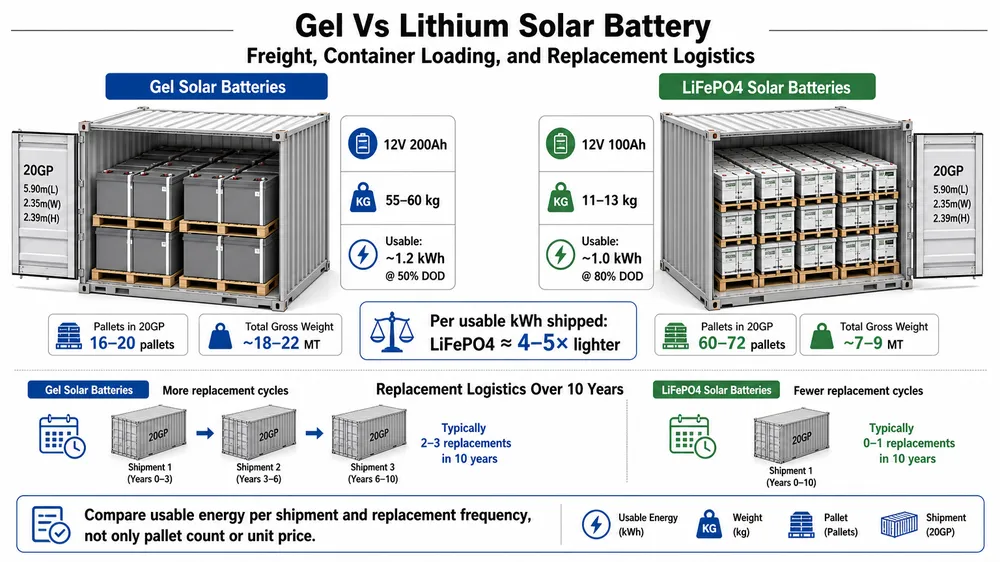
The gel vs lithium solar battery comparison changes again when you calculate landed energy cost instead of just battery cost. Weight and volume per usable kWh determine how much working energy fits in a 20GP container — and how many containers you ship over the project life.

A typical 12V 200Ah gel battery weighs approximately 55-60 kg and delivers 100Ah usable at 50% DOD. A 12V 100Ah LiFePO4 pack weighs approximately 11-13 kg and delivers 80Ah usable at 80% DOD. Per usable kWh, LiFePO4 ships roughly 4-5x lighter. That weight difference compounds across replacement cycles: if you are shipping gel replacements three times over a decade, your total ocean freight, port handling, and inland transport cost for batteries alone can approach or exceed the original battery purchase price.

Container utilization matters for distributors stocking both chemistries. A 20GP loaded with gel batteries carries significant dead weight relative to usable energy. The same container loaded with LiFePO4 packs carries more usable kWh at lower gross weight, leaving headroom for mixed-SKU loading or reducing per-unit freight allocation.

For African and rural Southeast Asian markets, inland logistics add another layer. Gel batteries are heavy, fragile to rough handling if packaging is inadequate, and need replacement more often — each replacement means another last-mile delivery to a site that may be hours from the nearest paved road. We pack gel shipments with reinforced corner protection and pallet strapping rated for unpaved transport, but the weight and frequency still cost you more per delivered kWh over the program life.

Container loading comparison for gel and lithium solar batteries by usable energy shipped

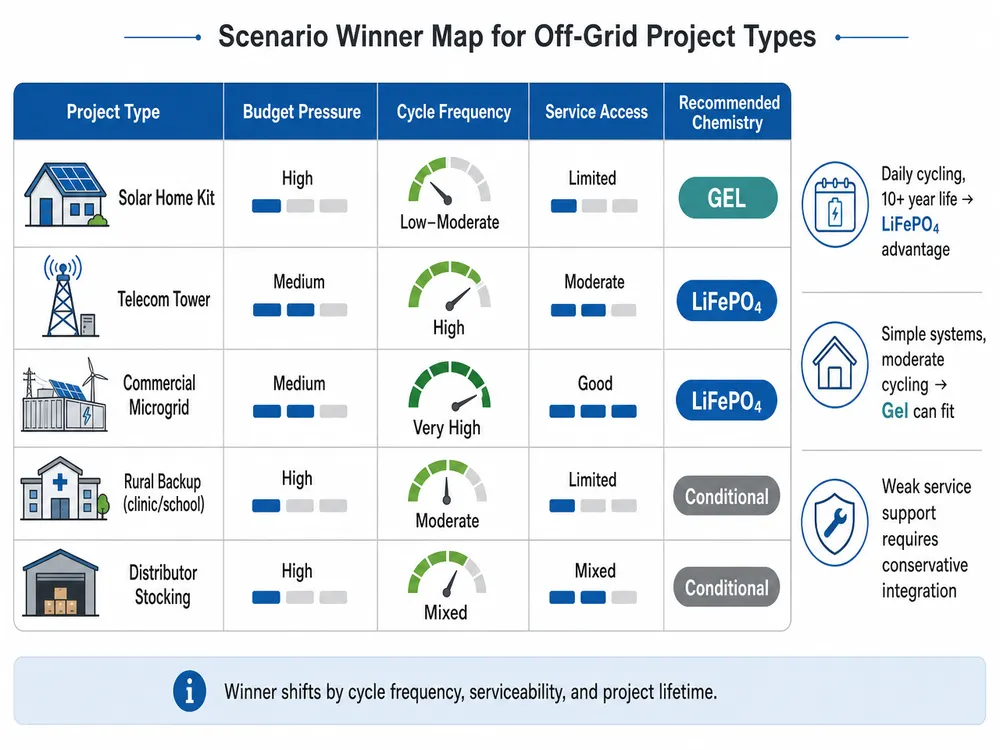
Scenario Winner Map for Off-Grid Project Types

The lead acid gel vs lifepo4 off-grid question has different answers depending on your project type, cycle frequency, service access, and budget structure. Here is where each chemistry wins — and why.

Budget solar home kits (price-sensitive retail markets) Winner: Gel — when daily cycling is moderate and charge control is enforced. Your end customer finances one battery at a time. The lower retail price protects your channel margin, and replacement is a repeat sale opportunity rather than a warranty liability. This works only if the charge controller holds voltage within gel-safe limits. If your kits ship with unregulated or poorly calibrated controllers, gel will fail early and your warranty cost erases the margin advantage.

Daily-cycle telecom tower backup Winner: LiFePO4. Telecom sites cycle daily, often deeply. The replacement interval for gel at this duty cycle is 2-3 years; for LiFePO4 it is 8-12 years. The service-trip cost to a remote tower site — generator, technician, transport — often exceeds the battery cost. Fewer replacements mean lower opex and fewer SLA penalties for your telecom client.

Commercial microgrid or community storage Winner: LiFePO4. Daily cycling at 80% DOD, 10+ year project life, and investor-grade TCO modeling all favor lithium. The higher upfront cost is amortized across thousands of cycles, and the lighter weight simplifies structural mounting and reduces civil works cost.

Rural electrification with limited technical service Winner: Conditional. Gel wins if the deployment includes proper charge controllers and the cycling is moderate (clinics, schools with daytime-only loads). LiFePO4 wins if the BMS is robust, the inverter communicates correctly with the pack, and there is a local technician who can interpret BMS fault codes. Without either condition, both chemistries fail — but gel fails more gracefully (gradual capacity loss vs. hard BMS lockout).

Distributor stocking program Winner: Both. Stock gel solar battery SKUs for your price-sensitive entry segment and lithium solar battery SKUs for your premium, high-margin, low-warranty segment. The margin structure is different: gel moves volume at thin margin with higher replacement revenue; LiFePO4 moves at higher margin per unit with lower after-sale cost.

Gel vs LiFePO4 solar battery decision matrix for telecom, solar home kit, and microgrid projects

Supplier Validation Checklist Before You Lock the Chemistry

Choosing between gel battery vs lithium battery solar is only half the decision. The other half is verifying that your supplier actually delivers the performance the chemistry promises. Here is what to request before you commit.

For gel solar battery orders:

  • Charge voltage specification matched to your target climate (temperature-compensated values, not just nominal 14.1V/14.4V)
  • Capacity test report at the DOD you plan to use — not just rated capacity at C20
  • Cycle life test data at 50% DOD with clear pass/fail criteria
  • High-temperature storage and transport packaging specification
  • Batch-level QC records: open-circuit voltage consistency, internal resistance spread, weight tolerance

For LiFePO4 solar battery orders:

  • Cell grade documentation and matching tolerance (voltage and capacity spread within the pack)
  • BMS protection settings: over-charge, over-discharge, over-current, temperature cutoff thresholds
  • Inverter/charge controller communication protocol compatibility (RS485, CAN, or dry contact)
  • UN38.3 transport test report, MSDS, and IEC 62133 safety certification
  • Cycle life test data at 80% DOD with capacity retention curve

We run lifecycle testing across both chemistries in-house — capacity, cycle life, high-temperature, low-temperature, and safety — with an 18-engineer R&D team and automated cell sorting that holds matching within 20mV. Our ISO 9001:2015, CE, IEC 62133, and UN38.3 certifications cover both gel and LiFePO4 lines. When you request a quote with your project voltage, capacity, climate zone, and expected daily cycles, we can spec both options side by side from the same production facility so you compare like for like.

Buyer Questions That Usually Change the Battery Choice

Is gel or LiFePO4 cheaper for an off-grid solar project over 10 years?

LiFePO4 is cheaper over 10 years for any project cycling daily. The lithium solar battery total cost of ownership drops below gel after the first replacement round — typically year 2-3 for daily-cycle gel systems. Gel is cheaper only if the project runs fewer than 300 deep cycles per year or ends within 3 years.

What DOD should I use when comparing gel solar battery cost per cycle?

Use 50% DOD for gel and 80% DOD for LiFePO4. These are the operating points where each chemistry delivers its rated cycle life. Comparing both at 100% nominal capacity is misleading — gel at 80% DOD loses half its cycle life, making the cost-per-cycle calculation look artificially close.

Does hot weather make gel or lithium solar batteries fail faster?

Both fail faster in heat, but through different mechanisms. Gel fails from electrolyte dry-out when charge voltage is not temperature-compensated. LiFePO4 fails from cell degradation when the BMS lacks proper thermal cutoff logic. In tropical markets, the charge profile specification (for gel) or BMS thermal design (for LiFePO4) matters more than the chemistry choice itself.

When does gel still make more sense than lithium for solar home kits?

Gel wins for solar home kits when: the retail price ceiling is below what LiFePO4 can reach, daily cycling is moderate (lighting and phone charging, not refrigeration), the charge controller enforces gel-safe voltage, and replacement is a revenue opportunity for your distribution channel rather than a warranty cost.

What should I ask a supplier before comparing gel and LiFePO4 quotations?

Ask for capacity test data at your planned DOD, cycle life curves at that DOD, climate-matched charge specifications, and landed cost including freight weight and replacement timing. A supplier who quotes only nominal capacity and unit price is hiding the variables that determine your real project cost.