The Cost Verdict Before the Specification Table
Most buyers comparing gel vs lithium solar battery start with unit price — and that is exactly where the wrong decision gets made. A gel battery costs less per unit, but it delivers fewer usable kWh per cycle, needs replacement sooner, and ships heavier. A LiFePO4 solar battery costs more upfront but usually delivers a lower cost per usable kWh over a 10-year off-grid program.
Here is the short verdict: LiFePO4 wins the total cost calculation for high-cycle off-grid systems — telecom towers, commercial microgrids, daily-cycling solar home systems. Gel solar battery still wins where budgets are tight, cycling is moderate (fewer than 300 deep cycles per year), charge voltage is controlled, and the project runs on existing lead-acid infrastructure with simple replacement logistics.
We manufacture both chemistries under one roof — gel and LiFePO4, same factory, same QC team, same shipping lane. That means the recommendation here is based on project economics, not on which catalog line we want to push.
Buyer Criteria That Actually Move the Off-Grid Budget
When you compare gel battery vs lithium battery solar, ignore the chemistry lesson and focus on what changes your landed cost and warranty exposure. The table below covers the criteria that actually shift budget decisions for off-grid projects.
| Criteria | Gel Solar Battery | LiFePO4 Solar Battery |
|---|---|---|
| Upfront unit cost | Lower (typically 40-55% of LiFePO4 price) | Higher initial investment |
| Usable DOD for long life | 50% recommended — deeper discharge shortens life fast | 80-90% usable under BMS protection |
| Cycle life at recommended DOD | 800-1,200 cycles at 50% DOD | 3,500-6,000 cycles at 80% DOD |
| Weight per usable kWh | Heavier — more freight cost per usable energy | ~60% lighter per usable kWh |
| Hot-climate tolerance | Proven if charge voltage is correct; dry-out risk if not | Needs quality BMS with temperature cutoff |
| BMS dependency | None — simpler system integration | Required — adds cost but enables deeper DOD safely |
| Replacement interval (daily cycling) | Every 2-4 years | Every 8-12 years |
| Container loading (usable energy shipped) | Lower energy density per pallet | More usable kWh per 20GP |
The decisive differences are in bold. Nominal capacity is not sellable project value — usable capacity after DOD discipline is. A 200Ah gel battery at 50% DOD gives you 100Ah of working energy. A 100Ah LiFePO4 at 80% DOD gives you 80Ah from a pack that weighs half as much and lasts three to five times longer.
10-Year TCO Model: Landed Cost Per Usable kWh
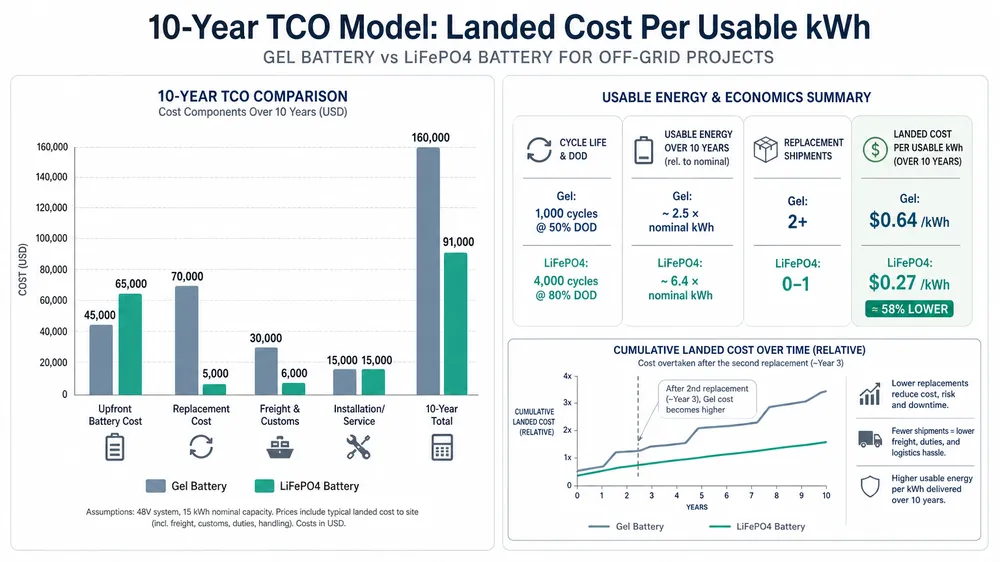
This is where the gel solar battery cost per cycle comparison gets real. Below is a model structure for a typical off-grid installation requiring 5 kWh of daily usable energy. The numbers are quote-based assumptions — recalculate with your actual supplier pricing, but the formula structure holds.
Model assumptions:
- Daily cycling, 365 days/year
- 10-year project life
- Gel DOD: 50% | LiFePO4 DOD: 80%
- Gel cycle life: 1,000 cycles at 50% DOD | LiFePO4: 4,000 cycles at 80% DOD
| Cost Line | Gel Option | LiFePO4 Option |
|---|---|---|
| Nominal capacity needed | 10 kWh (to get 5 kWh usable at 50% DOD) | 6.25 kWh (to get 5 kWh usable at 80% DOD) |
| Replacement rounds in 10 years | 3-4 replacements (1,000 cycles ÷ 365 = ~2.7 years per set) | 0-1 replacement (4,000 cycles ÷ 365 = ~10.9 years) |
| Total battery sets purchased | 4 sets | 1 set |
| Freight weight (per set, approximate) | ~300 kg for 10 kWh gel | ~65 kg for 6.25 kWh LiFePO4 |
| Total freight weight over 10 years | ~1,200 kg | ~65-130 kg |
| Field service / replacement labor | 3-4 site visits | 0-1 site visit |
| Charger/BMS cost | Minimal — standard charge controller | BMS included in pack + compatible inverter |
The lithium solar battery total cost of ownership drops below gel once you count the second replacement shipment. For projects cycling daily in Africa, Southeast Asia, or the Middle East, that second shipment usually arrives within 3 years — and it carries the same freight, customs, and installation cost as the first.
When does gel still win this math? Short-duration programs (under 3 years), seasonal or weekend-only cycling, and projects where the retail price ceiling is so tight that the first-purchase cost is the only cost the buyer can finance. (We see this often in entry-level solar home kit distribution — the end customer finances one battery at a time, and replacement is a future sale, not a future cost.)

Depth of Discharge and Replacement Cycles Set the Real Payback
The lead acid gel vs lifepo4 off-grid decision hinges on DOD discipline more than any other single variable. We test both chemistries in-house — cycling gel cells at 30%, 50%, and 70% DOD, and LiFePO4 packs at 60%, 80%, and 100% DOD — and the curves tell a clear story.
Gel at 50% DOD delivers roughly 1,000-1,200 cycles before capacity drops below 80% of rated. Push that to 70% DOD and you are looking at 400-600 cycles — less than two years of daily use. The gel solar battery cost per cycle doubles when your field installations over-discharge routinely, which happens constantly in markets without proper charge controller enforcement.
LiFePO4 at 80% DOD delivers 3,500-6,000 cycles depending on cell grade and BMS quality. Our automated cell sorting line matches cells within 20mV and 2% capacity variance, so the pack degrades evenly instead of one weak cell dragging the group down. (This is the single biggest quality variable in lithium packs — mismatched cells cause early BMS cutoff and apparent capacity loss that has nothing to do with chemistry limits.)
For your project math: fewer replacements mean fewer delayed project phases, lower warranty reserves, and less inland logistics coordination. If you are deploying 500 systems across rural sites, the difference between replacing batteries once versus four times over a decade is not a line item — it is a program-level cost structure change. See our deep cycle gel solar battery page for more on how DOD planning affects gel battery selection, or read our detailed breakdown of deep cycle gel solar battery DOD for field-tested discharge guidelines.
Hot-Climate Derating and Charging Risk Change the Winner
I have managed QC for gel battery shipments to West Africa, East Africa, the Middle East, and Southeast Asia since 2010. The failure patterns are consistent: gel batteries do not fail because of chemistry — they fail because of charge voltage.
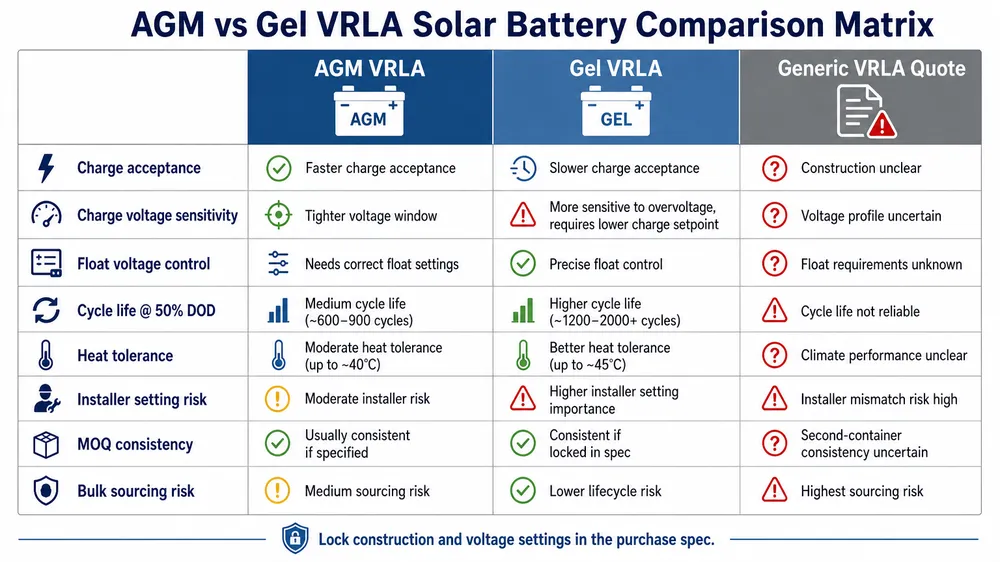
Gel electrolyte is sensitive to overcharge. In ambient temperatures above 35°C, the standard 14.1V charge voltage for a 12V gel battery is already too high. The electrolyte loses water through recombination gas venting, the gel structure cracks internally, and capacity drops permanently. We specify temperature-compensated charge profiles for every gel shipment to tropical markets — but once the battery leaves our factory, charge discipline depends on the controller and installer.
LiFePO4 in hot climates faces a different risk: BMS quality. A well-designed BMS with temperature-sensing MOSFETs will cut charge above 45°C cell temperature and cut discharge below 0°C. A cheap BMS without proper thermal logic lets the pack operate outside safe bounds until cell damage is irreversible. Our in-house BMS design team sets protection thresholds matched to the cell grade and target climate — this is not a generic off-the-shelf board. (For more on what separates a reliable lithium BMS from a liability, see our lithium solar battery BMS guide.)
The commercial consequence: field failures in remote off-grid projects cost far more than the battery price difference. A single truck roll to a rural telecom tower in Nigeria or a solar home system cluster in Cambodia can exceed the cost of the battery itself. Whichever chemistry you choose, the charge profile and protection logic must be specified for your deployment climate — not left to default factory settings.
Freight, Container Loading, and Replacement Logistics
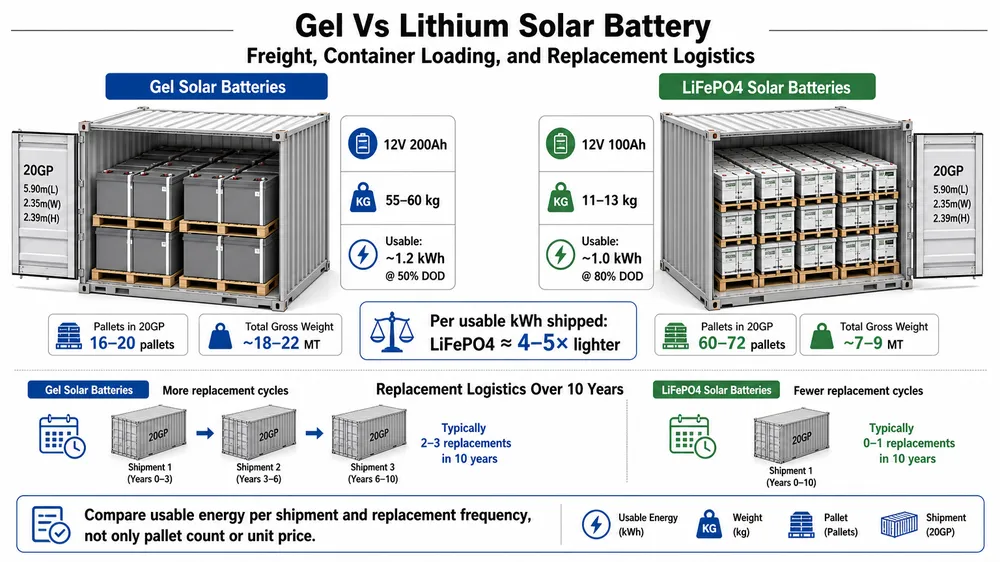
The gel vs lithium solar battery comparison changes again when you calculate landed energy cost instead of just battery cost. Weight and volume per usable kWh determine how much working energy fits in a 20GP container — and how many containers you ship over the project life.
A typical 12V 200Ah gel battery weighs approximately 55-60 kg and delivers 100Ah usable at 50% DOD. A 12V 100Ah LiFePO4 pack weighs approximately 11-13 kg and delivers 80Ah usable at 80% DOD. Per usable kWh, LiFePO4 ships roughly 4-5x lighter. That weight difference compounds across replacement cycles: if you are shipping gel replacements three times over a decade, your total ocean freight, port handling, and inland transport cost for batteries alone can approach or exceed the original battery purchase price.
Container utilization matters for distributors stocking both chemistries. A 20GP loaded with gel batteries carries significant dead weight relative to usable energy. The same container loaded with LiFePO4 packs carries more usable kWh at lower gross weight, leaving headroom for mixed-SKU loading or reducing per-unit freight allocation.
For African and rural Southeast Asian markets, inland logistics add another layer. Gel batteries are heavy, fragile to rough handling if packaging is inadequate, and need replacement more often — each replacement means another last-mile delivery to a site that may be hours from the nearest paved road. We pack gel shipments with reinforced corner protection and pallet strapping rated for unpaved transport, but the weight and frequency still cost you more per delivered kWh over the program life.
Scenario Winner Map for Off-Grid Project Types
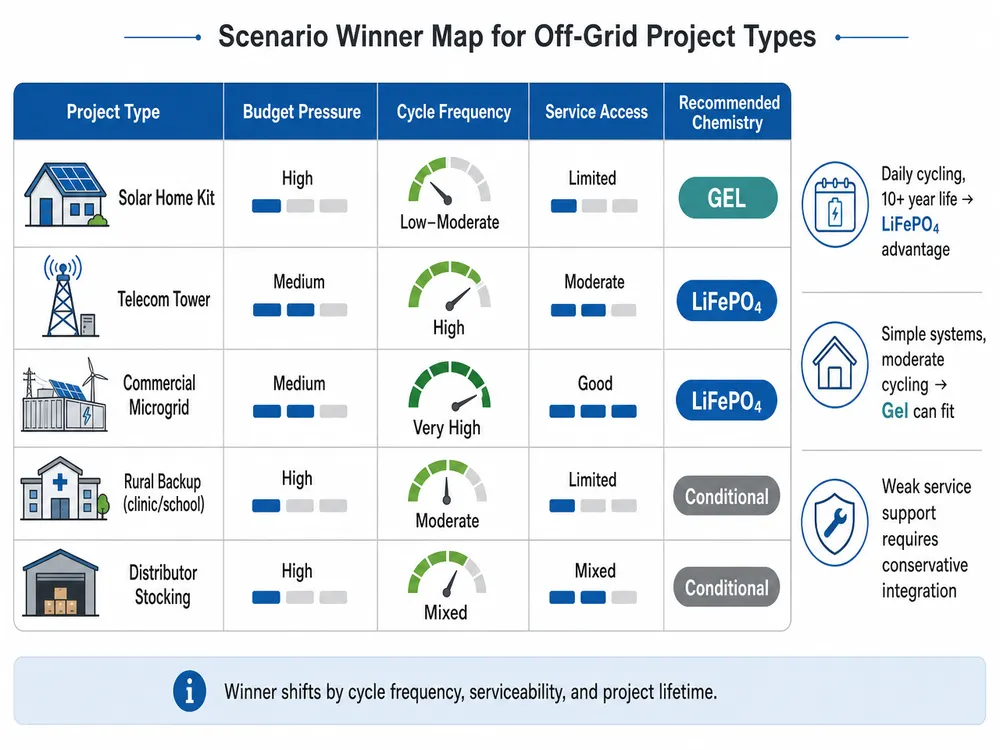
The lead acid gel vs lifepo4 off-grid question has different answers depending on your project type, cycle frequency, service access, and budget structure. Here is where each chemistry wins — and why.
Budget solar home kits (price-sensitive retail markets) Winner: Gel — when daily cycling is moderate and charge control is enforced. Your end customer finances one battery at a time. The lower retail price protects your channel margin, and replacement is a repeat sale opportunity rather than a warranty liability. This works only if the charge controller holds voltage within gel-safe limits. If your kits ship with unregulated or poorly calibrated controllers, gel will fail early and your warranty cost erases the margin advantage.
Daily-cycle telecom tower backup Winner: LiFePO4. Telecom sites cycle daily, often deeply. The replacement interval for gel at this duty cycle is 2-3 years; for LiFePO4 it is 8-12 years. The service-trip cost to a remote tower site — generator, technician, transport — often exceeds the battery cost. Fewer replacements mean lower opex and fewer SLA penalties for your telecom client.
Commercial microgrid or community storage Winner: LiFePO4. Daily cycling at 80% DOD, 10+ year project life, and investor-grade TCO modeling all favor lithium. The higher upfront cost is amortized across thousands of cycles, and the lighter weight simplifies structural mounting and reduces civil works cost.
Rural electrification with limited technical service Winner: Conditional. Gel wins if the deployment includes proper charge controllers and the cycling is moderate (clinics, schools with daytime-only loads). LiFePO4 wins if the BMS is robust, the inverter communicates correctly with the pack, and there is a local technician who can interpret BMS fault codes. Without either condition, both chemistries fail — but gel fails more gracefully (gradual capacity loss vs. hard BMS lockout).
Distributor stocking program Winner: Both. Stock gel solar battery SKUs for your price-sensitive entry segment and lithium solar battery SKUs for your premium, high-margin, low-warranty segment. The margin structure is different: gel moves volume at thin margin with higher replacement revenue; LiFePO4 moves at higher margin per unit with lower after-sale cost.
Supplier Validation Checklist Before You Lock the Chemistry
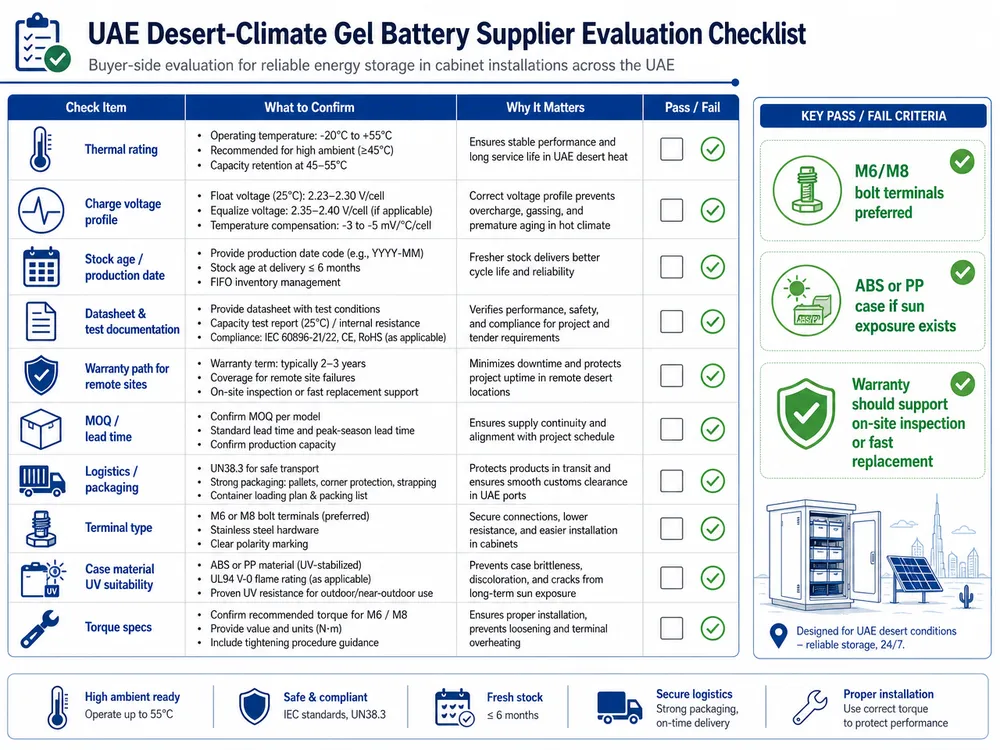
Choosing between gel battery vs lithium battery solar is only half the decision. The other half is verifying that your supplier actually delivers the performance the chemistry promises. Here is what to request before you commit.
For gel solar battery orders:
- Charge voltage specification matched to your target climate (temperature-compensated values, not just nominal 14.1V/14.4V)
- Capacity test report at the DOD you plan to use — not just rated capacity at C20
- Cycle life test data at 50% DOD with clear pass/fail criteria
- High-temperature storage and transport packaging specification
- Batch-level QC records: open-circuit voltage consistency, internal resistance spread, weight tolerance
For LiFePO4 solar battery orders:
- Cell grade documentation and matching tolerance (voltage and capacity spread within the pack)
- BMS protection settings: over-charge, over-discharge, over-current, temperature cutoff thresholds
- Inverter/charge controller communication protocol compatibility (RS485, CAN, or dry contact)
- UN38.3 transport test report, MSDS, and IEC 62133 safety certification
- Cycle life test data at 80% DOD with capacity retention curve
We run lifecycle testing across both chemistries in-house — capacity, cycle life, high-temperature, low-temperature, and safety — with an 18-engineer R&D team and automated cell sorting that holds matching within 20mV. Our ISO 9001:2015, CE, IEC 62133, and UN38.3 certifications cover both gel and LiFePO4 lines. When you request a quote with your project voltage, capacity, climate zone, and expected daily cycles, we can spec both options side by side from the same production facility so you compare like for like.
Buyer Questions That Usually Change the Battery Choice
Is gel or LiFePO4 cheaper for an off-grid solar project over 10 years?
LiFePO4 is cheaper over 10 years for any project cycling daily. The lithium solar battery total cost of ownership drops below gel after the first replacement round — typically year 2-3 for daily-cycle gel systems. Gel is cheaper only if the project runs fewer than 300 deep cycles per year or ends within 3 years.
What DOD should I use when comparing gel solar battery cost per cycle?
Use 50% DOD for gel and 80% DOD for LiFePO4. These are the operating points where each chemistry delivers its rated cycle life. Comparing both at 100% nominal capacity is misleading — gel at 80% DOD loses half its cycle life, making the cost-per-cycle calculation look artificially close.
Does hot weather make gel or lithium solar batteries fail faster?
Both fail faster in heat, but through different mechanisms. Gel fails from electrolyte dry-out when charge voltage is not temperature-compensated. LiFePO4 fails from cell degradation when the BMS lacks proper thermal cutoff logic. In tropical markets, the charge profile specification (for gel) or BMS thermal design (for LiFePO4) matters more than the chemistry choice itself.
When does gel still make more sense than lithium for solar home kits?
Gel wins for solar home kits when: the retail price ceiling is below what LiFePO4 can reach, daily cycling is moderate (lighting and phone charging, not refrigeration), the charge controller enforces gel-safe voltage, and replacement is a revenue opportunity for your distribution channel rather than a warranty cost.
What should I ask a supplier before comparing gel and LiFePO4 quotations?
Ask for capacity test data at your planned DOD, cycle life curves at that DOD, climate-matched charge specifications, and landed cost including freight weight and replacement timing. A supplier who quotes only nominal capacity and unit price is hiding the variables that determine your real project cost.