

Portable Solar Battery Charger Factory-Direct Wholesale
Compact solar power bank SKUs from a dedicated battery manufacturer, ready for your distribution catalog, e-commerce channel, or project kit program.
OEM branding and export compliance built in. Standard models start at 100-unit MOQ.
IEC 62133 + UN38.3
Certified
OEM/ODM from 100 Units
Low MOQ
2M Units/Year
Production Capacity
Since 2012
Manufacturing Experience
What Is a Portable Solar Battery Charger?
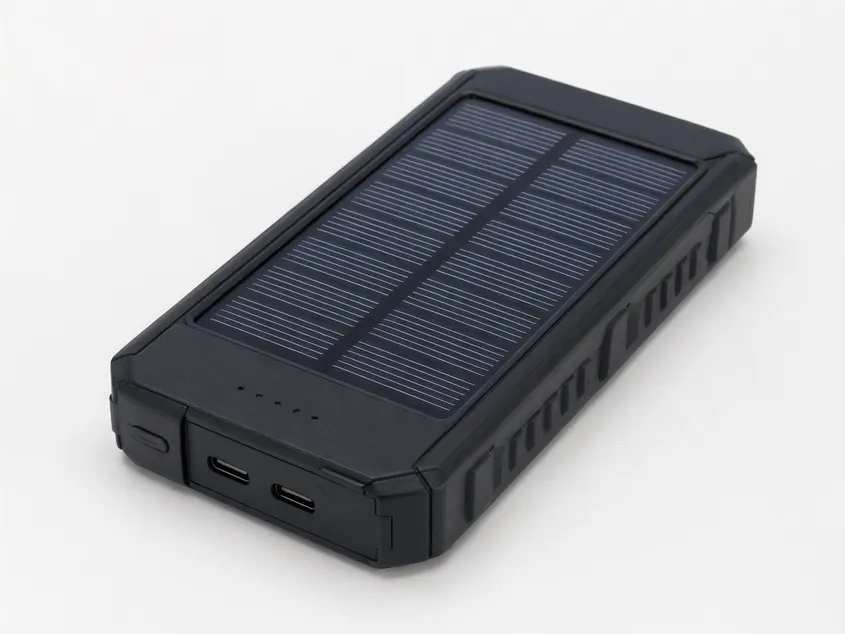
A portable solar battery charger is a compact rechargeable battery pack with integrated or compatible solar input, USB/USB-C output ports, and built-in BMS protection. It's the product category that sits between a phone accessory and a serious energy tool — small enough for retail shelves, useful enough for repeat orders.
We've manufactured portable solar battery packs at EVANBattery since 2012, and the product has evolved from a novelty into a staple SKU for outdoor distributors, emergency kit suppliers, and e-commerce sellers running private-label programs. As a portable solar battery charger manufacturer, we handle cell selection, BMS integration, pack assembly, and compliance documentation under one roof in Zhongshan, Guangdong.
Why This Category Works for B2B Buyers
-
Low per-unit cost
Competitive factory pricing scales well from sample to container orders.
-
Broad market appeal
Outdoor, emergency prep, travel, and everyday carry segments all buy.
-
Simple logistics
Small carton dimensions and manageable battery shipping requirements.
-
Strong private-label potential
Standard models start at 100-unit MOQ — test a SKU without container-level commitment.
Ready to source?
Send your target capacity, quantity, and destination market for a quote.
What's Covered on This Page
SKU Specifications That Control Landed Cost and Retail Positioning
The specification table below covers the typical planning ranges for portable solar battery pack and solar power bank SKUs we produce. These are not fixed catalog numbers — they're the parameters you'll choose from when building your order. Final specifications depend on the model and any OEM customization.
| Parameter | Compact Tier | Mid-Capacity Tier | High-Capacity Tier |
|---|---|---|---|
| Battery capacity | 5,000–10,000mAh | 15,000–25,000mAh | 30,000–50,000mAh |
| Cell type | Li-ion (18650/polymer) | Li-ion (21700/polymer) | Li-ion or LiFePO4 |
| Nominal voltage | 3.7V (single cell) | 3.7V (multi-cell parallel) | 3.7V or 7.4V (series-parallel) |
| Solar panel input | 1–1.5W integrated mono | 2–3W integrated mono | 3–5W integrated or external port |
| USB-A output | 5V/1A–2.1A | 5V/2.1A | 5V/2.4A |
| USB-C output | 5V/2A (select models) | 5V/3A or PD 18W | PD 18–22.5W |
| BMS protection | OC/OD/SC/OT | OC/OD/SC/OT/balance | OC/OD/SC/OT/balance |
| Housing material | ABS/PC | ABS/PC + rubber edge | ABS/PC + rubber, IP65 available |
| Weight (typical) | 150–250g | 350–550g | 600–900g |
| Cycle life | 500+ cycles to 80% | 500+ cycles to 80% | 800+ (LiFePO4: 2000+) |
| Operating temp | -10°C to 45°C | -10°C to 45°C | -20°C to 50°C |
OC = over-charge, OD = over-discharge, SC = short-circuit, OT = over-temperature
Compact Tier
Targets impulse-buy price points and promotional giveaway programs. Lightweight, low unit cost, high volume potential.
Mid-Capacity Tier
The volume sweet spot for outdoor retail and e-commerce — enough power to charge a phone 3–5 times, light enough for backpack carry.
High-Capacity Tier
Serves field crews, emergency kits, and buyers who want a premium SKU with higher margin per unit. LiFePO4 option for extended cycle life.
The integrated solar panel on most models is sized for emergency top-up — roughly 10–15% charge per full day of direct sun. If your customers expect full solar recharge, we recommend pairing with an external foldable panel, which is a separate SKU under our portable solar battery kit range.
Specifications shown are industry-standard planning values. Actual specifications vary by selected model and OEM scope. Contact us for detailed product datasheets.
Request Datasheet & QuoteCell Matching and BMS Control Reduce Return Risk on Small Battery Packs
Small battery packs are unforgiving. A portable solar battery charger with mismatched cells will show capacity drift within months — one cell ages faster, the BMS cuts off early, and your customer sees "50% less battery life" in their review. We've seen this pattern destroy product ratings for brands that sourced from assemblers without proper cell grading.
Here's what happens on our line before a portable solar battery pack ships:
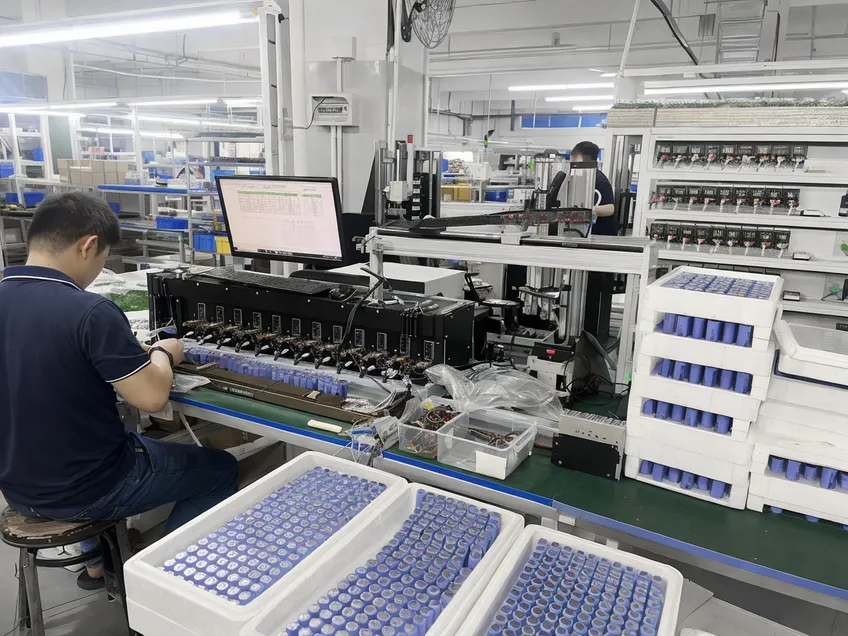
Incoming Cell Inspection
Every incoming cell lot is tested for voltage (within 10mV tolerance), internal resistance, and actual capacity. Cells that fall outside our acceptance band go back to the supplier. We don't downgrade rejects into "economy" products — they leave the factory.
Automated Sorting and Matching
Cells destined for the same pack are grouped by measured capacity and internal resistance, not by the supplier's printed label. For a 4-cell parallel pack, we hold matching within 20mV and 3mΩ. This is the step that determines whether your 1,000-unit batch performs consistently six months after delivery or starts generating warranty claims.
BMS Parameter Matching
We program protection thresholds to the specific cell chemistry and pack configuration. A 10,000mAh polymer pack gets different over-current limits than a 30,000mAh 21700 pack. Our BMS team designs and produces boards in-house, so we're not constrained by whatever generic module a third-party supplier happens to stock. A mismatched BMS is the number-one cause of premature shutdown complaints on solar power banks.
Capacity Verification and Aging
Every finished unit goes through charge/discharge cycling and a 24-hour aging period. Units that show abnormal self-discharge or capacity below threshold get pulled before packing.
The Result for Your Business
Predictable field performance across your entire order, fewer RMA claims eating into your margin, and product ratings that hold up over time.
Market Segments Where Portable Solar Battery Packs Move in Repeat Orders
A portable solar battery charger isn't a single market — it's a format that fits into multiple commercial channels. The buyers who reorder from us consistently have identified a specific segment and built their SKU around it. Here's where we see volume moving:
E-Commerce and Retail Solar Power Bank Programs
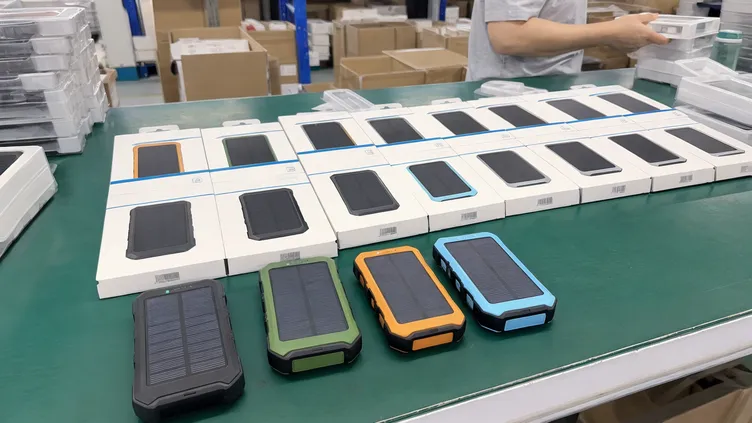
Online sellers running solar power bank wholesale programs on Amazon, Shopify, or regional marketplaces need three things:
- Stable specifications across reorders — so product listings stay accurate
- Retail-ready packaging with barcode and compliance marks
- Unit cost that leaves room for advertising spend
We supply private-label solar power banks with consistent specs batch to batch, individual retail boxes with your branding, and EAN/UPC barcode labels applied at the factory.
This segment has grown steadily for us over the past three years — the combination of "eco-friendly" positioning and practical utility gives these SKUs strong conversion rates compared to generic power banks.
Outdoor and Travel Accessory Distribution
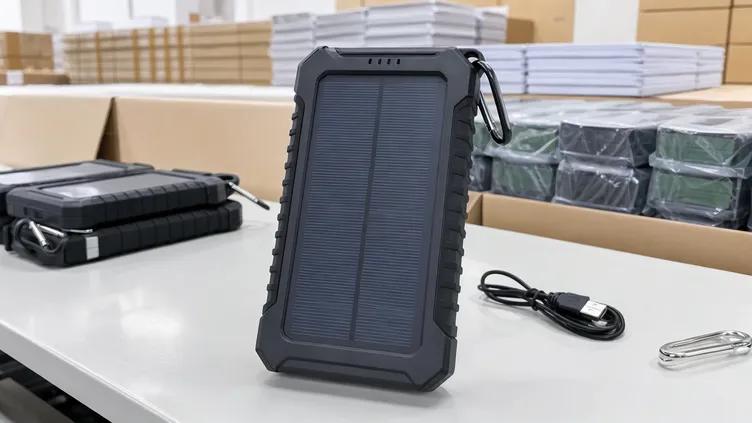
Distributors supplying outdoor retail chains, travel shops, and adventure gear stores want rugged housing, compact carton dimensions for efficient shelf replenishment, and features that justify premium shelf pricing.
We offer:
- IP65-rated housing options
- Rubberized edge protection
- Integrated LED flashlight on select models
- Built-in carabiner loops
Your margin comes from the perceived value gap between a "solar adventure charger" and a commodity power bank.
Emergency Preparedness and Disaster Kit Supply
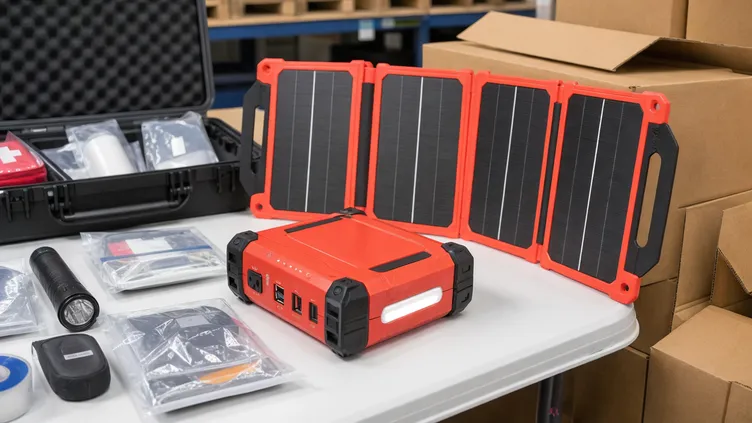
Government agencies, NGOs, and emergency kit assemblers order portable solar battery chargers in predictable annual cycles — budget-driven procurement with 6–12 month reorder patterns.
Requirements:
- Reliable charging from solar in grid-down scenarios
- Simple user interface — no apps, no Bluetooth pairing
- Durable packaging that survives warehouse storage
We configure units with high-visibility housing colors, simplified port layouts, and reinforced master cartons for long-term storage.
Field Service and Maintenance Teams
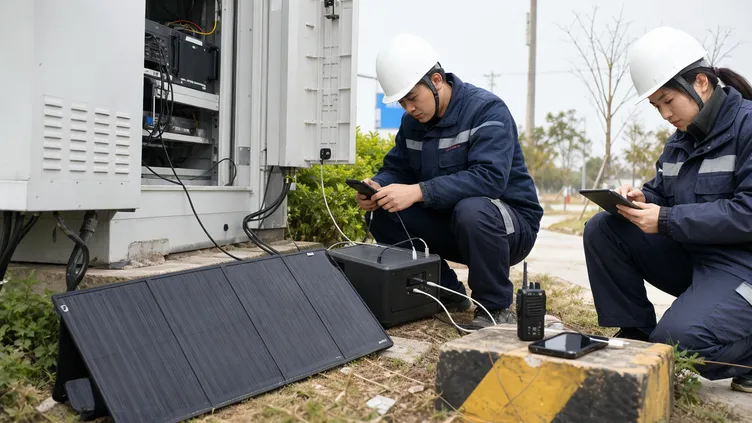
Telecom maintenance crews, utility inspectors, and agricultural monitoring teams need backup charging for phones, radios, tablets, and handheld instruments.
These aren't retail buyers — they're project procurement, typically 200–1,000 units per order with annual replacement cycles.
Spec priority:
Reliability and temperature tolerance over flashy features.
Private-Label Promotional and Corporate Gift Channels
Brands running promotional campaigns or corporate gift programs want low MOQ, fast turnaround, and logo placement.
Our standard models at 100-unit MOQ with pad printing or silk-screen logo application fit this channel.
The product doubles as a practical gift and a brand impression tool — higher perceived value than a branded pen, lower cost than a branded speaker.
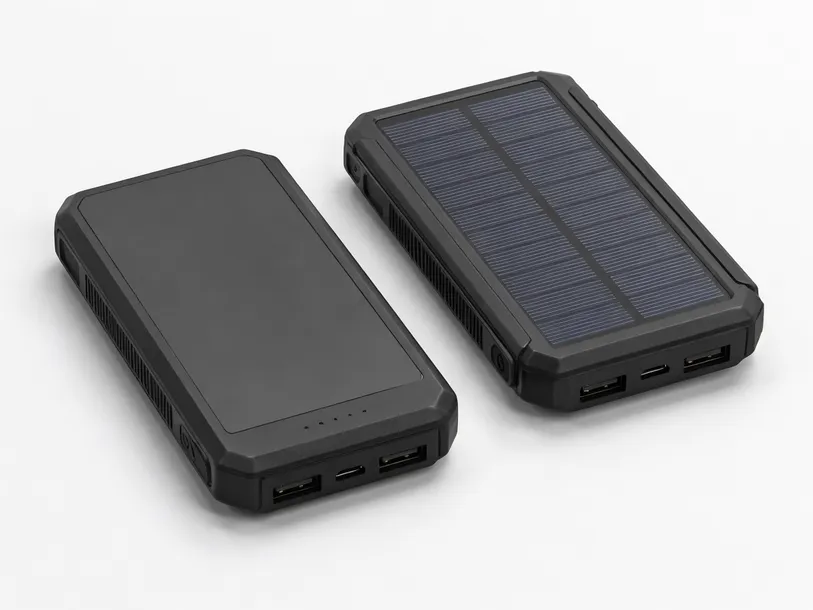
OEM Options Buyers Ask for Before Scaling a Solar Power Bank Program
We get the same customization questions from every new buyer evaluating us as a solar power bank manufacturer. Here's the practical scope — what's easy, what needs engineering validation, and what changes your MOQ.
Standard Customization
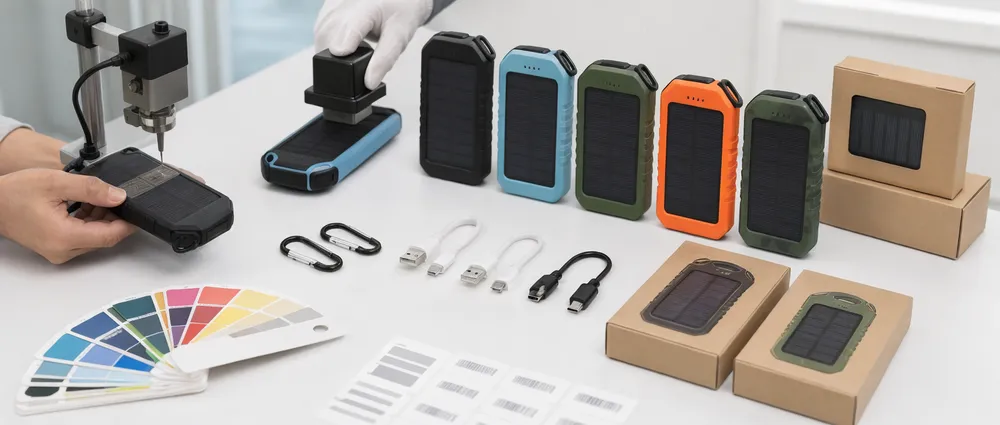
100-unit MOQ on existing models- Logo printing: pad print, silk-screen, or laser engraving on housing
- Color: standard palette (black, blue, green, orange, army green) or custom Pantone on orders above 500 units
- Retail packaging: custom box design with your branding, product photos, compliance marks, and barcode
- User manual: your brand, your language, your warranty terms
- Carton marking: your SKU labels, shipping marks, and pallet configuration
- Cable set: USB-A to Micro-USB, USB-A to USB-C, or USB-C to USB-C — included or sold separately per your preference
Product Configuration
MOQ varies by complexity- Capacity selection: choose from available cell configurations within each tier
- Output port layout: USB-A count, USB-C PD support, DC barrel jack (on high-capacity models)
- LED flashlight: single LED, multi-mode (steady/strobe/SOS), or no LED
- Housing options: standard ABS, rubberized shock-resistant, or IP65 sealed (model-dependent)
- Solar panel wattage: matched to housing size and target charge rate
Full OEM/ODM
Engineering validation required- Custom capacity and voltage configurations designed by our 18-engineer R&D team
- New housing mold development — requires tooling investment, amortized across order volume
- Custom BMS firmware: specific protection thresholds, LED indicator behavior, or communication features
- Unique port layouts or connector types not in our standard range
Honest note from our team:
If you're testing a new market, start with a standard model and custom branding. The 100-unit entry lets you validate demand before investing in tooling. We've seen too many buyers spend on custom molds for a SKU that needed market proof first.
Import Documents and Battery Compliance Before You Commit a SKU
Lithium batteries are classified dangerous goods for transport. If your portable solar charger supplier can't provide proper documentation, your shipment sits at the port — and your launch timeline breaks.
Here's what we provide as standard with every portable solar battery charger order:
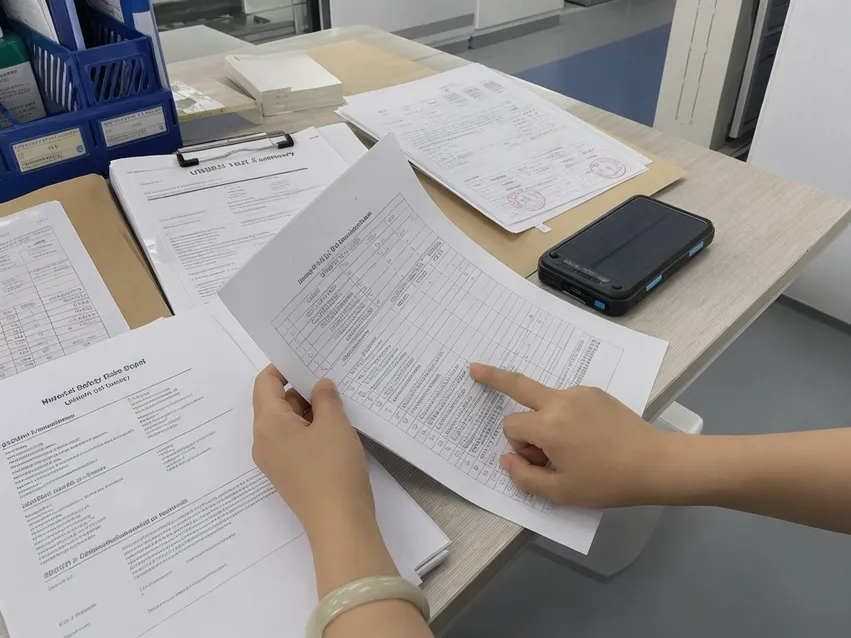
UN38.3 Test Summary
Required for lithium battery air and sea freight. Covers altitude simulation, thermal cycling, vibration, shock, external short circuit, impact, overcharge, and forced discharge. We maintain current reports for all standard models. Without this document, your freight forwarder won't book the shipment.
MSDS (Material Safety Data Sheet)
Required by carriers and customs authorities. Details chemical composition, handling precautions, and emergency procedures. We issue model-specific MSDS documents — not generic templates that customs officers flag for review.
CE Marking and IEC 62133 Test Reports
IEC 62133 covers safety requirements for portable sealed secondary cells. CE marking supports market access in the EU and other CE-recognizing markets. Reports are available for your import registration files.
ISO 9001:2015
Covers our manufacturing management system — batch traceability, process control, and corrective action procedures. Some distributor onboarding processes require supplier QMS certification; this satisfies that requirement.
Regional Certification Support
If your destination market requires FCC (US), RoHS/REACH (EU chemical compliance), UKCA (UK), BIS (India), or other regional certifications, confirm requirements before sampling. We can support the application process with test samples and technical data packages for most major test labs.
(We've been through the cycle with TÜV, SGS, and Intertek enough times to know the documentation requirements for each.)
Packaging That Protects Margin Across E-Commerce and Distributor Channels
A damaged portable solar battery bank arriving at your customer's door is a refund, a negative review, and a margin loss. Packaging isn't a shipping detail — it's profit protection.
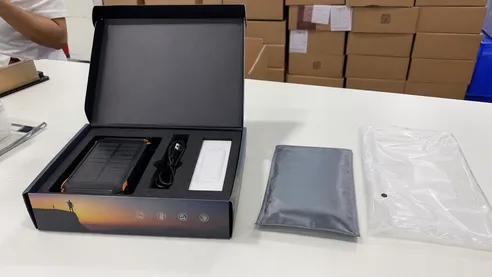
Retail and E-Commerce Packaging
- Individual retail box: custom-printed corrugated or rigid box with foam insert, product window optional
- Inner protection: molded pulp tray or EVA foam cutout holding the unit, cable, and manual in position
- Barcode labels: EAN/UPC on retail box, FNSKU or warehouse label on outer poly bag if required
- Poly bag: individual unit sealed in anti-static bag before boxing (prevents cosmetic scratches during transit)
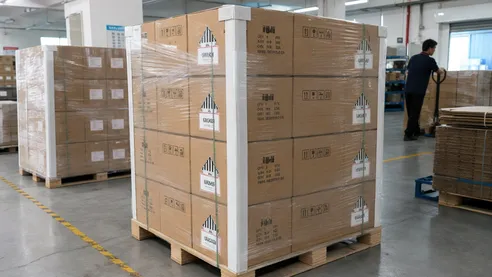
Master Carton and Palletization
- Master carton: double-wall corrugated, sized for standard pallet configurations (typically 50–100 units per carton depending on model size)
- Carton marking: lithium battery handling labels (UN3481 or UN3480 as applicable), your shipping marks, gross/net weight, and quantity
- Palletization: standard 1200×1000mm Euro pallet or 1200×800mm depending on destination, stretch-wrapped and corner-protected
- Container loading: compact charger SKUs load efficiently — a 20GP container typically holds 15,000–30,000 units depending on model and packaging configuration
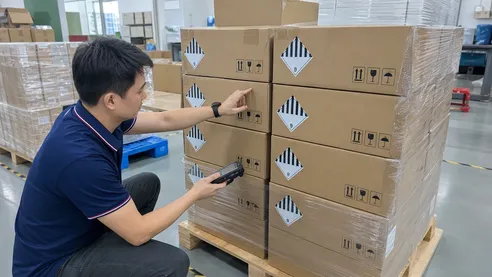
Battery-Specific Shipping Requirements
Lithium battery cartons require proper Class 9 labeling, and quantities per package must comply with IATA/IMDG packing instructions (PI966/PI967 for packed with or contained in equipment). We handle the carton marking and documentation coordination so your freight forwarder receives a shipment that's ready to book without delays.
First-time importer note: Some carriers have per-package watt-hour limits for lithium batteries. We configure carton quantities to stay within standard carrier acceptance thresholds — saves you the headache of re-packing at origin.
Need packaging configured for your sales channel?
Tell us your channel (Amazon FBA, retail distribution, D2C) and we'll spec the right packaging tier.
Choose the Right Portable Solar Battery Product Before Sending an RFQ
The portable solar battery category covers four distinct product types. If you're comparing options, here's how they split by commercial use case:
| Product | Format | Typical Buyer Use Case | Capacity Range | Key Difference |
|---|---|---|---|---|
| Portable Solar Battery Charger (this page) | Compact power bank with solar input | Wholesale, private label, e-commerce, promotional | 5,000–50,000mAh | Lowest unit cost, highest volume potential, simplest logistics |
| Portable Solar Battery Power Station | Larger unit with AC output | Distributor catalogs, outdoor retail, backup power | 200Wh–2,000Wh+ | AC inverter output, higher ticket value, heavier |
| Portable Solar Battery Kit | Battery + panel + cables bundled | Project kits, retail bundles, off-grid starter sets | Varies by configuration | Complete system in one box, higher perceived value |
| Portable Solar Battery for Camping | Outdoor-optimized battery unit | Outdoor channel distributors, camping retail | 20,000mAh–500Wh | Rugged housing, outdoor features, camping market positioning |
Portable Solar Battery Charger
Compact power bank with solar input
Portable Solar Battery Power Station
Larger unit with AC output
Portable Solar Battery Kit
Battery + panel + cables bundled
Portable Solar Battery for Camping
Outdoor-optimized battery unit
Building a high-volume, low-ticket SKU program?
You're on the right page. The portable solar battery charger format gives you the best combination of low landed cost, simple compliance, and broad channel fit.
Need AC output or higher capacity?
Look at the portable solar battery power station. Different product, different margin structure, different buyer.
Want a complete bundled package?
The portable solar battery kit includes matched panel and accessories in one retail-ready box.
Procurement FAQ for Portable Solar Battery Charger Orders
Common questions from wholesale buyers, distributors, and brand owners evaluating solar power bank programs.
What capacity range should I choose for a wholesale solar power bank program?
It depends on your channel and price point target. For e-commerce and promotional use, 10,000–20,000mAh hits the sweet spot — high enough to be genuinely useful (3–5 full phone charges), low enough to keep unit cost and weight manageable for shipping.
If you're supplying outdoor or emergency channels, 20,000–30,000mAh justifies a premium price and gives your customers multi-device charging capability.
Below 10,000mAh, the product competes on price alone and margins compress. Above 30,000mAh, you're approaching power station territory — consider whether the portable solar battery power station format serves your market better.
Can the integrated solar panel fully charge the battery?
Realistically, no — and any portable solar charger supplier telling you otherwise is overstating the physics. A 2–3W integrated panel on a 20,000mAh bank would need 40+ hours of direct sunlight for a full charge.
The integrated panel is designed for emergency top-up and trickle maintenance — keeping the battery alive during extended outdoor use or grid-down situations.
If your customers need meaningful solar charging speed, pair the charger with an external foldable panel (10–20W) connected via the DC or USB-C input port. We can supply both as separate SKUs or as a bundled kit.
Li-ion vs LiFePO4 for a portable solar battery charger: which fits my market better?
Li-ion (18650, 21700, or polymer cells) is the standard choice for portable chargers: lighter weight, higher energy density, lower cost per Wh, and well-suited to the 500-cycle lifespan that matches typical consumer replacement cycles.
LiFePO4 makes sense when your market values longevity over weight — 2,000+ cycle life, better thermal stability, and safer chemistry for high-temperature environments. The trade-off is 30–40% heavier at the same capacity and higher cell cost.
Most of our solar power bank wholesale buyers choose Li-ion for the compact/mid tier and reserve LiFePO4 for premium or industrial-use SKUs.
What certifications and documents do I need to import solar power banks?
At minimum: UN38.3 test summary (required for lithium battery transport), MSDS (required by carriers and customs), and a commercial invoice with proper battery declarations.
For EU market access: CE marking and IEC 62133 reports.
For US retail (Amazon, Walmart marketplace): FCC Part 15 may be required for units with wireless features.
For UK post-Brexit: UKCA marking.
We provide UN38.3, MSDS, CE, and IEC 62133 documentation as standard. Other regional certifications — confirm your specific requirements before sampling so we can prepare the right documentation package.
What is the MOQ for standard models and private-label packaging?
100 units for standard models with your logo and retail packaging. This covers pad-print or silk-screen logo, custom retail box, user manual in your language, and barcode labels.
For product configuration changes (different capacity, port layout, housing color outside standard palette), MOQ typically starts at 500 units.
Full OEM/ODM with custom mold or BMS firmware starts at 1,000–3,000 units depending on engineering complexity. We'll confirm exact MOQ when you send your specifications.
Can EVANBattery customize ports, housing, logo, and retail packaging?
Yes — all of the above. Logo and packaging customization is available on any standard model from 100 units. Housing color (custom Pantone) requires 500+ units for the color-matching process.
Port configuration changes (adding USB-C PD, removing USB-A, adding DC output) depend on the base model's PCB layout — some changes are simple component swaps, others require board revision.
Send us your target configuration and we'll confirm feasibility, MOQ, and lead time within 48 hours.
Send Capacity, Branding, and Destination Market for a Factory Quote
You've read the specs, the process, and the options. Here's what we need from you to return an accurate quote:
Target capacity
mAh range or specific model interest
Output ports
USB-A, USB-C, PD wattage, DC
Charging method
Solar only, solar + USB-C input, solar + DC input
Branding scope
Logo only, full custom packaging, or plain/unbranded
Order quantity
Even a rough range helps us quote accurately
Certifications needed
CE, FCC, RoHS, UKCA, or others
Destination market
Affects documentation, labeling, and shipping method
48-Hour Response
We respond with a technical recommendation and pricing within 48 hours. If you're comparing multiple configurations, send them all — we'll quote each option so you can evaluate landed cost side by side.
Contact Us Directly
Phone / WhatsApp
+86 13560690838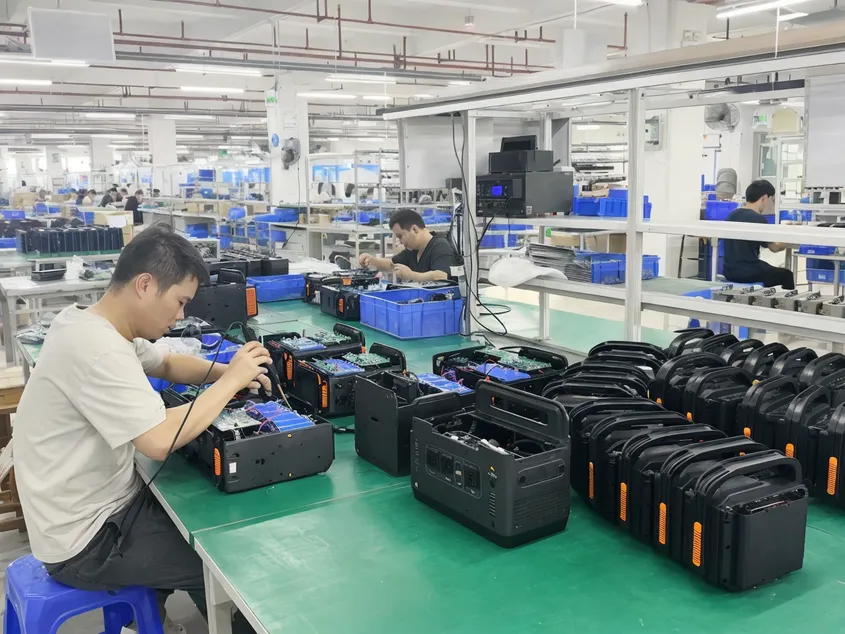
Explore More Portable Solar Battery Products
Portable Solar Battery Power Station
Higher-capacity stations for off-grid and backup power applications.
ProductPortable Solar Battery Kit
Bundled panel-and-battery kits for retail and distributor channels.
ProductPortable Solar Battery for Camping
Rugged, lightweight packs designed for outdoor and recreation markets.