

Container Solar Battery Storage Engineered at the Cell Level
LiFePO4 battery systems sized, matched, and tested for commercial, industrial, and off-grid projects from 100kWh upward. We build the packs and BMS; you get a containerized system with documentation ready for your destination market.
Not assembled from catalog parts.
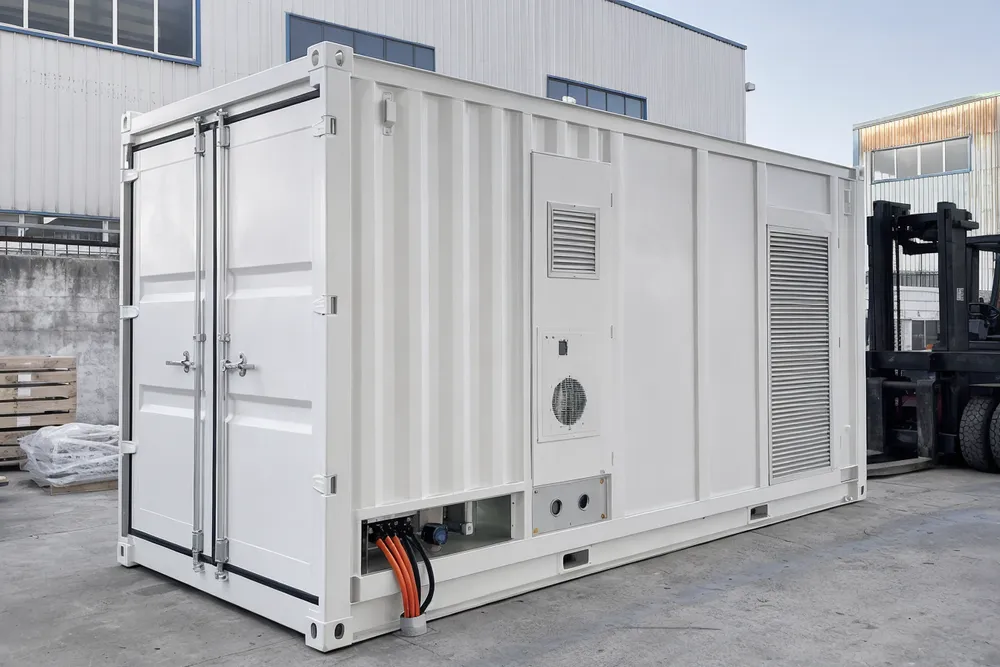
Container Solar Battery Storage for Project-Scale Orders
Container solar battery storage is where our production capability meets your project scope. When a job calls for hundreds of kilowatt-hours in a single enclosure — pre-wired, thermally managed, and shipped as one unit — you're no longer buying batteries off a catalog. You're buying a configured system that needs cell-level engineering, BMS coordination, safety integration, and export logistics handled by the same team.
We are a container solar battery storage manufacturer that controls the battery side of that equation: LiFePO4 cell procurement and incoming inspection, automated cell sorting and matching, pack assembly, BMS design and programming, lifecycle testing, and dangerous-goods export documentation. We don't manufacture inverters, PCS units, or container shells — we focus on what goes inside and how it communicates with what's outside. That focus is what keeps your commissioning clean.
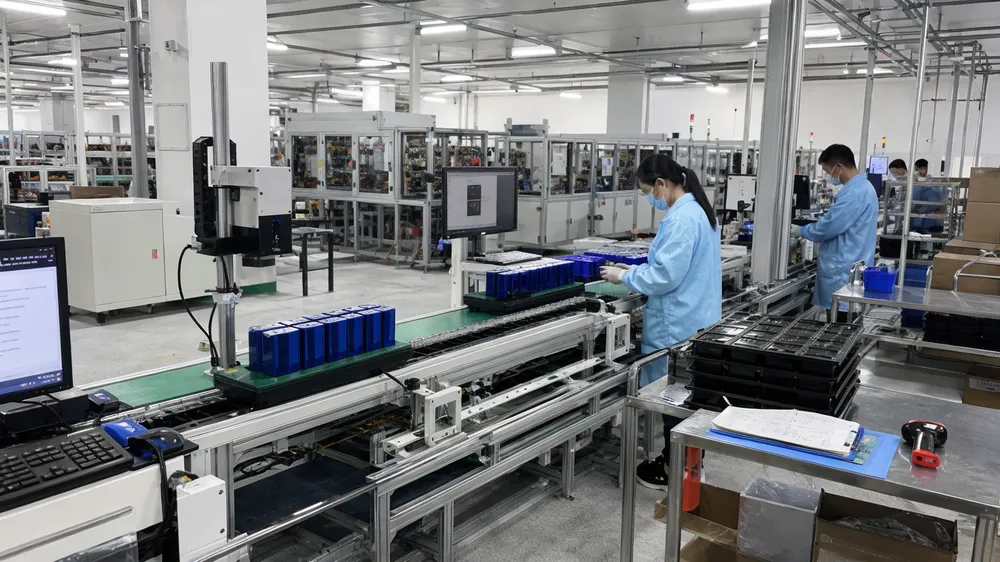
Our 9,900m² facility in Zhongshan runs 6 production lines with 150 employees and 18+ engineers dedicated to battery pack and BMS development. Annual capacity is 2,000,000 battery units. For container projects, the relevant number is engineering bandwidth — we can run your project-specific configuration through design, prototyping, batch testing, and production without pulling resources from standard product lines.
Send Your Project SpecificationsCell-Level Control
LiFePO4 cell procurement, incoming inspection, automated sorting and matching — every cell is graded before it enters a pack.
BMS Design & Programming
In-house BMS development tuned to your system architecture — not a generic off-the-shelf board with default parameters.
Lifecycle Testing
Pack assembly followed by full lifecycle validation — capacity, thermal, and safety testing before the system leaves the factory.
Export Documentation
Dangerous-goods export paperwork handled in-house — UN38.3 test summaries, MSDS, and shipping declarations for your destination market.
When Container Storage Beats Rack Modules
The decision between rack-mounted batteries and a containerized system is not about capacity alone — it's about site conditions, project schedule, and total installed cost.
When Rack Modules Still Work
Rack-mounted 48V/51.2V modules work well for commercial installations up to roughly 100–200kWh where you have an existing electrical room, standard 19-inch cabinet space, and a controlled indoor environment. You add modules as needed, the building provides climate control, and commissioning is straightforward.
See our rack mounted solar battery product line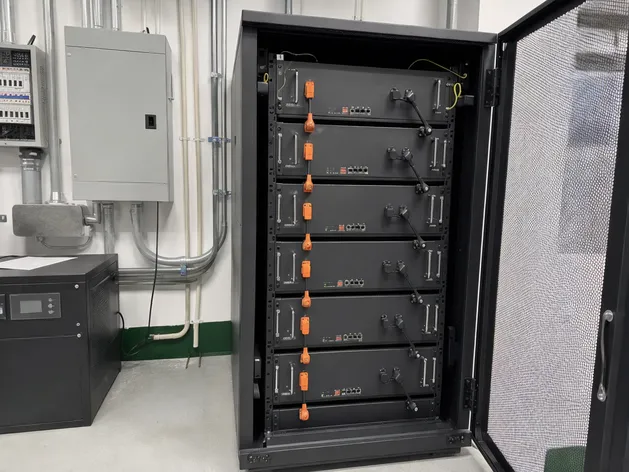
Container Storage Becomes the Practical Choice When:
No Battery Room Exists
The site is a greenfield, a rooftop, or an outdoor industrial yard with no indoor space allocated for batteries.
Capacity Exceeds 100–200kWh
At this scale, the number of rack modules, cabling runs, and individual BMS units creates coordination complexity that a pre-integrated enclosure eliminates.
Deployment Speed Matters
A containerized system arrives pre-wired and pre-tested, so your site commissioning drops from weeks to days.
Centralized Safety Systems Required
Fire suppression, HVAC, gas detection, and emergency disconnect are easier to engineer into a single enclosure than to retrofit across a room full of racks.
Remote or Off-Grid Project
Container format survives transport to sites where building infrastructure doesn't exist yet.
For large scale solar battery storage projects, the commercial solar battery storage system format you choose determines your installation labor, commissioning risk, and project timeline. Container storage front-loads engineering cost but compresses everything downstream.
(We've seen projects switch from rack to container mid-design because the site survey revealed no suitable indoor space — that switch costs less pain when your battery supplier handles both formats.)
Get a Quote for Container or Rack-Mounted Storage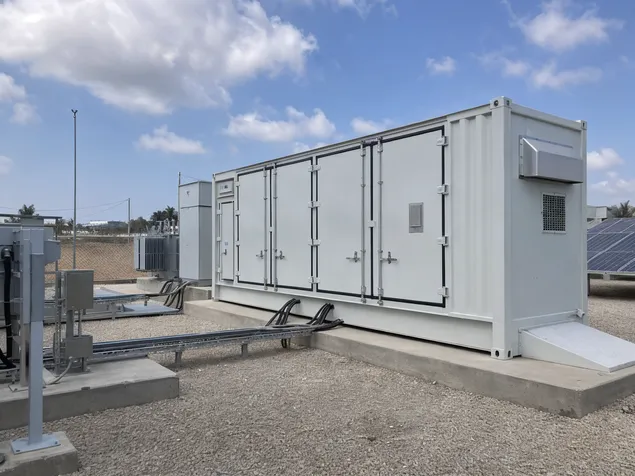
Project Scope and Specification Table Buyers Can Price Against
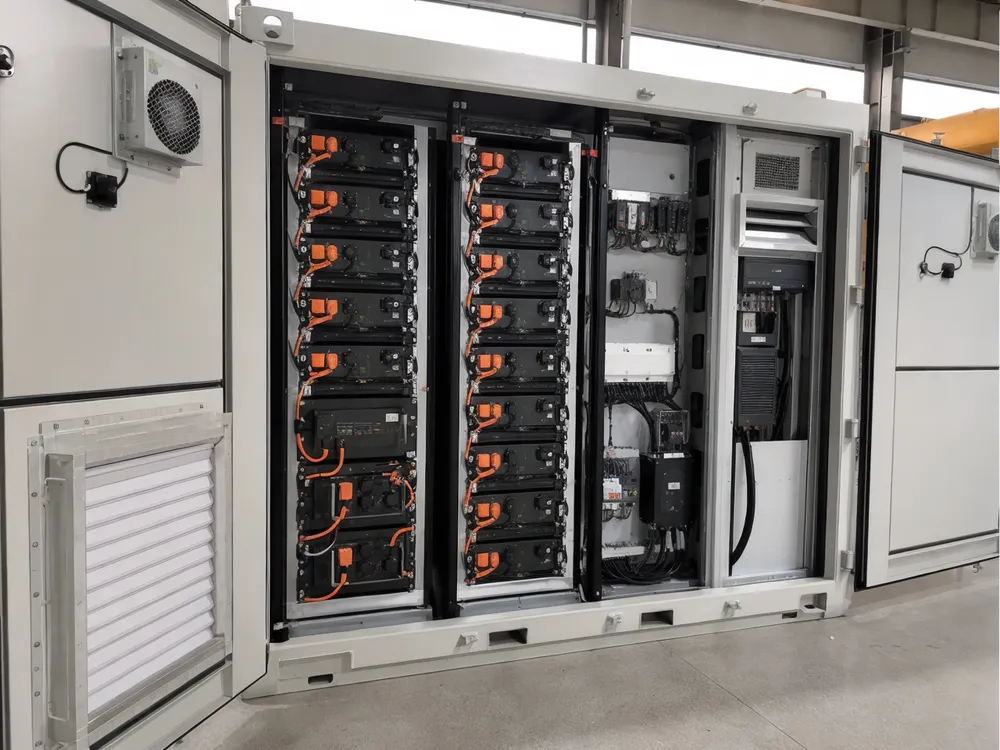
Container solar battery storage specifications are project-dependent — two systems with the same kWh target can differ significantly in rack layout, cooling design, BMS architecture, and communication interface based on site conditions and inverter selection.
The table below shows the specification framework we engineer within. Use it to confirm that our capability range covers your project, then send us your site data for exact configuration.
| Parameter | Typical Range / Direction |
|---|---|
| Cell Chemistry | LiFePO4 (lithium iron phosphate) |
| Container Size | 10ft, 20ft, 40ft — selected based on capacity target and site access constraints |
| System Capacity | 100kWh to 5MWh+ (project-dependent, scalable by container count) |
| DC Voltage Platform | 512V, 614V, 768V, 1024V, or higher — matched to PCS/inverter input requirements |
| Module Configuration | 51.2V / 100-280Ah rack modules, series/parallel arrangement per system voltage |
| BMS Architecture | Cell-level monitoring → module BMS → rack BMS → system-level master BMS |
| Communication Interface | CAN bus, RS485 — configurable for target PCS/EMS platform protocol |
| Thermal Management | Forced-air or liquid cooling, HVAC integration for hot/cold climate operation |
| Fire Suppression Interface | Aerosol, gas-based, or liquid system mounting provisions — type selected per local code |
| Enclosure Protection | IP54 or IP55 typical for outdoor deployment |
| Operating Temperature | -20°C to 55°C (discharge) / 0°C to 50°C (charge) — extended range with active cooling |
| Monitoring | Local HMI + remote monitoring via 4G/Ethernet, SNMP or Modbus TCP |
| Certifications (Battery Level) | ISO 9001:2015, CE, IEC 62133, UN38.3, MSDS |
Note: Specifications shown represent our engineering capability range for industrial solar battery storage projects. Final system specifications are confirmed through engineering review based on your project data — capacity target, PCS/inverter brand, site environment, and destination market requirements.
Contact us for a detailed project data sheetWhat We Configure
Battery-side architecture — cell arrangement, BMS parameters, communication protocol, and rack layout.
PCS/Inverter Coordination
PCS/inverter selection must match the project's grid code and power requirements. We'll coordinate with your PCS supplier on communication protocol and DC voltage interface to ensure clean integration.
Capacity Sizing Data That Changes the Quote
Two projects requesting "500kWh container storage" can require fundamentally different engineering — different cell grades, different cooling capacity, different BMS settings, and different landed costs. The variables that drive the difference:
Daily Cycle Count and C-Rate
A peak-shaving system cycling 1-2 times daily at 0.5C uses standard-grade cells and passive cooling. A frequency-regulation or EV-charging buffer cycling 4-6 times daily at 1C needs higher-grade cells with tighter capacity matching and active liquid cooling to maintain cycle life.
The cell cost difference alone can be 15-25%.
Ambient Temperature Range
A system deployed in the Middle East at 45°C+ ambient needs significantly more cooling capacity than one installed in Northern Europe. Undersizing the HVAC means accelerated cell degradation.
We've seen projects lose 20% capacity in 18 months because the thermal design was based on datasheet numbers rather than actual site conditions.
Backup Duration vs. Power Output
A 500kWh system providing 4 hours of backup at 125kW output is a different design than a 500kWh system providing 1 hour at 500kW.
The second needs heavier busbars, larger contactors, and a BMS configured for higher continuous current.
What We Need From You to Size Accurately
- Target energy capacity (kWh) and output power (kW)
- Daily cycle count and expected duty profile
- Backup duration requirement (if applicable)
- Solar array size and PCS/inverter brand (if solar-coupled)
- Site ambient temperature range (summer peak, winter low)
- Indoor or outdoor installation
- Destination country and applicable grid/safety codes
- Project timeline and quantity
Accurate sizing upfront means fewer change orders, cleaner budget approval on your end, and a commissioning process that matches the engineering documentation.
Market Segments Where Container Storage Protects Project Margin
Container solar battery storage is not a single product — it's a delivery format that serves different commercial logic depending on the market segment. Here's where we see our buyers deploying containerized systems and why the format protects their project economics:
Commercial & Industrial Peak Shaving and Backup
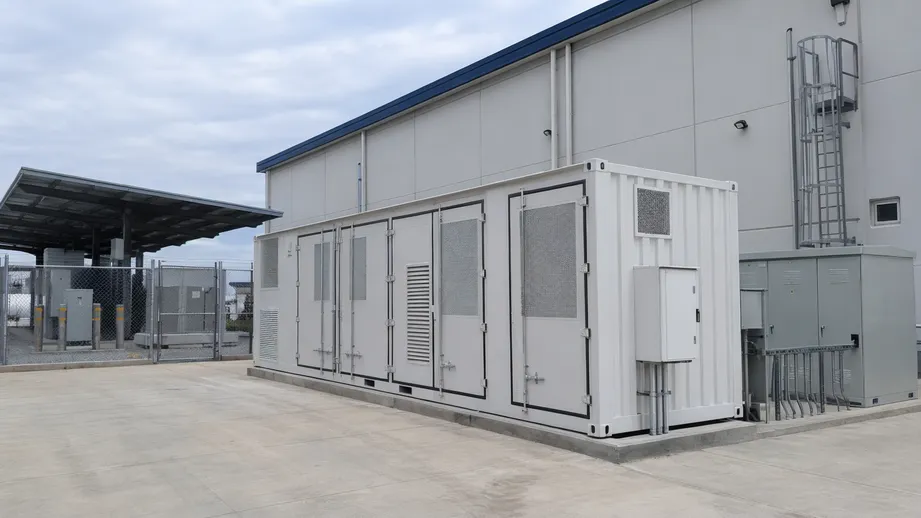
Factories, warehouses, and commercial buildings with demand charges or unreliable grid supply. Container storage sits outside the building, charges from solar or off-peak grid, and discharges during peak demand windows.
For you as the project supplier, the containerized format means one delivery, one commissioning event, and one warranty scope — not a room full of individual rack modules each with their own potential failure point.
Microgrids and Off-Grid Communities
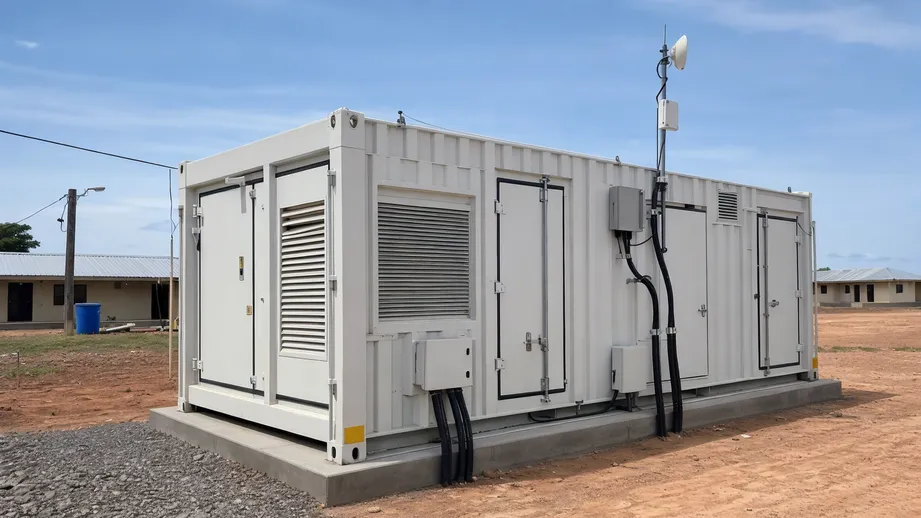
Remote communities, island installations, and mining camps where diesel generator runtime directly eats project margin. Every kWh the battery displaces is measurable fuel savings.
Container format is essential here because there's no building infrastructure — the battery arrives as a self-contained unit that needs only a concrete pad, cable connections, and communication hookup.
We've shipped LiFePO4 packs to African and Southeast Asian off-grid projects where the container itself becomes the battery room.
Telecom and Critical Infrastructure
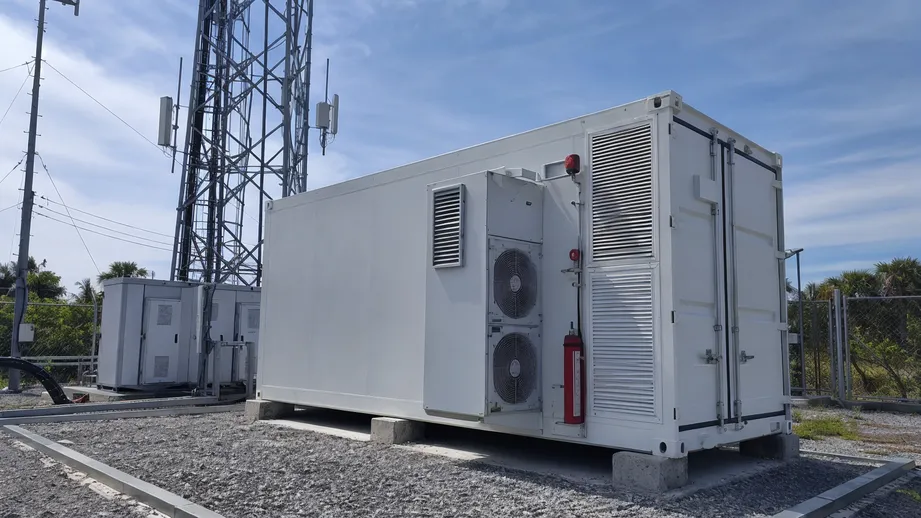
Base stations, data centers, and water treatment facilities where downtime has contractual penalties. These sites need unattended operation with remote monitoring and predictable maintenance cycles.
The containerized format with integrated HVAC and fire suppression gives you a sealed, monitored environment that doesn't depend on building maintenance.
Solar-Plus-Storage and Large Distributed Generation
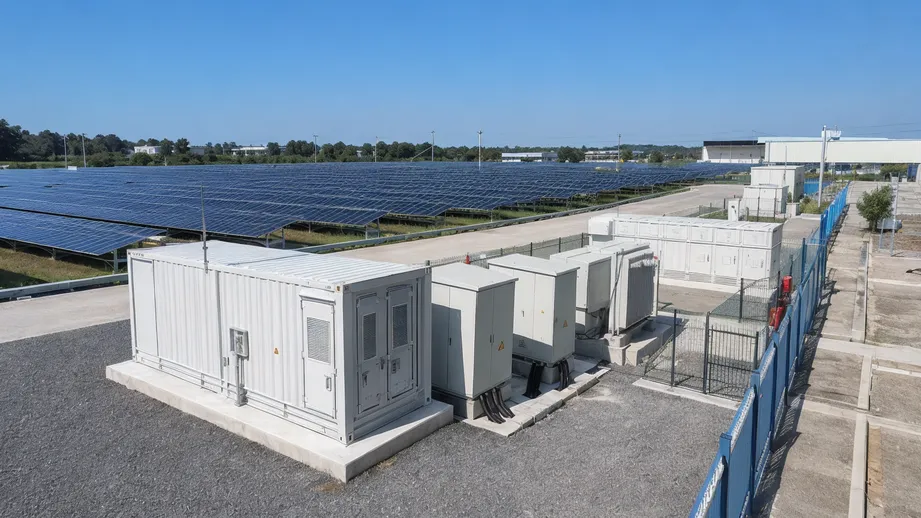
Utility-adjacent projects and large commercial rooftop installations where storage supports output smoothing, ramp-rate control, or self-consumption optimization.
Container storage at this scale lets you bid projects with a single battery supplier relationship rather than coordinating multiple rack vendors.
EV Charging Buffer Storage
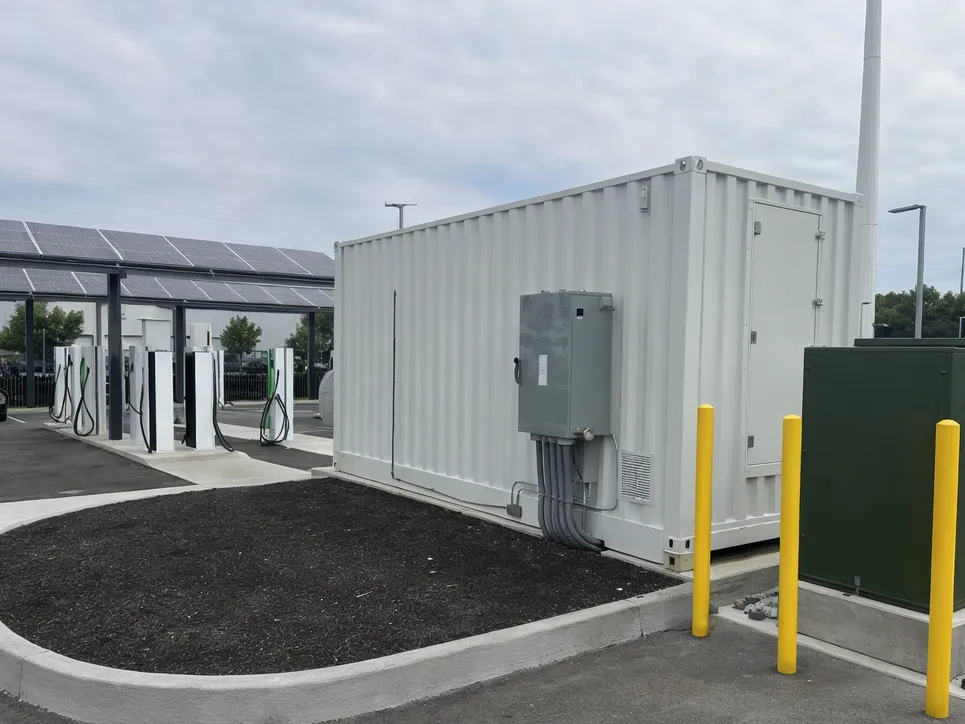
Sites where grid capacity can't support fast-charger peak demand. The container charges slowly from grid or solar, then delivers high-power bursts to chargers.
This segment is growing fast — if you're building EV infrastructure, buffer storage is becoming a standard project component.
This segment has grown significantly for industrial solar battery storage suppliers over the past three years — worth building into your project pipeline.
For smaller commercial projects under 100kWh, our commercial solar battery storage in 48V rack format may be a better fit for your bid.
Integration Details That Reduce Commissioning Risk
The difference between a container that commissions in three days and one that takes three weeks usually comes down to how well the battery side was engineered for the specific PCS, site conditions, and communication requirements. Here's what we control and how it connects to your project timeline:
Battery Rack Layout and DC Architecture
Modules are arranged in series strings to reach the target DC bus voltage, with parallel strings for capacity. We design the rack layout for thermal uniformity — cells in the center of a container run hotter than those near the walls, so airflow paths and rack spacing are planned to keep temperature delta below 5°C across the system.
Why this matters: Uneven temperature distribution is the number-one cause of capacity divergence between strings after 12 months of operation.
BMS Hierarchy and Protection Coordination
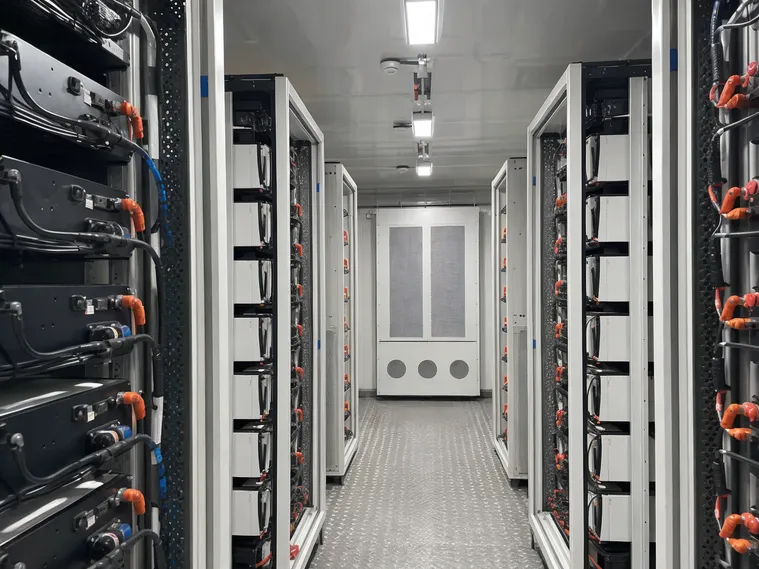
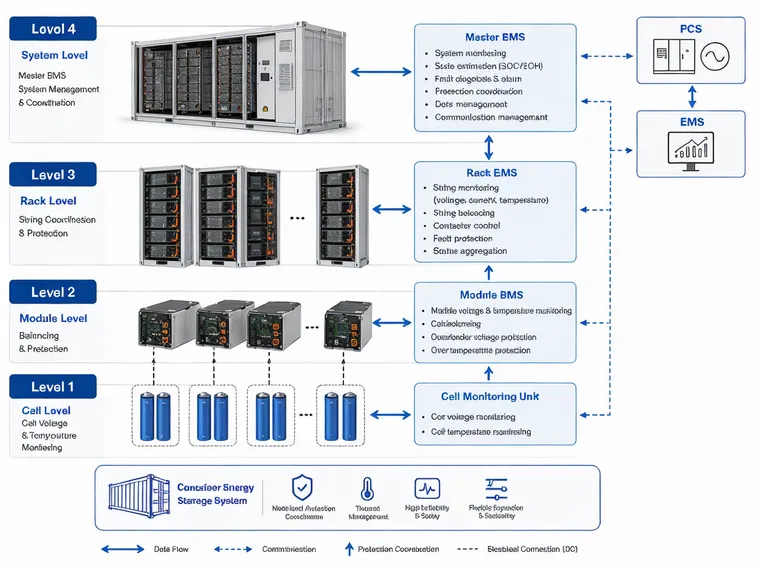
Our BMS architecture runs four levels:
Cell-level voltage and temperature monitoring
Module-level balancing and protection
Rack-level string coordination
System-level master BMS interfacing with PCS/EMS
Each level has independent protection — if the system-level communication fails, rack-level protection still prevents damage. We program protection thresholds based on the actual cell grade and expected duty cycle, not generic defaults.
Communication Protocol Configuration
The master BMS communicates with your PCS or EMS via CAN bus or RS485. Protocol details — register mapping, data refresh rate, alarm codes, and state-of-charge reporting method — must match your PCS supplier's requirements.
We configure this during engineering review, not during site commissioning.
Send us your PCS brand and communication specification, and we'll pre-program the interface before the system ships.
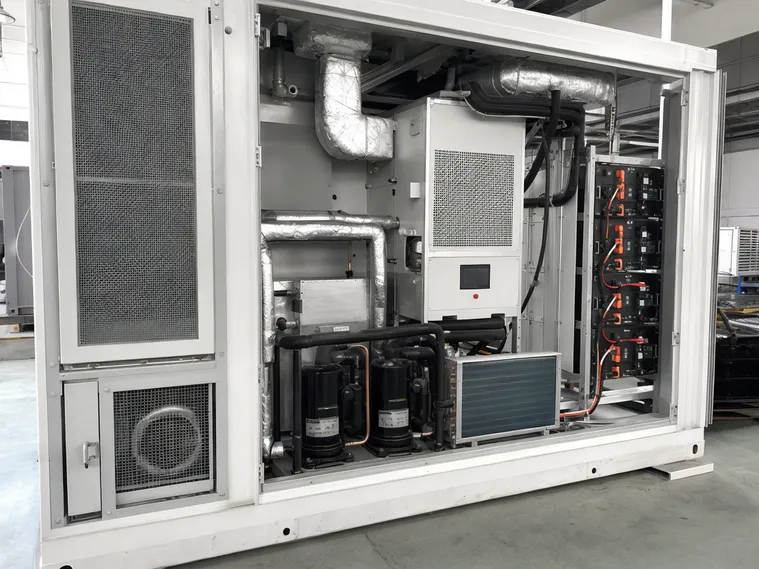
Thermal Management Planning
Hot climates (ambient above 35°C sustained): Industrial HVAC with redundant compressors.
Cold climates (below -10°C): Heating elements activate to maintain minimum charge temperature.
The thermal system sizing is based on your site's actual temperature data, not a generic "works from -20 to 55°C" claim.
Most expensive mistake in container storage: Undersized cooling doesn't show up at commissioning — it shows up 18 months later as accelerated capacity fade.
Safety Systems Interface
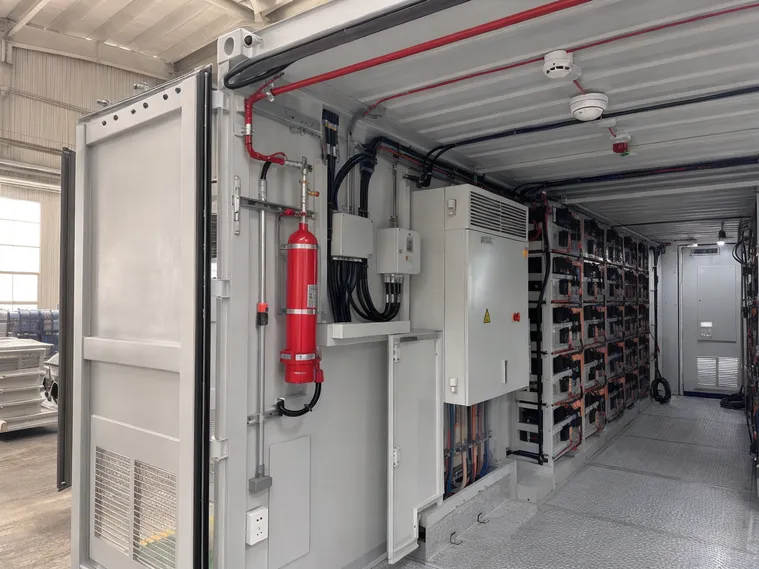
Fire suppression, gas detection, smoke detection, and emergency disconnect are planned into the container layout during engineering. We provide mounting provisions, cable routing, and BMS alarm triggers for the safety systems.
The specific suppression type (aerosol, clean agent, liquid) depends on your local fire code requirements.
We don't claim certifications we don't hold, but we design the battery side to interface cleanly with whatever safety system your project specifies.
Manufacturing Precision That Reduces Site Surprises
Our automated cell sorting (within 20mV and 5mΩ across each pack), in-house BMS design, and full lifecycle testing on every production batch mean the battery side arrives at your site performing exactly as the engineering documentation describes.
Fewer surprises at commissioning means your project stays on schedule.
Customization Boundaries Before Engineering Starts
Container solar battery storage is project-engineered by nature — there's no "standard container" that fits every site. Here's what we can configure and where the boundaries sit.
What We Configure Directly
-
Capacity and rack count: From 100kWh single-rack systems in 10ft containers to multi-MWh installations in 40ft enclosures or multi-container arrays
-
Battery module specification: Cell capacity (100Ah, 200Ah, 280Ah cells), module voltage, and series/parallel arrangement to match your DC bus requirement
-
BMS parameters: Protection thresholds, balancing strategy, communication protocol, alarm mapping, and SOC calculation method — all programmed to your project specification
-
Communication interface: CAN, RS485, Modbus RTU/TCP — configured to match your specific PCS or EMS platform
-
Rack layout and cable routing: Optimized for your container size, thermal management approach, and maintenance access requirements
-
Labeling and documentation: Your brand, your language, your market's regulatory labeling requirements
-
Export documentation package: UN38.3, MSDS, CE declarations, packing lists, and shipping declarations formatted for your destination port
What Requires Your Project Data
-
PCS/inverter compatibility: We need your PCS brand, model, and communication specification to configure the DC voltage and protocol interface
-
Local grid and safety codes: Fire suppression type, grounding requirements, and disconnect specifications depend on your installation country's regulations
-
Thermal design: Requires actual site temperature data (not just "tropical" or "cold climate")
-
Container shell specification: If you're sourcing the container separately, we need internal dimensions and mounting point locations. If you want us to coordinate container procurement, we need your site access constraints (door orientation, lifting points, transport route width)
-
Final certification pathway: If your market requires system-level certification beyond our component-level CE/IEC 62133, we support the testing process but the certification scope depends on the complete system configuration
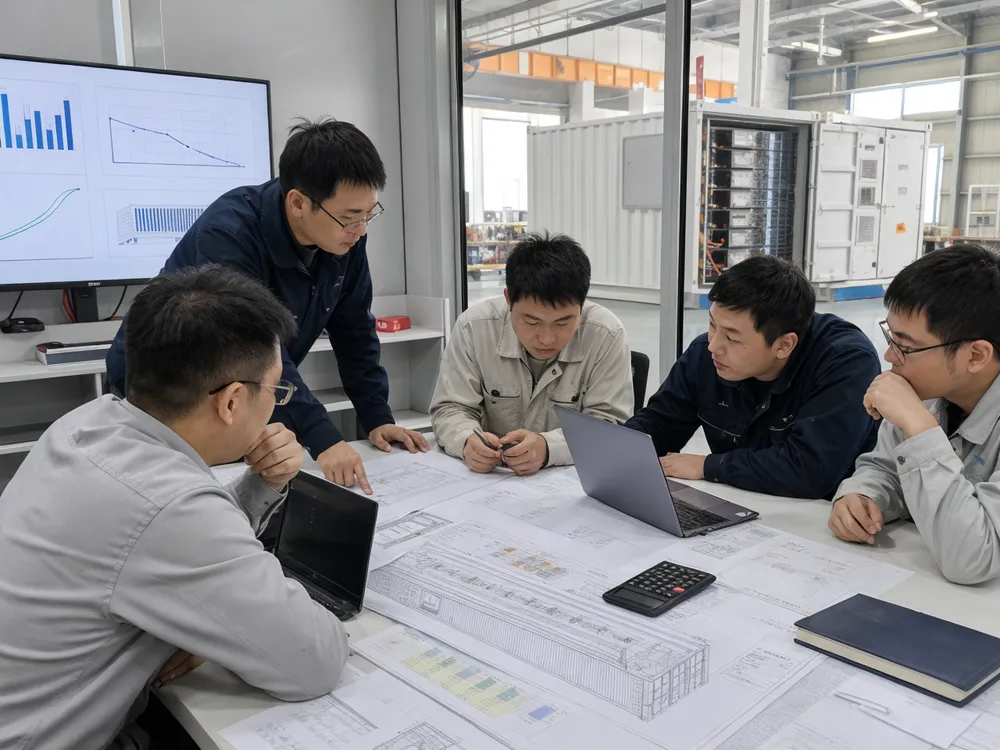
Our 18-engineer R&D team handles OEM/ODM container storage projects from specification through production validation. The difference from standard battery orders: container projects need more upfront data exchange before we can quote accurately.
That data exchange is the engineering review — it's not a sales step, it's a technical step that prevents expensive changes later.
Testing, Compliance, and Export Logistics for Battery Containers
Shipping large-format LiFePO4 systems internationally involves three risk areas that overlap: battery safety compliance, transport documentation, and physical logistics. We handle all three as part of the project scope.
Certifications We Hold (Battery Level)
Manufacturing management system, covering process control, traceability, and corrective action
European market conformity for battery products
Safety testing for portable and stationary lithium battery cells and packs
Transport safety testing — altitude simulation, thermal cycling, vibration, shock, short circuit, impact, overcharge, forced discharge
Material safety documentation for all battery chemistries we produce
For system-level certifications (IEC 62619 for stationary storage, UL 9540A for thermal runaway, local grid codes), we support the testing and documentation process. These certifications depend on the complete system configuration — container, BMS, safety systems, and PCS integration — so they're project-specific rather than catalog-level. We'll tell you upfront what documentation pathway your destination market requires and what testing support we provide.
Batch-Level QC for Container Projects
Every cell batch goes through our standard QC sequence — incoming inspection, automated sorting and matching (within 20mV/5mΩ), BMS protection verification, capacity testing, charge/discharge cycling, temperature testing, and safety checks.
For container projects, we add system-level integration testing:
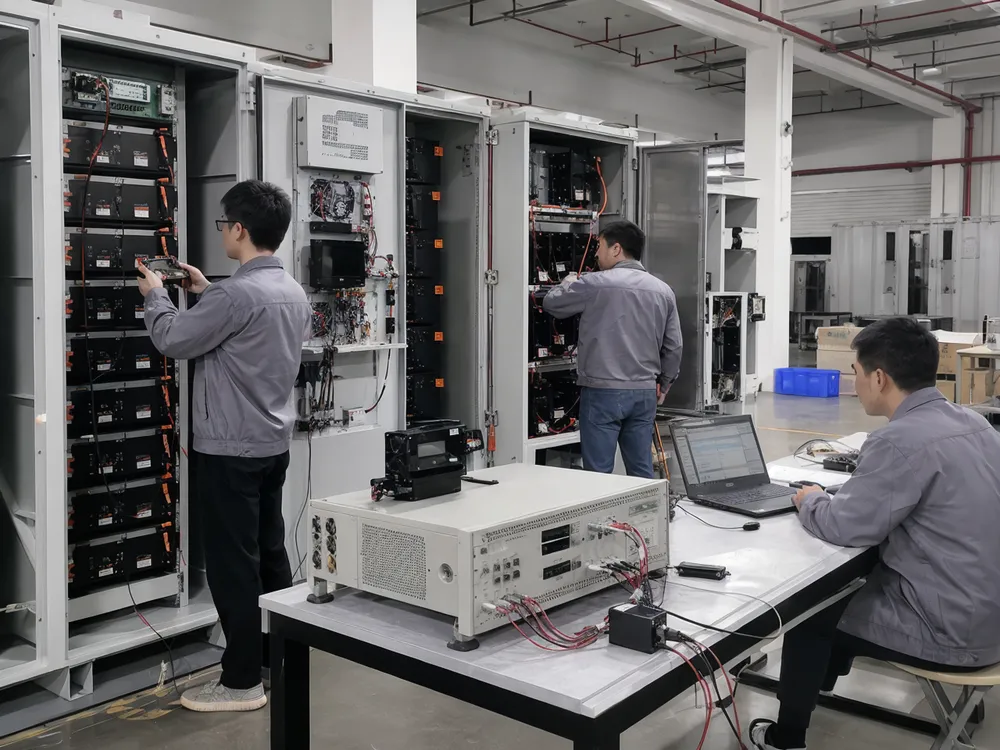
- String balancing verification
- Communication protocol validation with a PCS simulator
- Thermal system function check before the racks leave our factory
We run the PCS communication test on a simulator because your actual PCS isn't in our factory — but the protocol behavior is identical. This catches register mapping errors and alarm code mismatches before the system ships, not during site commissioning.
Export Documentation and Dangerous Goods Handling
LiFePO4 batteries are Class 9 dangerous goods for sea freight. Your shipment requires:
We maintain all documentation for our standard cell and module configurations. For container projects, we prepare the complete documentation package as part of the project deliverable — you receive it with the shipping notification, not as an afterthought when your freight forwarder asks for it.
Physical Logistics Planning
Container battery systems are heavy — a fully loaded 20ft container can exceed 15 tonnes. Your site needs:
We provide weight distribution data, lifting point specifications, and foundation loading requirements as part of the engineering package.
If your site has access constraints (narrow roads, low overhead clearance, limited crane reach), tell us during the engineering review — it affects container orientation and door placement.
Choose the Right EVANBattery Storage Format
Not every project needs containerized storage. Here's how our solar battery storage product families map to different project scales and site conditions:
| Storage Format | Best Fit | Capacity Range | Site Requirement |
|---|---|---|---|
| Solar Battery Backup | Residential and light-commercial backup programs | 5–30 kWh per unit | Indoor wall or floor mounting |
| Rack Mounted Solar Battery | Commercial buildings with existing electrical rooms | 10–200 kWh modular | Indoor rack cabinet space, climate-controlled |
| Solar Battery Bank | Off-grid systems, solar home kits, telecom backup | 1–50 kWh per bank | Ventilated indoor space or battery enclosure |
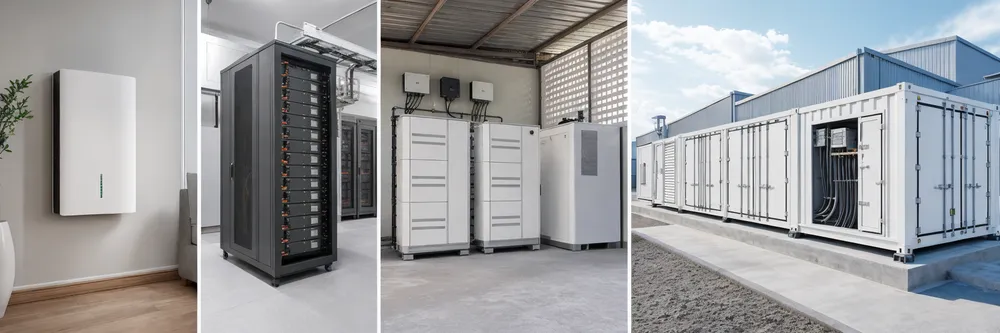
| Container Solar Battery Storage | C&I, microgrid, off-grid, utility-adjacent projects | 100 kWh to multi-MWh | Outdoor pad, crane access, cable routing |
Decision Logic
The decision logic is straightforward: if you have indoor space and need under 200 kWh, rack-mounted modules give you flexibility and lower upfront engineering cost. If you need more capacity, have no indoor space, or want a single-delivery commissioning event, container storage is the format.
Multi-Scale Catalog Strategy
If you're building a commercial solar battery storage system catalog that spans multiple project scales, carrying both rack-mounted and container options lets you bid a wider range of projects without subcontracting the battery scope.
Procurement FAQ for Container Solar Battery Storage
Answers to the questions procurement teams and system integrators ask most during the quoting and engineering review process.
When should you choose container solar battery storage instead of rack-mounted batteries?
When your project exceeds 100–200 kWh, when no suitable indoor battery room exists, or when you need a single-delivery commissioning event. Container format also makes sense for remote sites where building infrastructure isn't available — the container IS the battery room. If you have an existing electrical room with rack space and need under 200 kWh, rack-mounted solar battery is simpler and cheaper to deploy.
What project data is needed to size a container solar battery storage system?
At minimum: target energy capacity (kWh), output power requirement (kW), daily cycle count, backup duration, PCS/inverter brand and model, site ambient temperature range, indoor/outdoor placement, destination country, and project timeline.
The more data you provide upfront, the more accurate the first-round quote — and the fewer revision cycles before production.
How does BMS communication affect PCS or inverter compatibility?
The master BMS communicates system state (SOC, voltage, current, temperature, alarms) to the PCS via CAN or RS485. If the register mapping, data format, or refresh rate doesn't match the PCS expectations, the system either won't start or will operate in degraded mode.
We pre-configure the communication protocol to match your specific PCS during engineering review — send us the PCS communication specification document and we'll validate compatibility before production.
What safety systems should be planned for industrial solar battery storage?
At minimum: smoke detection, gas detection (for thermal runaway early warning), fire suppression (type per local code — aerosol, clean agent, or liquid), emergency disconnect (manual and BMS-triggered), and ventilation for gas evacuation.
We design the battery-side interface — BMS alarm triggers, cable routing provisions, and mounting space — for whatever safety system your local fire code requires. The specific suppression equipment is typically sourced locally to meet regional certification.
What certifications and documents are needed for importing battery containers?
For most markets: UN38.3 transport test summary, MSDS, and CE declaration cover the battery components. Sea freight requires Class 9 dangerous goods documentation per IMDG code.
Some markets require additional system-level certifications (IEC 62619, UL 9540A, local grid connection approvals) — these depend on the complete system configuration and destination country. We provide all battery-level documentation and support system-level certification testing where required.
Can EVANBattery customize container storage for different climates or site layouts?
Yes — thermal management, rack layout, cable routing, and container orientation are all project-specific. For hot climates we specify higher-capacity HVAC with redundant compressors. For cold climates we add heating elements and insulation. For constrained sites we adjust door placement, lifting points, and service access orientation.
Send us your site temperature data and access constraints during the engineering review phase.
Ready to Scope Your Container Storage Project?
Send your project data — capacity, power, site conditions, PCS model — and get a practical engineering quote tailored to your deployment.
Get a Container Storage QuoteSend Project Data for a Practical Engineering Quote
Container solar battery storage quotes are engineering exercises, not catalog lookups. The more complete your project data, the faster we return a configuration that matches your actual requirements — and the fewer revision cycles before production starts.
Phone / WhatsApp
+86 13560690838Include in Your Inquiry
-
Target energy capacity (kWh) and output power (kW)
-
Daily cycle count and duty profile (peak shaving, backup, frequency regulation)
-
PCS/inverter brand, model, and communication specification
-
Site ambient temperature range (summer peak and winter low)
-
Indoor or outdoor installation; available footprint and access constraints
-
Destination country and applicable grid/safety codes
-
Project quantity (single system or multi-site rollout)
-
Timeline from order to required site delivery
-
Documentation and certification requirements for your market
What You'll Receive
We'll respond with a technical recommendation covering system architecture, rack layout direction, BMS configuration, thermal management approach, documentation availability, and pricing based on your actual project scope.
Explore More Storage Formats
Find the right configuration for your project scale and site requirements.