

Hybrid Solar Battery Inverter-Matched LiFePO4
48V/51.2V LiFePO4 modules with CAN bus and RS485 protocol matching — built to pair with your target hybrid inverter, reduce commissioning failures, and ship as a repeatable SKU.
Factory-programmed BMS communication for grid-tied residential and light commercial storage.
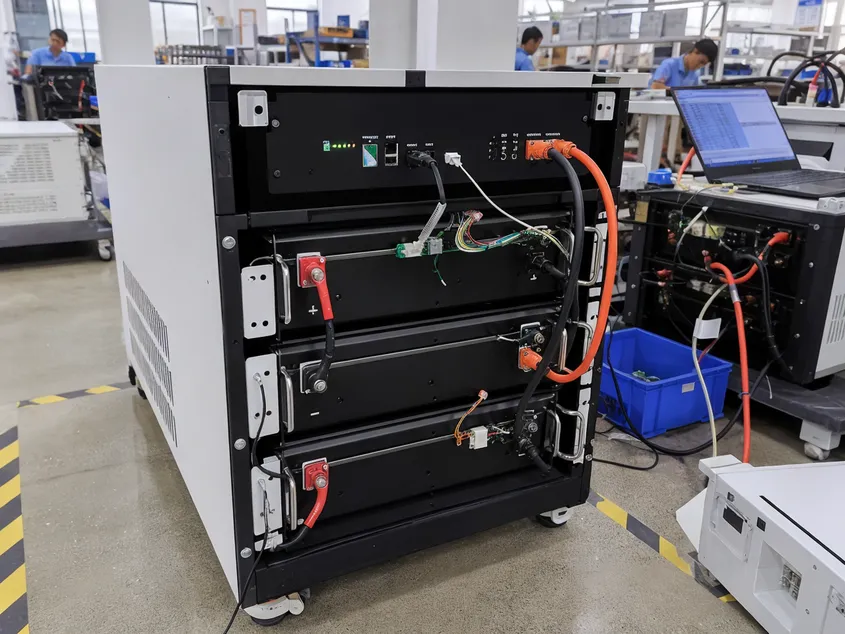
Hybrid Solar Battery for Inverter-Matched Grid-Tied Storage
A hybrid solar battery is a LiFePO4 battery pack with an integrated BMS designed to communicate with a hybrid inverter — storing daytime PV generation, discharging during peak tariff windows, and switching to backup mode during grid outages. We manufacture the battery and BMS. We don't make panels or inverters.
What separates a hybrid solar battery from a generic storage pack is the communication layer. Your hybrid inverter needs real-time data — state of charge, cell voltages, temperature, charge/discharge permissions — delivered over CAN bus or RS485 in the exact protocol format it expects. When that communication works cleanly, your installer commissions the system in 30 minutes. When it doesn't, you get callbacks, truck rolls, and warranty disputes that eat your margin.
We build these packs specifically for grid-tied solar battery storage programs where the battery must actively participate in energy management — not just sit idle waiting for an outage. If your market sells self-consumption, time-of-use arbitrage, or backup-plus-grid operation, this is the product route that fits.
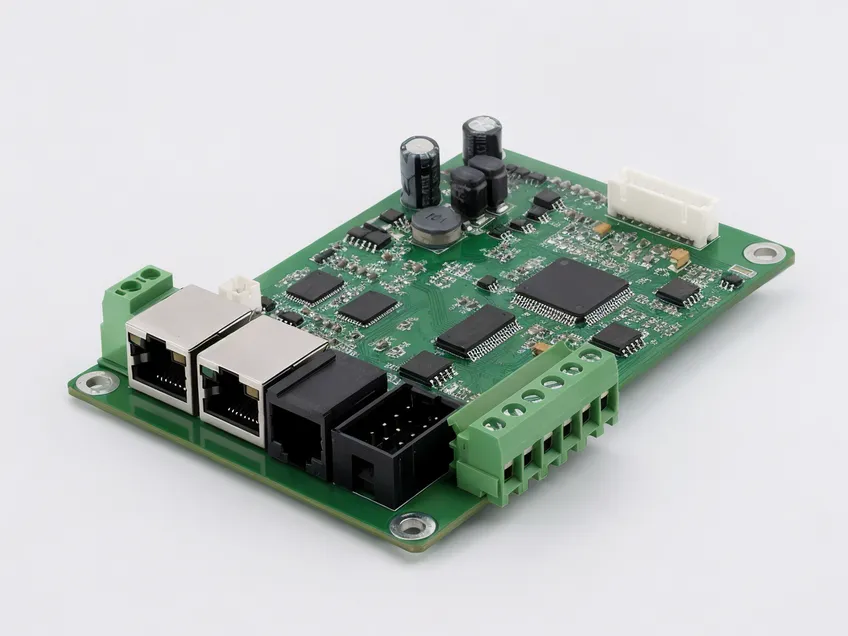
Real-Time BMS Communication
State of charge, cell voltages, temperature, charge/discharge permissions — delivered over CAN bus or RS485 in the exact protocol format your inverter expects.
Active Energy Management
Not idle backup — actively participates in PV storage, peak shaving, and grid interaction.
30-Min Commissioning
Clean protocol matching means your installer finishes fast — no callbacks, no truck rolls.
Where Hybrid Batteries Create Sellable Storage Programs
The hybrid solar battery isn't a single-use product — it's a platform for multiple market programs. Each one represents a repeatable revenue stream for your distribution or contracting business.
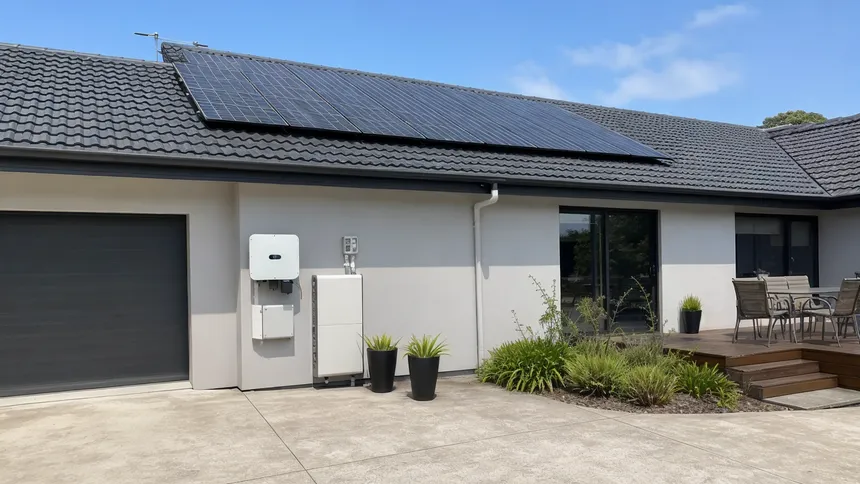
Residential Self-Consumption Markets
Europe, Australia, and parts of East Asia have feed-in tariffs low enough that homeowners save more by storing and using their own solar generation. Your customers buy a hybrid battery to maximize self-consumption ratios from 30% to 70-80%.
This is a high-volume, repeatable segment — once an installer validates the battery-inverter pairing, they reorder the same SKU for every job. Typical order patterns: 50-200 units per quarter from established channel partners.
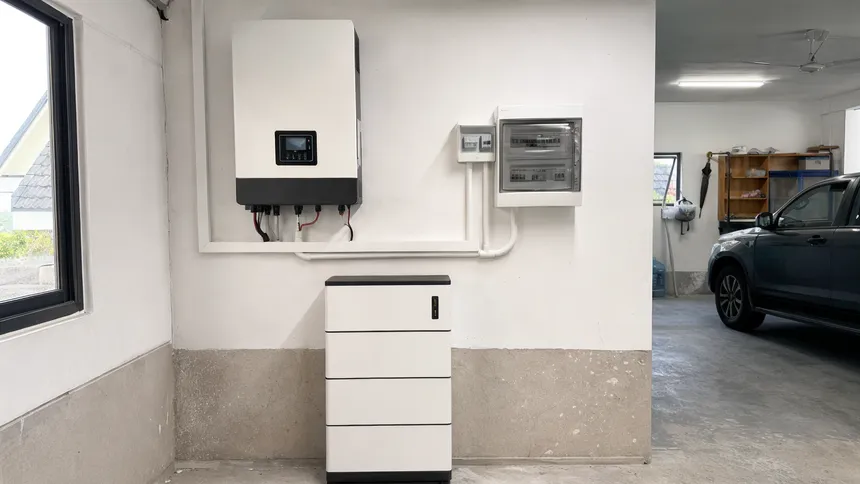
Backup-Plus-Grid Regions
South Africa, parts of Southeast Asia, and the Middle East have grids that work most of the time but fail often enough that backup is a selling point. A hybrid battery handles both — daily grid-tied operation with automatic backup switchover.
You sell one product that covers two value propositions, so your catalog stays lean and your inventory turns faster.
Time-of-Use Tariff Arbitrage
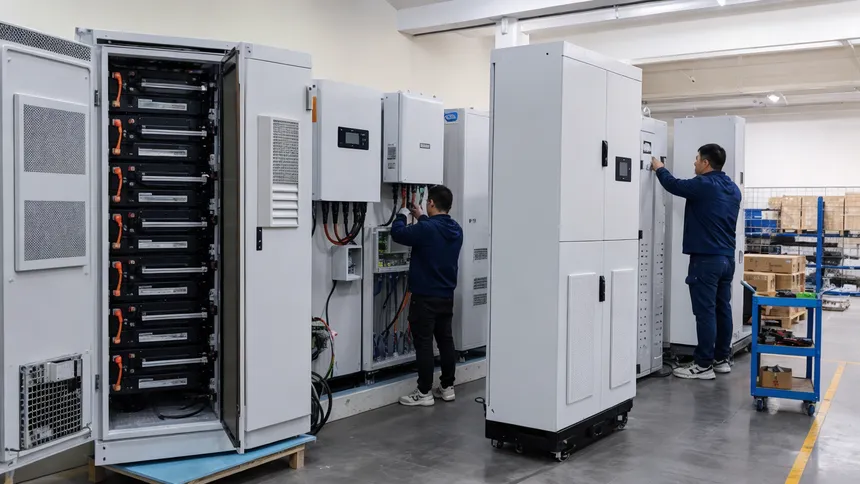
Markets with significant peak/off-peak price differentials (California, Germany, UK, Australia) create a financial case for grid-tied solar battery storage independent of backup needs. The battery charges from solar or cheap off-peak grid power and discharges during expensive peak hours.
Your buyers in these markets need BMS firmware that supports scheduled charge/discharge windows — we program those schedules into the BMS at the factory level.
Installer Retrofit Programs
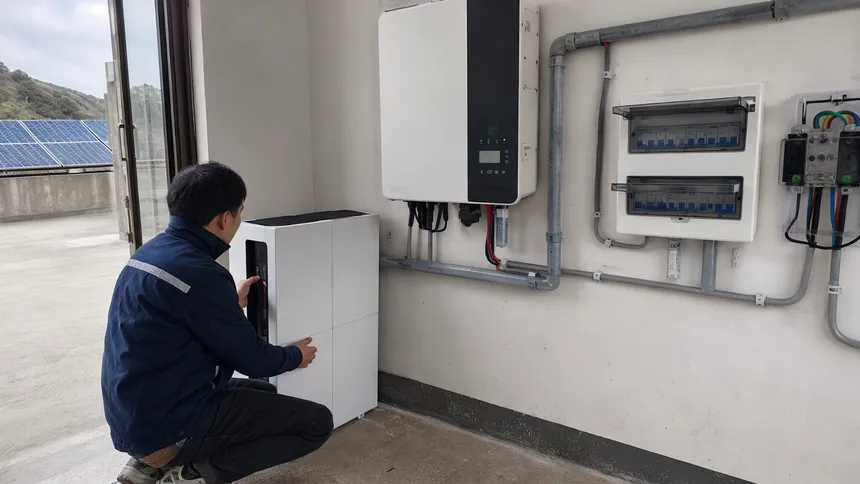
Existing solar PV installations without storage represent a retrofit opportunity. Installers adding a hybrid battery to an existing hybrid inverter need a pack that communicates correctly with equipment already in the field.
We maintain protocol configurations for major inverter brands, so your retrofit SKU works with installed base equipment without firmware guesswork.
Which market segments are you targeting?
Tell us your target markets — we'll recommend the configuration and MOQ that fits your channel.
Specification Data for Hybrid Inverter Comparison Sheets
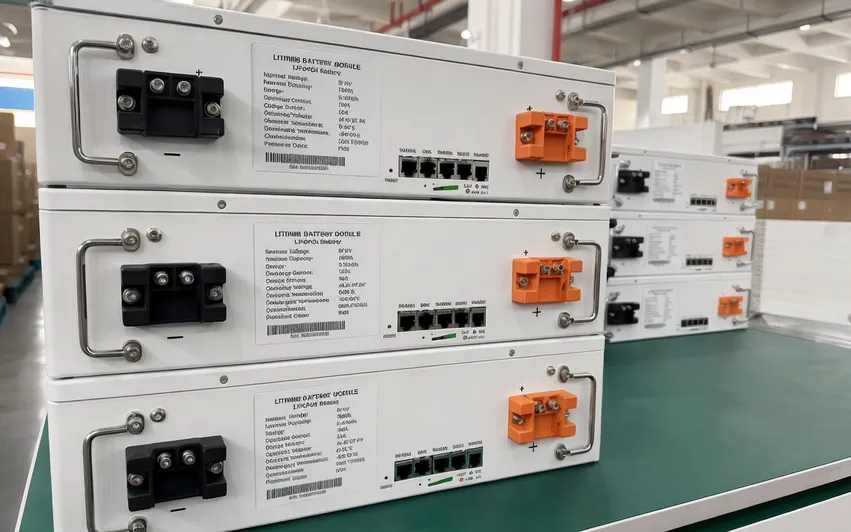
Your procurement team or project engineers need numbers they can drop directly into comparison sheets and project proposals. Here's what our standard hybrid solar battery range covers:
| Parameter | Standard/Typical Values |
|---|---|
| Cell Chemistry | LiFePO4 (lithium iron phosphate) |
| Nominal Voltage | 48V / 51.2V (16S configuration) |
| Capacity Range | 100Ah – 280Ah per module |
| Usable Energy | 5.12 kWh – 14.3 kWh per module |
| Max Continuous Charge/Discharge | 50A – 100A (model dependent) |
| Peak Discharge | Up to 150A for 30 seconds (model dependent) |
| Communication Protocol | CAN bus, RS485 (configurable per inverter brand) |
| BMS Protections | Over-charge, over-discharge, over-current, short-circuit, over-temperature, under-temperature, cell balancing |
| Cycle Life | 4,000 – 6,000 cycles at 80% DoD |
| Round-Trip Efficiency | ≥95% |
| Operating Temperature | -20°C to 55°C (discharge), 0°C to 45°C (charge) |
| Storage Temperature | -10°C to 45°C |
| Enclosure Options | Floor-standing, wall-mount, rack-mount (IP20 – IP65) |
| Expandability | Parallel connection up to 16 units (model dependent) |
| Certifications | CE, IEC 62133, UN38.3, MSDS |
| Weight Range | 45 kg – 120 kg (model dependent) |
Specifications shown are standard values across our hybrid battery range. Exact parameters depend on model selection and are confirmed in the quotation data sheet.
Matching Against a Specific Inverter?
These numbers are formatted for your comparison process. If you're matching against a specific hybrid inverter's battery compatibility list, send us the inverter model — we'll confirm which configuration meets its voltage window, charge current limits, and communication requirements.
Request a Detailed Spec SheetVoltage Note
The 51.2V nominal is 16 cells in series at 3.2V per cell. Some inverter brands specify "48V compatible" but actually require 51.2V nominal with a 44.8V–57.6V operating window. We match the exact voltage profile the inverter expects.
BMS Protocol Matching That Reduces Field Commissioning Calls
This is where most hybrid battery sourcing decisions succeed or fail. A battery with correct voltage and capacity but wrong communication protocol generates more after-sales cost than a battery that arrives with a dented enclosure. The enclosure is cosmetic — the protocol mismatch means the system doesn't work.
What the BMS Communicates to the Inverter
Every charge/discharge cycle, the BMS sends the hybrid inverter a continuous data stream:
The inverter uses this data to decide how much current to push into the battery, when to stop charging, and when to switch to grid power.
What Happens When Protocols Don't Match
If any of these data points arrive in the wrong format, at the wrong baud rate, or with the wrong register mapping, the inverter either ignores the battery entirely or misinterprets its state.
Common symptoms of protocol mismatch:
- SOC stuck at 0% or 100%
- Inverter refusing to charge
- Random disconnection events
- Inverter charging past the battery's safe voltage limit because it never received the "stop" command
How We Match Protocols
Our 18-engineer R&D team maintains protocol libraries for major hybrid inverter brands. When you place an order, you tell us: inverter brand, inverter model, communication interface (CAN or RS485), and target operating mode (self-consumption, backup, time-of-use, or all three).
We configure the BMS firmware to match that specific inverter's expected data frame structure, baud rate, byte order, and command set.
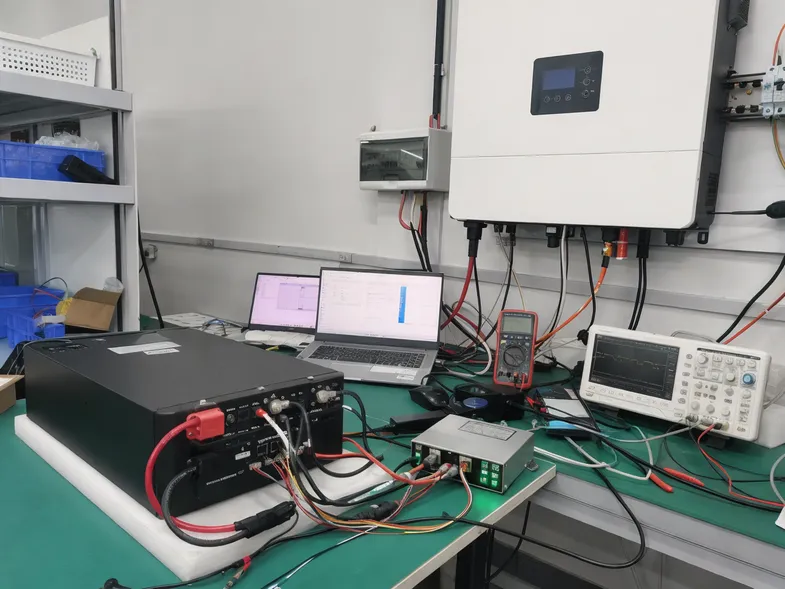
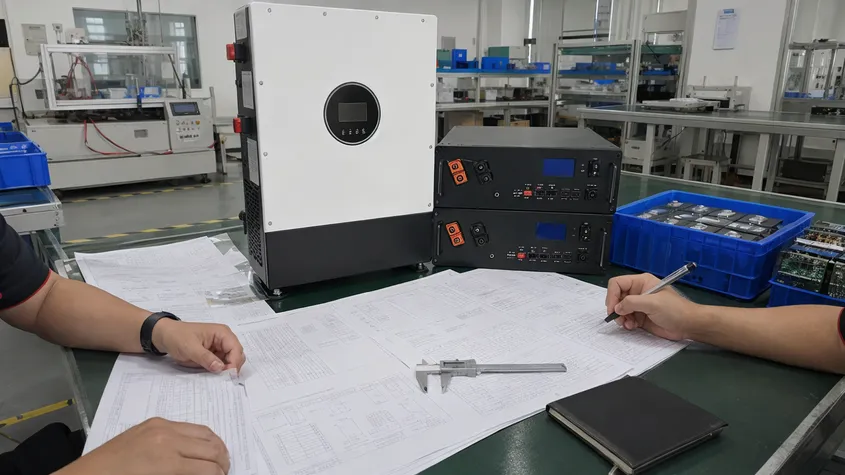
We test the pairing on our bench with the actual inverter model before production runs begin. If we don't have the inverter in our lab, we request the communication protocol document from the inverter manufacturer and validate against their specification. This step adds a few days to the development cycle but eliminates the field commissioning failures that cost you truck rolls and customer trust.
What You Should Send Us for Accurate Protocol Matching
Include in your RFQ:
Inverter Brand & Model
Exact model number, not just brand
Communication Interface
CAN bus or RS485 preference
Operating Modes
Self-consumption, backup, TOU scheduling
Firmware Update Support
Whether inverter supports OTA via comm bus
SOC Calibration Requirements
Any specific requirements from inverter manufacturer
Important: We've seen cases where two models from the same inverter brand use different CAN protocols — the model number matters, not just the brand. A "Deye-compatible" BMS that works with the SUN-8K-SG04LP3 may not work with the SUN-12K-SG04LP3-EU without parameter adjustment.
Battery Build Choices That Protect Margin After Installation
A hybrid solar battery that works on day one but drifts by month eight costs you more than the original sale was worth. Warranty claims, site visits, and replacement units destroy the margin you built into the deal. The manufacturing decisions we make at the cell and pack level are specifically aimed at preventing that drift.

Automated Cell Sorting and Matching
Every incoming cell batch goes through individual measurement — actual capacity and internal resistance, not the supplier's printed label. We sort cells into groups within 20mV voltage tolerance and 5mΩ internal resistance tolerance before they enter pack assembly.
Tight matching means all 16 cells in a 51.2V pack age at the same rate, so your customer sees consistent capacity at year three, not a pack limited by one weak cell.
We run 6 production lines across our 9,900 m² facility with 150 employees. The sorting step creates some cell waste — cells that fall outside tolerance bands get returned to the supplier rather than downgraded into lower-tier products. That waste is the cost of batch consistency across your 500-unit order.
Pack Assembly and BMS Integration
Cell-to-pack assembly uses fixed torque values on busbar connections (we calibrate torque drivers weekly — loose connections are the second most common field failure after protocol mismatch).
BMS boards are pre-tested for all protection functions before marriage to the cell pack:
- Over-charge protection
- Over-discharge protection
- Over-current protection
- Short-circuit protection
- Temperature response
After integration, the complete pack goes through a formation cycle and capacity verification.
Aging and Final Verification
Every pack sits on the aging rack for a minimum period after assembly, monitored for voltage drift and self-discharge rate. Packs that show abnormal self-discharge get pulled for investigation — a high self-discharge rate at this stage indicates a micro-short that will become a field failure within months.
After aging, final capacity verification confirms the pack delivers rated energy within specification.
Full lifecycle testing on every production batch:
This is batch-level verification, not a type-approval test we ran once three years ago.
Custom Hybrid Battery Options for OEM and Distributor Programs
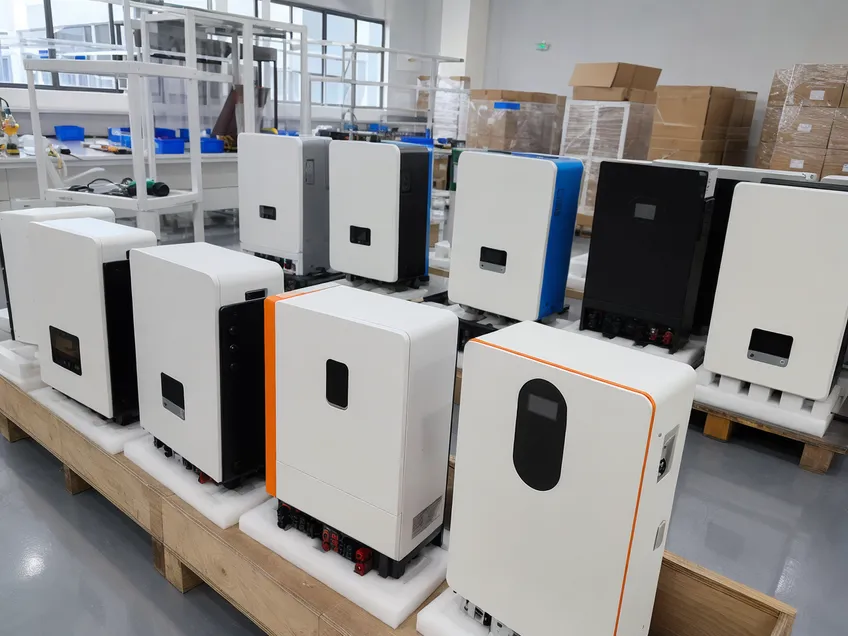
If you're building a branded hybrid solar battery line or need configurations matched to a specific inverter ecosystem, we handle the development from specification through production validation. Our in-house capability as a hybrid solar battery system supplier means you're working with the engineers who design the BMS, not a trading company relaying messages to a subcontractor.
What's Configurable
Voltage and Capacity
48V/51.2V standard, or non-standard configurations (25.6V, custom Ah ratings) for specific inverter requirements.
BMS Protocol
CAN bus or RS485, programmed to your target inverter brand and model — including multi-inverter compatibility if your catalog spans brands.
Enclosure Style
Floor-standing, wall-mount, rack-mount, or custom dimensions. Color, finish, and mounting hardware to your specification.
Connectors
Anderson, MC4, terminal block, or custom harness — matched to your installer's preferred wiring practice.
Branding
Your brand name, logo, color scheme, serial number format, and regulatory labels on product and packaging.
Documentation
User manuals, spec sheets, and compliance documents in your language and brand identity.
Packaging
Retail-ready boxes with your marketing materials, plain export cartons, or custom packaging design.
MOQ and Engineering Scope
Standard models from our existing hybrid battery catalog: 100 units MOQ. This lets you test the SKU in your market without container-level risk.
For OEM/ODM work, MOQ depends on what changes:
Light Customization
Label, color, packaging — close to standard MOQ, minimal lead time addition.
Protocol Customization
New inverter brand matching — moderate MOQ, requires BMS firmware development and bench testing.
Full Custom
New cell configuration, new enclosure tooling, new BMS hardware — higher MOQ to justify engineering validation and tooling investment. We quote the threshold upfront.
We provide prototype samples at the development stage so you can verify inverter pairing and physical fit before committing to production volume.
Why Custom Protects Your Business
A branded, protocol-matched hybrid battery that only you carry in your market is not a commodity. Your competitors can't price-match a product they can't source.
Your installers build muscle memory with your specific product, reducing their commissioning time and increasing their loyalty to your brand.
Custom configurations are margin protection, not just cosmetic differentiation.
Compliance Documents and Battery Freight Planning
Lithium batteries are Class 9 dangerous goods for international transport. Your import process requires specific documentation — missing paperwork means port holds, shipping line rejections, or customs delays that push your project timeline back weeks.

Documents We Maintain for Hybrid Battery Models
| Document | What It Covers | Your Use Case |
|---|---|---|
| UN38.3 Test Summary | Transport safety classification for lithium batteries | Required by shipping lines and airlines for booking confirmation |
| MSDS | Hazardous material handling and emergency procedures | Required by customs, warehouse operators, and freight forwarders |
| CE Declaration | EU market access for electrical equipment | Required for European import clearance and market registration |
| IEC 62133 Test Report | Battery safety standard compliance | Required by many importers for downstream market registration |
| ISO 9001:2015 Certificate | Manufacturing quality management system | Supports supplier qualification for your procurement process |
We maintain current documentation for all standard hybrid battery models. For OEM/ODM configurations, new documentation is generated as part of the development cycle — you receive the full compliance package before the first shipment.
If your market requires additional local certification (UL for North America, TÜV for Germany, BIS for India), our engineering team supports the application with test samples and technical data packages. We've been through this process for enough regions to know which labs are efficient and which timelines are realistic.
Export Packaging for Grid-Tied Solar Battery Storage
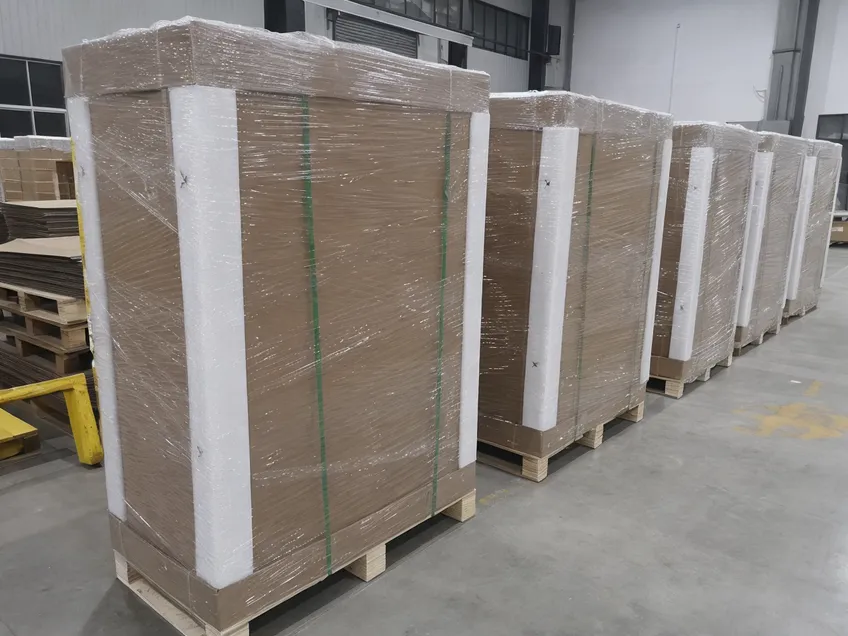
Hybrid batteries ship as heavy, dense cargo — typically 45–120 kg per unit depending on capacity. Our standard export packaging:
- Reinforced double-wall corrugated cartons with foam-in-place cushioning
- Terminal protection caps to prevent short-circuit during transit
- Desiccant packs for moisture control in ocean freight containers
- Individual unit boxing, palletized and stretch-wrapped
- Corner protectors for markets with rough inland logistics
We provide gross weight, carton dimensions, and CBM per unit in your quotation so you can calculate container loading and freight cost accurately. Model-mix loading plans are available when your order combines multiple configurations — we optimize pallet arrangement to maximize container utilization.
Terminal protection is non-negotiable for lithium battery freight.
One exposed terminal contacting the carton's metal staple during transit is a short-circuit event. We cap every terminal and tape every connector, even on units shipping in foam-lined boxes.
We export regularly to Europe, Southeast Asia, Africa, South America, and the Middle East — view our certification documents or check shipping and delivery details.
Choose the Right Residential Battery Route Before You Quote
The hybrid solar battery is one of five product routes under our home solar battery storage category. Each route serves a different market need. If you're not sure which fits your program, this comparison helps:
Hybrid Solar Battery
Best For:
Grid-tied self-consumption, TOU arbitrage, backup-plus-grid
Key Differentiator:
Active inverter communication, scheduled charge/discharge
Communication:
CAN/RS485 required
Home Solar Battery Backup
Best For:
Outage-first markets, emergency backup
Key Differentiator:
Fast switchover, infrequent cycling
Communication:
Basic or none
Wall Mounted Solar Battery
Best For:
Space-constrained residential, European aesthetics
Key Differentiator:
Slim profile, integrated mounting, IP65
Communication:
CAN/RS485 available
Off Grid Solar Battery Storage
Best For:
No-grid or weak-grid daily cycling
Key Differentiator:
Deep-cycle rated, wide temperature range
Communication:
Basic charge controller interface
Solar Panel and Battery Storage
Best For:
Bundled kit programs, turnkey residential packages
Key Differentiator:
Battery + BMS + harness as one SKU
Communication:
Depends on kit configuration
Choose Hybrid When
Your market has reliable grid plus solar penetration, your customers use hybrid inverters, and the value proposition is energy cost reduction or self-consumption — not just emergency backup. The BMS communication layer is what makes this route distinct from a backup battery with the same voltage and capacity.
Choose a Different Route When
Your market is primarily off-grid (no inverter communication needed), your customers want the slimmest possible wall-mount form factor (wall-mounted route), or you're building complete kits with panels included (solar panel and battery storage route).
Frequently Asked Questions About Hybrid Solar Battery Sourcing
Protocol details, chemistry selection, import documentation, and order thresholds — answered for distributors and system integrators evaluating hybrid battery supply.
What inverter details are needed before quoting a hybrid solar battery?
Send us the inverter brand, exact model number, communication interface (CAN bus or RS485), and your target operating modes (self-consumption, backup, TOU, or combination). The model number is critical — different models from the same brand often use different protocol versions. We also need to know whether you require single-inverter or multi-inverter compatibility, since some distributors serve installers who use different brands across projects.
How is a hybrid solar battery different from a standard backup battery?
A backup battery waits idle until the grid fails, then discharges to cover loads. Its BMS needs fast switchover but minimal communication — it doesn't actively manage energy flow during normal operation.
A hybrid solar battery operates daily: storing solar generation, discharging during peak tariff hours, communicating continuously with the inverter about charge/discharge permissions, and providing backup as a secondary function. The BMS firmware, communication protocol, and cycling profile are fundamentally different.
You cannot take a backup-only battery, connect it to a hybrid inverter, and expect grid-tied operation — the inverter needs active data exchange to manage energy flow.
Why do hybrid inverter communication faults happen?
Three common causes:
- Baud rate mismatch — the BMS sends at 250kbps but the inverter expects 500kbps
- Incorrect byte order — big-endian vs little-endian in the data frame
- Register mapping errors — the BMS reports SOC in a register the inverter reads as voltage
These are configuration issues, not hardware defects. They happen when a generic BMS module is used without verifying against the specific inverter's protocol documentation.
We eliminate this by programming and bench-testing against the actual inverter protocol before production.
Is 48V/51.2V LiFePO4 suitable for grid-tied solar battery storage?
Yes — 51.2V nominal (16S LiFePO4) is the industry standard for residential grid-tied solar battery storage. Most hybrid inverters in the 3–15 kW range are designed for 48V battery input with an operating window of approximately 44.8V–57.6V, which matches the 16S LiFePO4 charge/discharge curve precisely.
For commercial applications above 15 kW, parallel connection of multiple 51.2V modules scales the system without requiring higher-voltage architectures.
What documents are needed to import lithium hybrid solar batteries?
Minimum requirements for most markets:
- UN38.3 test summary — transport classification; shipping lines won't book without it
- MSDS — customs and warehouse handling
- Dangerous goods declaration — from your freight forwarder
For EU import, add:
- CE declaration of conformity
- IEC 62133 test report for your market registration file
Some markets require additional local certification — UL for North America, TÜV for Germany, BIS for India.
We provide: UN38.3, MSDS, CE, and IEC 62133 for all standard hybrid models. Additional certifications are supported on request with test samples and technical data.
What is the MOQ for EVANBattery standard and OEM hybrid battery models?
Standard hybrid battery models from our existing catalog: 100 units.
OEM/ODM configurations depend on engineering scope — a branding change on an existing model stays near standard MOQ, while a new BMS protocol development or custom cell configuration requires higher volume to justify validation. We quote the exact threshold when you describe your customization requirements.
Most new buyers start with a standard-model trial order to validate quality and inverter compatibility, then move to OEM configuration on the second or third reorder.
Have a question not covered here?
RFQ Checklist for a Faster Hybrid Battery Quote
Send us these details and we'll respond with a technical recommendation, protocol confirmation, and pricing.
The more complete your initial inquiry, the faster we confirm compatibility and quote accurately. Most quotes go out within 48 hours of receiving complete specifications.
Include in Your RFQ
-
Target voltage and capacity 48V/51.2V standard, or specify
-
Hybrid inverter brand and exact model number
-
Communication protocol preference CAN bus or RS485
-
Target operating modes Self-consumption, backup, TOU, combination
-
Estimated order quantity Initial + projected annual
-
Destination market and required certifications
-
Enclosure preference Floor-standing, wall-mount, rack-mount
-
Branding requirements Standard EVANBattery label or OEM
-
Packaging preference Export carton or retail-ready
Explore More Home Solar Battery Storage
Home Solar Battery Backup
Backup-focused residential battery systems
ProductWall Mounted Solar Battery
Space-saving wall-mount configurations
ProductOff Grid Solar Battery Storage
Independent off-grid energy storage
ProductSolar Panel and Battery Storage
Integrated panel + storage solutions