

Solar Panel and Battery Storage Bundles Built Around Factory-Made LiFePO4
We manufacture the battery core, design the BMS, test the system, and support panel-to-battery matching so your bundled SKUs ship as verified kits — not loose components.
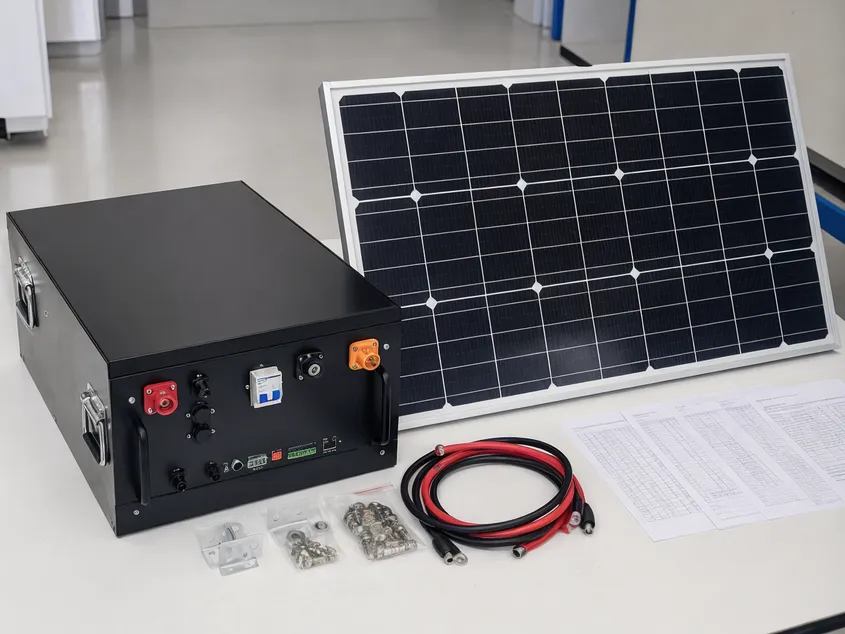
What EVANBattery Supplies in a Solar Panel and Battery Storage Program
We need to be clear about what we make and what we help you source — because that boundary is where your procurement confidence starts.
What We Manufacture
EVANBattery manufactures the battery pack (LiFePO4 or lead-acid), the BMS board, the battery enclosure, wiring harnesses, connectors, and all compliance documentation. These come off our own 6 production lines in Zhongshan, Guangdong.
We control cell sorting, pack assembly, BMS programming, and full lifecycle testing in-house.
Panel-to-Battery Matching
Solar panels are not something we manufacture. What we do is support panel-to-battery matching: you specify the panel brand and wattage you want in the bundle, or we recommend compatible panel partners based on your target market and landed-cost target.
Either way, the battery and BMS — the components that determine system reliability and your warranty exposure — are factory-made by us.
Typical Solar Panel and Battery Storage Program Scope
The scope flexes based on what your channel needs — some buyers want battery-only with panel specs confirmed for compatibility; others want us to coordinate the full kit including panels, charge controller, and accessory bag.
We started offering bundle coordination in 2018 after enough distributors asked us to solve the "I bought panels from one factory and batteries from another and they don't work together" problem. The panel isn't our product, but the system match is our responsibility.
Bundle Specification Planning for Wholesale SKU Development
If you're building a solar panel storage system wholesale catalog, you need a specification ladder — not one generic kit. Here's how we help buyers plan bundle tiers that match real market demand.
The table below shows typical planning bands. These are reference configurations, not fixed SKUs — your actual bundle depends on target market, inverter ecosystem, and retail price positioning.
| Bundle Tier | Panel Array (typical) | Battery Voltage | Battery Capacity | Usable Energy (80% DoD) | Chemistry | Target Market Fit |
|---|---|---|---|---|---|---|
| Entry Residential | 1–2 kW | 12.8V or 25.6V | 100–150Ah | 1.3–3.8 kWh | LiFePO4 | Solar home systems, rural electrification, budget backup |
| Standard Residential | 3–5 kW | 48V (51.2V) | 100–200Ah | 5.1–10.2 kWh | LiFePO4 | Self-consumption, short-outage backup, installer starter kits |
| Extended / Off-Grid | 5–8 kW | 48V (51.2V) | 200–280Ah | 10.2–14.3 kWh | LiFePO4 | Full off-grid homes, long-backup markets, multi-day autonomy |
| Budget Off-Grid | 1–3 kW | 12V / 24V | 100–200Ah | 1.2–4.8 kWh | Gel (VRLA) | Price-sensitive markets, Africa/SE Asia solar home kits |
Specifications shown are industry-standard planning values. Actual configurations depend on load profile, local irradiation, inverter sizing, and code requirements. Contact us for detailed product data sheets.
What This Table Gives You as a Bundle Supplier
A clear SKU ladder. Your entry tier captures price-sensitive buyers. Your standard tier covers the volume residential segment. Your extended tier serves premium or off-grid accounts. Three SKUs, one supplier relationship, one container shipment.
Captures price-sensitive buyers and rural electrification projects
Covers the volume residential segment — self-consumption and backup
Serves premium or off-grid accounts requiring multi-day autonomy
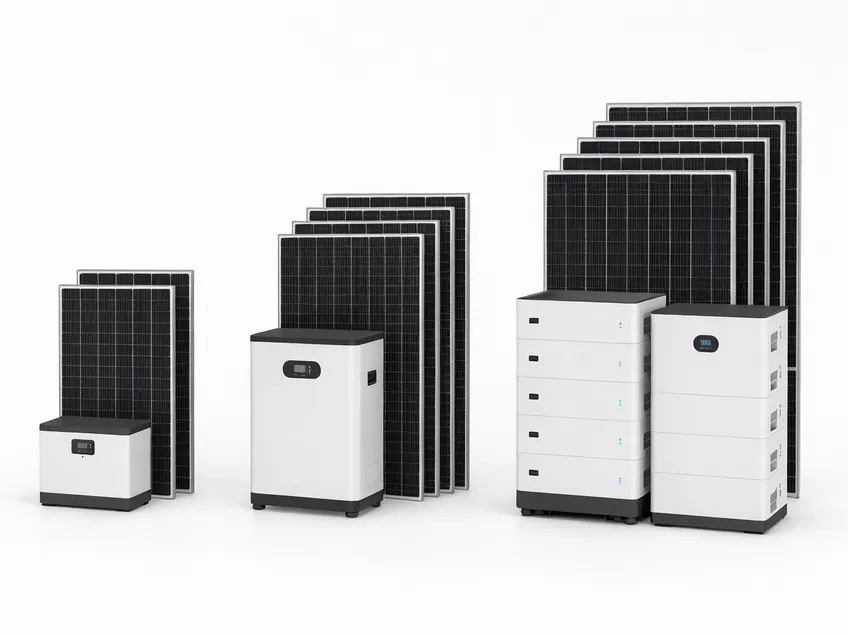
We provide exact battery specifications, BMS configuration, and panel compatibility confirmation for each tier once you tell us your target market and inverter preference.
Panel-to-Battery Sizing That Protects Margin and Reduces Returns
Mis-sized solar panel and battery storage bundles create two expensive problems: undersized batteries that disappoint end users and generate returns, or oversized batteries that inflate your landed cost and sit unsold. Both eat margin.
Here's the sizing logic we walk through with every bundle buyer:
Daily energy requirement first, not panel wattage.
Your end customer's daily consumption (typically 8–25 kWh for residential) determines battery capacity. The panel array then needs to recharge that battery within available sun hours. Working backwards from panels to battery is how bundles end up mismatched — a 5 kW array in northern Europe generates very different daily yield than the same array in sub-Saharan Africa.
Usable capacity, not nameplate.
LiFePO4 batteries should be planned at 80% depth of discharge for optimal cycle life. A 10 kWh nameplate battery delivers 8 kWh usable. If your bundle promises "10 kWh backup" but the BMS limits discharge to 80% DoD, your customer sees 8 kWh and calls you. We spec bundles on usable energy so your marketing matches reality.
Charge current matching.
The panel array's maximum charge current (through the MPPT controller or hybrid inverter) must not exceed the battery's maximum charge rate. A 51.2V 100Ah LiFePO4 pack typically accepts 50-100A charge current depending on cell grade and BMS configuration. Overdriving the charge rate shortens cycle life and triggers BMS protection shutdowns — your installer gets a callback.
The good/better/best approach.
Instead of one bundle per market, we recommend building three tiers: a 4-hour backup entry kit, an 8-hour standard kit, and a 12+ hour extended kit. Same panel array, different battery capacity. Your sales team can upsell within the same product family, and your warehouse stocks one panel SKU instead of three.
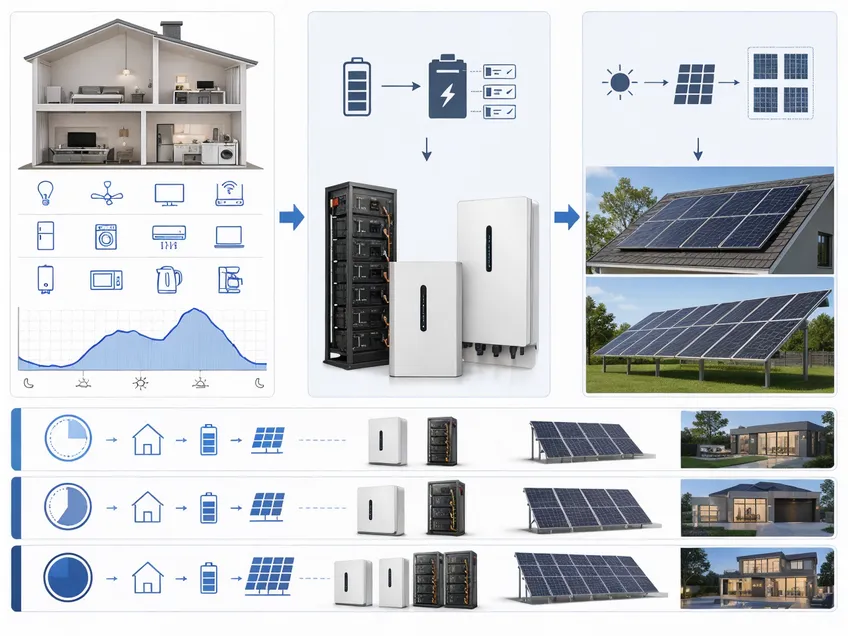
Recommended Bundle Tiers
| Tier | Backup Hours | Use Case |
|---|---|---|
| Entry Kit | 4 hours | Essential loads, price-sensitive markets |
| Standard Kit | 8 hours | Full evening coverage, most residential |
| Extended Kit | 12+ hours | Whole-home backup, unreliable grid areas |
We've seen distributors try to sell a single "universal" bundle across markets with 3-hour and 12-hour backup expectations. It doesn't work — you end up with returns from both ends. Three tiers solve this cleanly.
Send your target backup hours, load profile, and destination market for sizing support.
Get Sizing SupportBMS and Inverter Matching — The Integration Step That Prevents Field Failures
The most common failure in bundled solar panel and battery storage systems isn't a dead cell or a cracked panel — it's a BMS that can't communicate with the inverter.
The battery charges and discharges fine on the bench, but once connected to the customer's hybrid inverter, it shows incorrect state-of-charge, refuses to charge past 80%, or triggers nuisance shutdowns. Your installer spends two hours on-site troubleshooting what should have been a plug-and-play installation.
In-House BMS Engineering
18 engineers, dedicated firmware team
We design and manufacture BMS boards in-house with CAN bus and RS485 protocol libraries for major inverter brands. When you tell us which inverter your market uses, we program the BMS communication parameters to match that specific inverter's data frame structure, baud rate, and command set before the battery leaves our factory.
Pre-Configured Inverter Brands
If your target inverter isn't in our existing library, our firmware team needs the protocol documentation and 2-3 weeks to develop and validate the match.
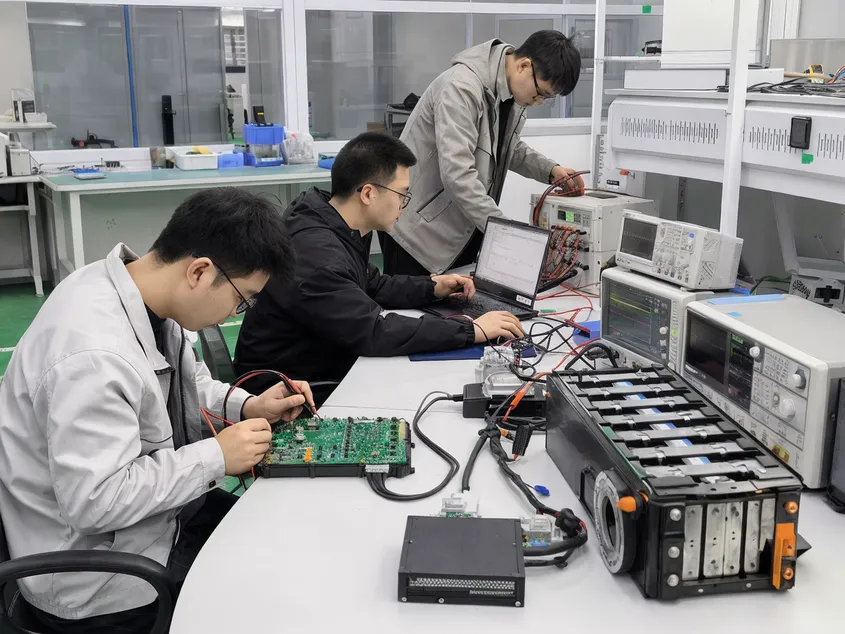
Lab Validation — Not a Generic Compatibility Claim
This isn't a generic compatibility claim. We test the BMS-inverter pairing in our lab:
SOC reporting accuracy verification
Charge/discharge current limits communicated correctly
Protection event handling validated
Inverter monitoring platform displays battery data properly
The Commercial Value
Pre-matched BMS means:
Installers commission systems in 30 minutes instead of 3 hours
After-sales team handles fewer "battery not recognized" tickets
Fewer callbacks, lower warranty cost, stronger channel confidence for reorders
Full Bundle Communication Chain
For solar panel and battery storage manufacturer programs where the inverter or charge controller is included in the bundle, we confirm the full communication chain before shipment — battery BMS to inverter, inverter to monitoring platform, and any parallel/cascade communication if multiple batteries are connected.
Send your inverter or controller model for compatibility confirmation.
Confirm CompatibilityBattery Manufacturing Controls Behind the Bundle
The panel in your bundle might come from any number of qualified suppliers. The battery is where your warranty risk concentrates — and it's the component we control from raw cell to finished pack.
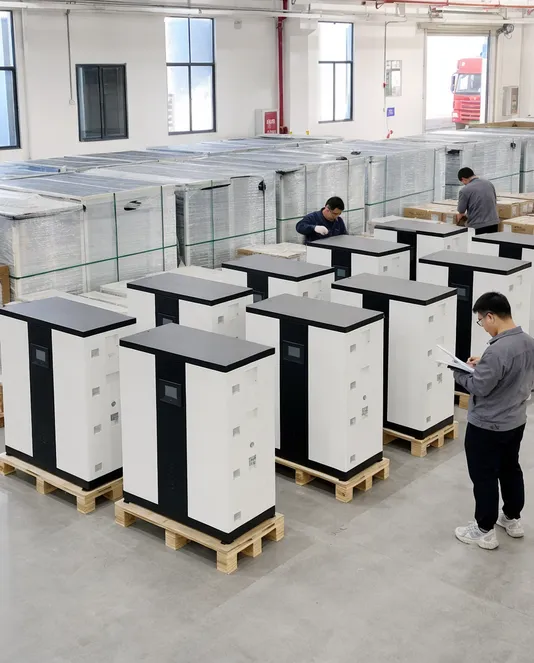
Our production sequence for solar panel and battery storage packs runs through the same 9,900 m² facility that produces 2,000,000 battery units per year across 6 lines:
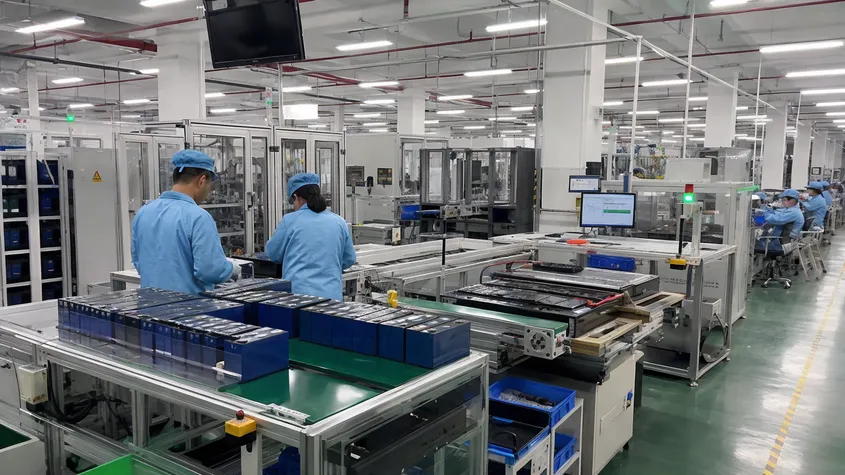
Cell Incoming Inspection and Grading
Every cell batch is tested for voltage, internal resistance, and capacity before entering the sorting system. Cells outside our acceptance window go back to the supplier — we don't re-grade rejects into lower-tier products.
Automated Cell Sorting and Matching
Cells are grouped within 20mV voltage and 5mΩ internal resistance tolerance. This is the step that determines whether your 500-unit batch performs consistently at month 18 or drifts apart as weaker cells limit pack capacity. Manual sorting can't hold these tolerances at volume — the automated system processes and groups cells faster and tighter than a human operator with a multimeter.
Pack Assembly and BMS Integration
Cell-to-busbar connections, BMS wiring, temperature sensor placement, and enclosure assembly happen on dedicated lithium lines (separated from lead-acid production to prevent cross-contamination in electrolyte handling). BMS boards are programmed with the specific protection parameters and communication protocol for your order before they're married to the cell pack.
Full Lifecycle Testing on Every Production Batch
Capacity verification, charge/discharge cycling, 55°C high-temperature soak, -20°C low-temperature discharge, vibration, and drop testing. This runs on every batch, not just during initial type approval — so your reorder performs identically to your first shipment.
The Result for Your Bundle Program
Consistent battery performance across orders, predictable warranty exposure you can price into your margin, and reorder stability that lets you build a repeat supply relationship instead of re-qualifying every shipment.
Market Segments Where Solar Panel Battery Bundles Sell Repeatedly
Solar panel and battery storage bundles aren't a single product — they're a supply format that fits multiple commercial segments. Here's where our existing buyers deploy them profitably:
Residential Solar Kit Wholesale
Distributor ChannelDistributors building branded solar kit catalogs for installer networks. You need entry/standard/premium tiers with consistent specifications across reorders. The bundle format simplifies your warehouse: one SKU per tier instead of separate battery, panel, and accessory line items.
Typical order pattern: 200–500 kits per quarter, seasonal peaks before summer installation season.
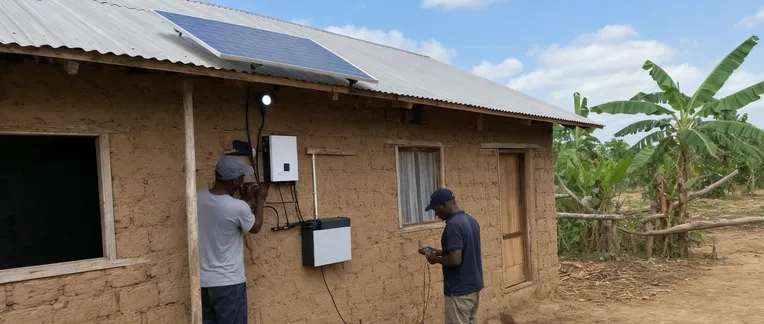
Rural Electrification and Weak-Grid Programs
Program / TenderNGO procurement, government tenders, and private-sector rural energy companies deploying solar home systems across Africa, Southeast Asia, and South America. These programs need standardized kits that field technicians can install without engineering decisions on-site. We configure bundles with pre-terminated connectors, simplified wiring, and pictorial installation guides in local languages.
Order volumes: 500 to 5,000+ kits per program phase.
This segment has been our fastest-growing bundle category since 2020 — rural electrification programs prefer a single-source kit over multi-vendor procurement because it eliminates finger-pointing when something doesn't work in the field.
Installer Starter Packages
Installation CompaniesSolar installation companies that want predictable site commissioning. A pre-matched bundle means the installer knows exactly what arrives, how it connects, and that the BMS-inverter communication is already validated. No on-site troubleshooting, no mismatched components, no second truck rolls.
Growth path: Typically start with 50–100 kits to validate the workflow, then scale to quarterly container orders.
Private-Label Distributor Programs
OEM / Brand BuildingDistributors building their own solar storage brand. You need branded cartons, custom labels, your logo on the battery enclosure, documentation in your market's language, and serial number formats that integrate with your warranty tracking system.
The bundle format — battery, harness, accessories, documentation all in one branded box — lets you build brand equity instead of reselling a factory's identity. Branded bundles are harder for competitors to price-match than generic standalone batteries.
Competitive advantage: Branded bundles are harder for competitors to price-match than generic standalone batteries.
Project Contractors Bidding Multi-Home Deployments
Project / Tender ScaleContractors bidding residential storage projects (new housing developments, community solar programs, social housing upgrades) need consistent specifications across 50–500 homes. A standardized bundle simplifies your tender BOM, your installation training, and your warranty administration.
We provide project-specific documentation packages and can stagger deliveries to match your construction schedule.
Delivery flexibility: Staggered shipments aligned to your construction phases — no warehouse burden for the full project volume upfront.
Ready to explore which bundle format fits your channel?
Tell Us Your Target Market for a Starter Bundle RecommendationOEM/ODM Bundle Options and Practical Limits
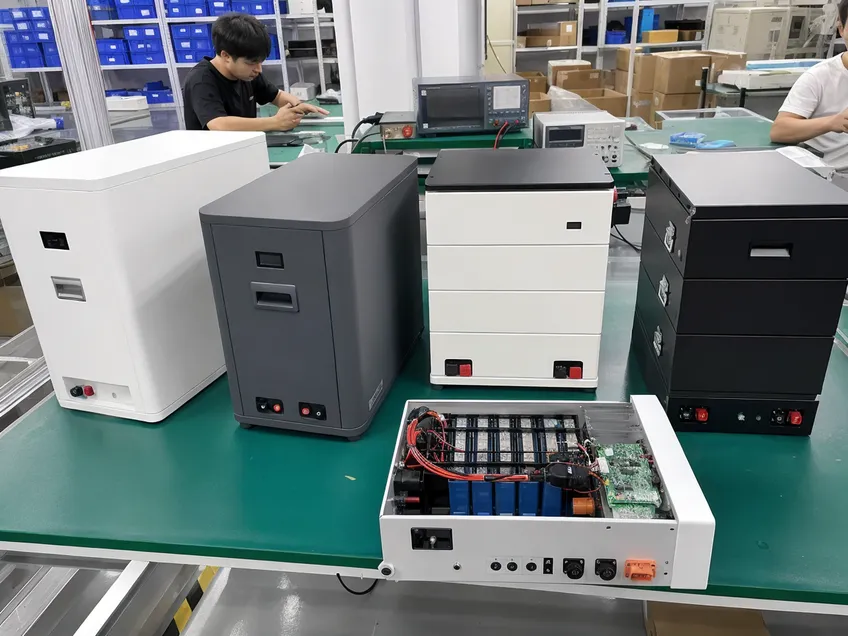
Here's what you can customize in a solar panel and battery storage program — and where the boundaries are.
Customization Matrix
| Dimension | What's Available | Limits / Notes |
|---|---|---|
| Battery voltage | 12.8V, 25.6V, 51.2V, or custom series/parallel | Non-standard voltages require BMS validation cycle |
| Battery capacity | 50Ah – 280Ah per unit (stackable for higher) | Cell availability may affect lead time on unusual capacities |
| Cell chemistry | LiFePO4 (primary), Gel, AGM | LiFePO4 recommended for cycle life in daily solar use |
| BMS communication | CAN bus, RS485, Bluetooth, dry-contact | New inverter protocol matching needs 2-3 weeks firmware development |
| Enclosure | Wall-mount, floor-standing, rack-mount, custom dimensions | Custom enclosure tooling above 500-unit MOQ |
| Connectors | Anderson, MC4, terminal block, custom harness | Harness length and gauge specified at order |
| Branding | Logo, color, label design, serial number format | Minimum 100 units for branded packaging |
| Packaging | Retail-ready box, plain export carton, custom design | Custom box artwork provided by buyer or designed by our team |
| Documentation | Manual language, warranty card, QR code registration | We translate into 8 languages; others on request |
| Panel matching | Wattage, brand, and model confirmed for compatibility | EVANBattery does not manufacture panels — sourced or buyer-specified |
| Accessories | Mounting brackets, cable clips, fuse holders, accessory bags | Accessory list confirmed during order planning |
Where the Boundaries Are
Core Manufacturing Scope
We manufacture the battery pack and BMS. That's our core, and that's where your quality guarantee lives. Panels, inverters, and charge controllers can be included in the bundle scope, but they're sourced components — their certifications and warranties are separate from the battery's.
Protocol Validation Required
New BMS firmware for an untested inverter protocol requires validation before production. We won't ship a bundle with unverified communication — that's how field failures happen. Allow 2-3 weeks for new protocol development if your inverter isn't already in our library.
MOQ Thresholds
Standard battery models start at 100 units MOQ. Full OEM scope (custom enclosure, new BMS configuration, branded packaging) typically requires 300+ units to justify the engineering and tooling investment. We'll quote the exact threshold when you describe the scope — no surprises after you've committed.
Margin Protection
Custom configurations protect your margin. A branded, protocol-matched solar panel and battery storage bundle is harder for competitors to undercut than a generic battery anyone can source from Alibaba.
Compliance and Documentation for Bundled Solar Storage Orders
Lithium batteries are classified dangerous goods for international freight. Missing or incorrect documentation means port holds, customs rejections, and project delays your customer won't tolerate.
What We Provide for the Battery Component
UN38.3 Test Summary
Transport classification — required by shipping lines and airlines.
Current reports for all standard modelsMSDS
Hazardous material handling for customs and warehouse operators.
Available per modelCE Declaration of Conformity
EU market access for electrical equipment.
Available for LiFePO4 residential rangeIEC 62133 Test Report
Battery safety standard for market registration.
Available for LiFePO4 modelsISO 9001:2015 Certificate
Manufacturing quality management verification.
Factory-level certificateThese documents cover the battery pack — the DG-classified component in your shipment. For solar panel storage system wholesale programs where panels and inverters are included in the bundle, those components carry their own CE marks, IEC certifications, and declarations of conformity from their respective manufacturers. We coordinate documentation packages so your import file is complete, but panel/inverter compliance responsibility sits with the panel/inverter source.
Supporting Your Market Entry
If your destination market requires certifications beyond what we currently hold (UL for North America, BIS for India, INMETRO for Brazil, TLC for some African markets), our engineering team supports the application process with test samples, technical data packages, and test lab coordination. We've been through this cycle for enough regions to know which labs are efficient and which certification paths run parallel versus sequential.
Timeline for New Market Certifications
Budget 8-12 weeks for additional certification processes. We can ship standard-certified product while the local certification is in progress, depending on your market's enforcement timeline.
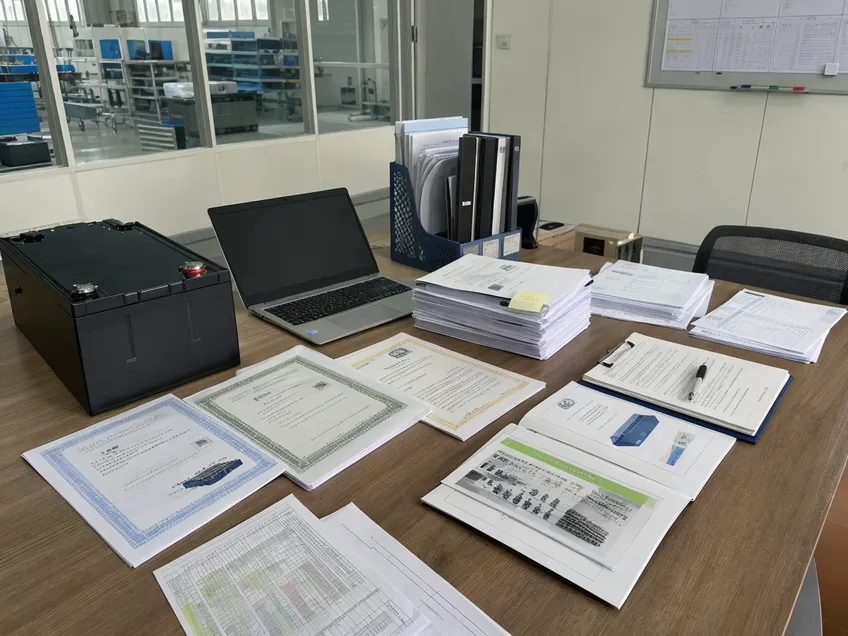
We Coordinate the Full Package
- Test samples for certification labs
- Technical data packages for applications
- Test lab coordination and scheduling
- Parallel vs sequential path guidance
Packaging and Logistics for Mixed Solar Panel + Battery Shipments
Bundled solar panel and battery storage shipments are more complex than standalone battery orders. You're combining dense, DG-classified battery cartons with large, fragile panel boxes and small accessory items — all needing to arrive as a matched kit, not a pile of loose cargo.
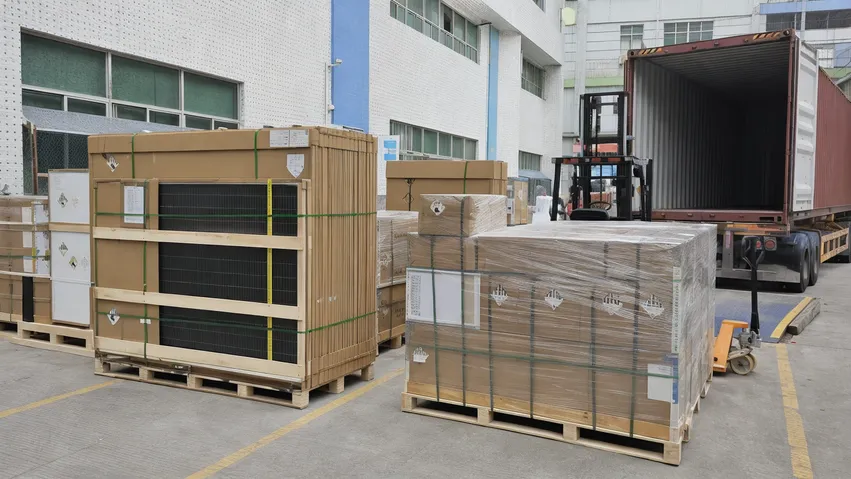
How We Package Bundle Orders
Battery Cartons
Reinforced double-wall corrugated with foam-in-place cushioning. Terminal protection caps prevent short-circuit during transit. Each unit individually boxed with desiccant packs. Batteries are the heaviest component per cubic meter — they go on the bottom of the pallet stack.
Panel Coordination
When panels are included in the bundle scope, we coordinate carton dimensions and pallet plans with the panel source to ensure efficient container loading. Panels ship in their own protective packaging (corner protectors, anti-vibration foam) — we don't repackage them, but we plan the load so panels and batteries arrive together.
Kit Labeling and SKU Control
Each bundle tier gets a unique SKU label on the outer carton. Packing lists match your purchase order line items. If you're distributing to multiple warehouse locations, we can sort and label by destination within the container.
Accessory Bags
Mounting hardware, cable clips, fuse holders, and documentation packed in labeled poly bags inside the battery carton or in a separate accessory box per kit — your choice based on how your warehouse processes receiving.
Why This Matters for Your Margin
Damaged batteries generate expensive claims — not just the replacement cost, but the shipping, the installer's wasted site visit, and the customer confidence you lose. Proper packaging is margin protection.
We provide gross weight, CBM, and pallet dimensions per model at quotation stage so you can calculate container loading and freight cost before committing to volume.
We don't publish fixed "units per container" numbers because your model mix changes the answer. A 20GP of 12V 100Ah entry kits loads very differently from a 40HQ of 48V 200Ah extended systems.
Send us your model and quantity — we'll provide exact pallet plans and loading diagrams.
Choose the Right Residential Storage Route Before You Order
Solar panel and battery storage bundles are one of five product routes under our home solar battery storage category. If you're not sure whether a full bundle program is what you need, this comparison helps you self-select:
Solar Panel and Battery Storage
Best Fit
Wholesalers and contractors building complete kit SKUs
What You're Really Sourcing
Battery + BMS + harness + panel matching + documentation as a bundled program
When to Choose This Route
You want a sellable or deployable package, not just a standalone battery
Best Fit
Distributors serving outage-focused residential markets
What You're Really Sourcing
Battery packs optimized for standby + fast switchover
When to Choose This Route
Your market buys backup power, not daily solar self-consumption
Best Fit
Channel partners in space-constrained residential markets
What You're Really Sourcing
Slim-profile battery with integrated mounting system
When to Choose This Route
Your installers need garage/wall installations under 180mm depth
Best Fit
Project contractors and solar kit assemblers for no-grid homes
What You're Really Sourcing
Deep-cycle batteries rated for daily 80–90% DoD
When to Choose This Route
Your end users have no grid connection — the battery is the primary power source
Best Fit
System integrators pairing with grid-tied hybrid inverters
What You're Really Sourcing
Battery with CAN/RS485 communication for active energy management
When to Choose This Route
Your market uses time-of-use tariffs or feed-in optimization
If you need batteries across multiple routes, we run them simultaneously on separate production lines — your container ships complete rather than in split deliveries.
FAQ for Solar Panel and Battery Storage Buyers
Direct answers to the manufacturing scope, sizing, and sourcing questions we hear most from wholesalers and system integrators evaluating bundled solar storage programs.
Does EVANBattery manufacture solar panels or only the battery storage part?
We manufacture the battery pack and BMS — that's our core production capability across 6 lines and 13+ years of specialization. We do not manufacture solar panel cells or modules.
For bundled solar panel and battery storage programs, panels are either buyer-specified (you source your own and we confirm compatibility) or coordinated through our approved panel partners based on your target wattage, market, and landed-cost requirements.
In short: The battery, BMS, wiring, documentation, and packaging are factory-made by us. Panel sourcing is a coordination service, not a manufacturing claim.
How do I size battery capacity for a solar panel and battery storage bundle?
Start with your end customer's daily energy consumption, not the panel wattage. Typical residential loads range from 8–25 kWh/day depending on market.
Sizing Formula
- Divide daily consumption by usable depth of discharge (80% for LiFePO4) to get required battery capacity.
- Size the panel array to recharge that capacity within available peak sun hours (4–6 hours in most markets).
Worked Example
15 kWh daily load ÷ 0.8 DoD = 18.75 kWh battery capacity needed.
A 51.2V 200Ah LiFePO4 pack provides 10.2 kWh usable — so you'd need two units or a higher-capacity configuration.
Send us your target backup hours and load profile, and we'll provide exact sizing with panel wattage recommendations.
What battery chemistry works best for wholesale solar panel battery bundles?
LiFePO4 for most markets. Cycle life (3,000–6,000 cycles at 80% DoD) supports 10–15 year product warranties, which is what residential buyers expect. Weight is lower than lead-acid, so your freight cost per kWh is better. Calendar life holds even in partial-state-of-charge operation, which is how solar batteries actually cycle in the field.
- 3,000–6,000 cycles at 80% DoD
- Supports 10–15 year product warranties
- Lower weight = better freight cost per kWh
- Calendar life holds in partial-state-of-charge operation
- Budget-constrained markets
- Upfront cost matters more than lifecycle cost
- Rural African solar home kits and similar use cases
- End-user price point must stay under a threshold
We manufacture both and can mix chemistries within a single container order if your catalog spans both segments.
What inverter or controller information should I provide before ordering?
Brand, model number, and firmware version of the inverter or charge controller your bundle will pair with. We need this to program BMS communication parameters — CAN bus data frame structure, baud rate, command set, and SOC reporting format vary by inverter brand.
BMS Communication Parameters We Configure
If you're targeting multiple inverter brands across different markets, tell us all of them — we can program different BMS firmware variants within the same production batch.
Charge-controller-only systems (no hybrid inverter): We need the controller's maximum charge current and voltage setpoints to configure BMS charge acceptance parameters.
What documents are needed to import lithium battery storage bundles?
At minimum: UN38.3 test summary (transport classification for lithium batteries), MSDS (material safety data for customs), and a proper DG shipping declaration from your freight forwarder.
For EU market access: CE declaration of conformity and IEC 62133 test report for your market registration file. For other markets: check local requirements — UL (North America), BIS (India), INMETRO (Brazil), or equivalent.
We provide UN38.3, MSDS, CE, and IEC 62133 documentation for all standard battery models. If panels and inverters are included in your bundle, their compliance documents come from their respective manufacturers — we coordinate the full documentation package so your import file is complete.
What is the MOQ for standard solar panel and battery storage bundle programs?
Standard battery models from our existing catalog: 100 units MOQ. This applies to the battery component of the bundle.
For full OEM/ODM scope (custom BMS protocol, branded enclosure, custom packaging, specific panel matching): typically 300+ units depending on engineering complexity.
A label and color change on an existing model is straightforward at 100 units. A new cell configuration with untested inverter protocol matching needs higher volume to justify validation. We quote exact MOQ when you describe the full bundle scope — no ambiguity after you've started planning.
MOQ Summary
RFQ Checklist — What to Include for a Solar Panel and Battery Storage Quote
Send us these details and we'll respond with a technical recommendation, bundle specification, and pricing within 48 hours.
Target Market
Country or region where the bundle will be sold/deployed
Panel Specification
Wattage, brand/model (or let us recommend)
Battery Chemistry
LiFePO4 or gel (or let us recommend based on application)
Battery Voltage and Capacity
12V/24V/48V, target Ah or kWh
Inverter/Controller Model
Brand, model number, firmware version
Backup-Hour Target
How many hours of autonomy your end customer expects
Quantity
Per order and estimated annual volume
Branding Requirements
Logo, color, label design, documentation language
Certification Requirements
CE, UL, BIS, or other market-specific standards
Packaging Preference
Retail-ready, plain export, or custom design
Destination Port or Country
For freight and compliance planning
Contact Us Directly
Explore More Solar Battery Storage Solutions
Related product pages from our home solar battery storage range.