

Portable Solar Battery Power Station Built for Repeat Wholesale Programs
Integrated LiFePO4 packs with BMS, inverter, and market-ready interfaces from a single factory.
We build the battery core, design the BMS logic, assemble the complete station, and handle export documentation — so your portable power SKU ships from one source with consistent batch quality.
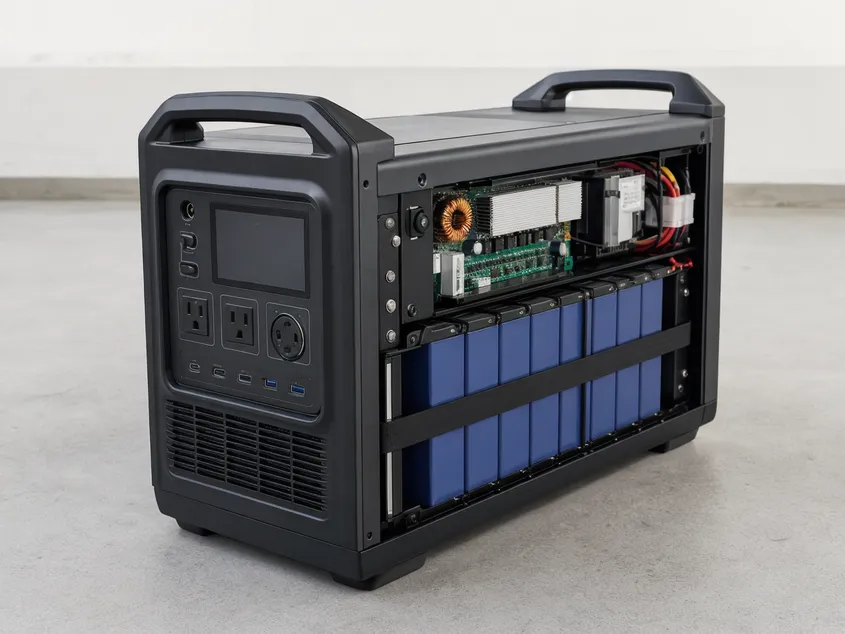
What Is a Portable Solar Battery Power Station?
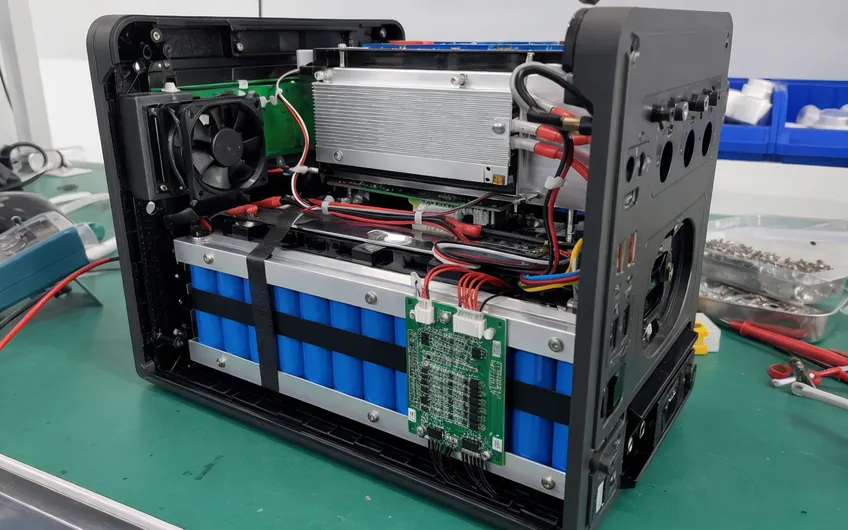
A portable solar battery power station is an integrated unit: lithium cells, BMS protection, inverter, MPPT solar charge controller, and AC/DC/USB output interfaces — all inside a single enclosure your customer can carry, charge from a solar panel, and use to power devices off-grid.
This is not a power bank or a bare battery pack. It's a complete portable solar battery storage product with inverter output, ready for retail shelves, project deployments, or emergency backup programs.
Core Components in Every Unit
- LiFePO4 lithium cells (matched and sorted)
- BMS protection board (in-house design)
- Pure sine wave inverter (AC output)
- MPPT solar charge controller
- AC / DC / USB output interfaces
Ready to Specify?
If you already know your target capacity, inverter rating, and plug standard — send your specifications for a quote. We'll respond with model options and pricing within 48 hours.
Send SpecificationsManufacturing Solar Batteries Since 2012
Portable power stations are a natural extension of our cell-matching, BMS design, and pack assembly capabilities. The same automated sorting that builds our 48V rack-mounted systems builds the cell packs inside these stations.
Factory Space
Production Lines
Annual Unit Capacity
Years in Production
You get the same consistency whether you're ordering 200 portable units or 2,000 rack batteries. Our automated cell sorting ensures every pack in a batch has matched internal resistance and capacity, which directly affects cycle life uniformity and after-sales return rates for your brand.
Explore Related Portable Solar Battery Products
Portable Solar Battery Charger
Solar charging modules and standalone charger units for portable battery systems.
KitPortable Solar Battery Kit
Bundled station + panel + accessories packages for retail and project deployment.
CampingPortable Solar Battery for Camping
Lightweight, ruggedized units designed for outdoor recreation and overlanding markets.
Spec Bands That Make Your Quote Sheet Comparable
Every portable solar battery power station we produce falls within defined specification bands. The table below gives you comparable parameters for building your quote sheet. Exact values depend on the model and any OEM customization — request specific datasheets once you've identified your target tier.
Entry-Level
300–600 Wh- LiFePO4 cells, 2,000+ cycles at 80% DoD
- Inverter rated 300–600 W, surge 2× rated
- Solar MPPT input: 12–28 V / 100–200 W max
- 1–2 AC outlets (market-specific plug)
- DC: 12 V car port, USB-A, USB-C
- BMS: over-charge, over-discharge, over-current, short-circuit, temperature
- Weight: 4–8 kg
Mid-Range
1,000–2,000 Wh- LiFePO4 cells, 3,000+ cycles at 80% DoD
- Inverter rated 1,000–2,000 W, surge 2× rated
- Solar MPPT input: 12–50 V / 200–400 W max
- 2–4 AC outlets
- DC: 12 V, USB-A, USB-C (PD)
- BMS: full protection suite
- Weight: 12–22 kg
High-Capacity
2,500–5,000+ Wh- LiFePO4 cells, 3,000+ cycles at 80% DoD
- Inverter rated 2,500–5,000 W, surge 2× rated
- Solar MPPT input: 12–60 V / 400–1,200 W max
- 2–6 AC outlets
- DC: 12 V, USB-A, USB-C (PD), Anderson
- BMS: full suite + active balancing
- Weight: 25–60 kg (model-dependent)
| Parameter | Entry-Level | Mid-Range | High-Capacity |
|---|---|---|---|
| Battery capacity | 300–600 Wh | 1,000–2,000 Wh | 2,500–5,000+ Wh |
| Cell chemistry | LiFePO4 (standard) | LiFePO4 | LiFePO4 |
| Cycle life (80% DoD) | 2,000+ cycles | 3,000+ cycles | 3,000+ cycles |
| Inverter rated power | 300–600 W | 1,000–2,000 W | 2,500–5,000 W |
| Inverter surge | 2× rated (typical) | 2× rated | 2× rated |
| Solar input (MPPT) | 12–28 V / 100–200 W max | 12–50 V / 200–400 W max | 12–60 V / 400–1,200 W max |
| AC output | 1–2 outlets (market-specific plug) | 2–4 outlets | 2–6 outlets |
| DC output | 12 V car port, USB-A, USB-C | 12 V, USB-A, USB-C (PD) | 12 V, USB-A, USB-C (PD), Anderson |
| BMS protections | Over-charge, over-discharge, over-current, short-circuit, temperature | Full suite | Full suite + active balancing |
| Weight range | 4–8 kg | 12–22 kg | 25–60 kg (model-dependent) |
| Dimensions | Model-specific | Model-specific | Model-specific |
Why LiFePO4 Across the Range
We use LiFePO4 cells across the range because cycle life directly controls your warranty exposure. A portable solar battery generator built on ternary lithium (NMC) might save a few percent on cell cost, but the 800-cycle lifespan creates return headaches for distributors selling into repeat-use markets.
LiFePO4 at 2,000–3,000+ cycles means your end customers replace panels before they replace the station — and your after-sales budget stays predictable.
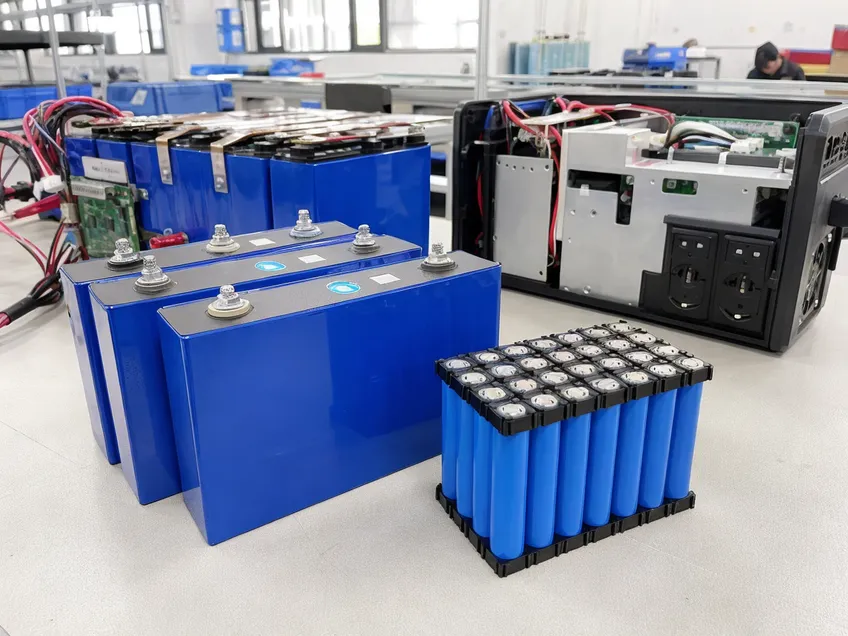
NMC available on request: If your market specifically requires NMC for weight-sensitive applications, we can configure it — but we'll flag the warranty implications upfront so you can price accordingly.
Specifications shown are typical values across our portable solar battery storage range. Actual parameters vary by model and customization. Contact us for detailed product datasheets.
Capacity Tiers Matched to Sellable Market Segments
Choosing the right capacity tier isn't about finding the biggest number — it's about matching your SKU to a market segment where the reorder pattern justifies your inventory investment. Here's how we see the tiers mapping to commercial channels:
Entry-Level
300–600 WhTrial Orders & High-Volume Retail
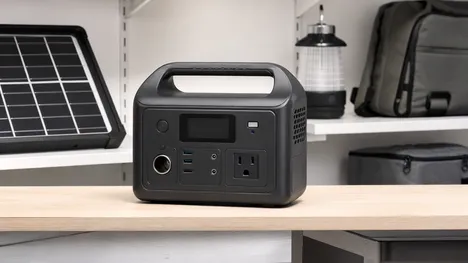
This tier sells into outdoor retail chains, emergency preparedness kits, and promotional programs. Unit cost is low enough for aggressive retail markup, and the physical size fits standard shelf displays.
Distributors typically use this tier for market entry — a 200-unit trial order tests sell-through before committing to a container.
Reorder pattern: Seasonal (camping season, hurricane season, holiday gifting). Warranty risk is low because duty cycles are light.
If you're building a camping-focused outdoor retail SKU, this tier overlaps — the difference is branding and channel positioning, not hardware.
Mid-Range
1,000–2,000 WhSolar Kit Sellers & Home Backup Starters
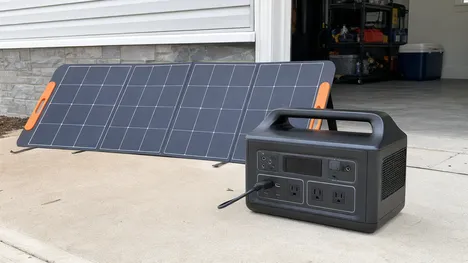
The mid-range portable solar battery generator covers the gap between "gadget" and "system." Solar kit sellers bundle these with 200–400 W panels for off-grid starter packages. Home backup buyers use them for essential loads during outages — lights, router, phone charging, small appliances.
This is where distributors build margin. The product is complex enough that buyers can't easily price-compare against commodity power banks, and the solar-charging capability creates a perceived value premium.
SKU ladder strategy: Good-better-best works well here — same enclosure platform, different capacity and inverter ratings, three price points from one production run.
High-Capacity
2,500–5,000+ WhField Work, Telecom & Off-Grid Programs
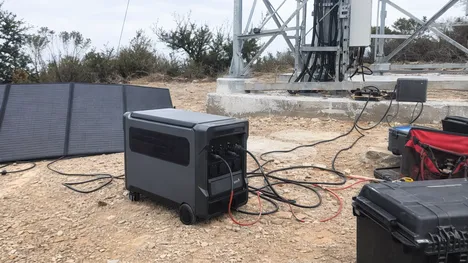
Higher-capacity stations serve commercial buyers directly: construction site tool charging, mobile vendor power, telecom maintenance teams, medical field clinics, and off-grid backup where a full battery system isn't justified.
Order volumes per buyer are smaller, but unit margins are significantly higher and reorders are driven by fleet expansion rather than seasonal demand.
Emerging segment: Growing demand from African and South American distributors stocking these as "mini solar generators" for small shops and market stalls — a segment worth watching if you're building your portable product line in those regions.
Building Your SKU Ladder
Rather than carrying six overlapping models, most successful distributors stock three: one entry, one mid, one high.
We can configure all three on the same production run — same BMS architecture, same enclosure design language, different cell count and inverter module. Your customers see a coherent product family; your warehouse carries three SKUs instead of twelve.
Entry SKU
300–600 Wh
Mid SKU
1–2 kWh
High SKU
2.5–5 kWh
Solar Input, Inverter Output, and Plug Choices That Prevent After-Sales Confusion
The fastest way to generate warranty claims on a portable solar battery generator is to ship units with mismatched specifications for the destination market. These are the technical matching decisions you need to lock down before production:
Solar Panel Compatibility
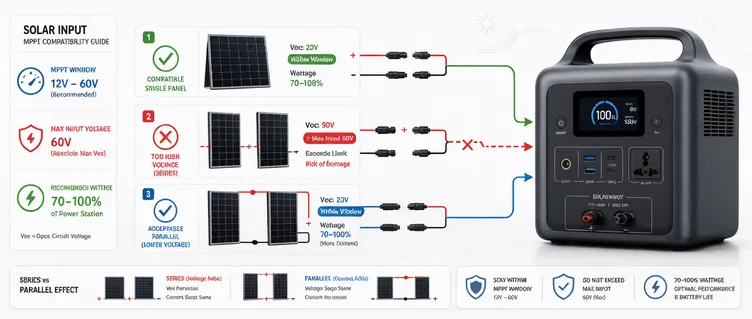
Your station's MPPT input has a voltage window and maximum wattage. If your customer connects a panel outside that window, the charge controller either rejects it or operates at reduced efficiency — and they call your support line. Confirm:
- Panel open-circuit voltage (Voc) must stay below the station's maximum input voltage
- Panel wattage should match 70–100% of the station's rated solar input for reasonable charge times
- Series vs. parallel panel configurations affect voltage — if you're bundling panels with the station, specify the wiring in your manual
AC Output: Voltage, Frequency & Plug Standard
This is non-negotiable and must be confirmed per destination market. We configure the inverter output at production. Changing voltage/frequency after assembly means replacing the inverter module — it's not a firmware toggle. Get this right on your first order.
| Standard | Markets |
|---|---|
| 110V/120V 60Hz | North America, parts of South America, Japan |
| 220V/230V 50Hz | Europe, Africa, Middle East, Southeast Asia, most of South America |
Plug types: Type A/B, Type C/F, Type G, Type I, or others depending on your market. Confirm before RFQ submission.
Buyer Checklist Before RFQ Submission
Before you send your target market plug and voltage requirements, confirm these five items to avoid production delays and costly re-work:
- 1 Destination market AC voltage and frequency
- 2 Required plug type(s) for AC outlets
- 3 Solar panel wattage and Voc you plan to bundle or recommend
- 4 Manual language and warning label language
- 5 Any regulatory markings required on the enclosure
Ready to configure your order?
Submit your market specs and we'll confirm inverter configuration within 24 hours.
Request Configuration QuoteCell Matching, BMS Logic, and Output Testing Before Your Brand Carries the Warranty
When your logo goes on a portable solar battery power station, your brand absorbs the warranty risk. Our job as a portable solar battery power station manufacturer is to control that risk before the unit leaves our factory. Here's the production sequence that makes batch consistency possible:
Incoming Cell Inspection
Every LiFePO4 cell batch gets tested for voltage, internal resistance, and actual capacity before entering production. We reject cells outside our acceptance window — typically ±10 mV voltage spread and ±3 mΩ resistance spread within a batch. Cells that don't meet spec go back to the supplier.
We don't downgrade them into "economy" products.
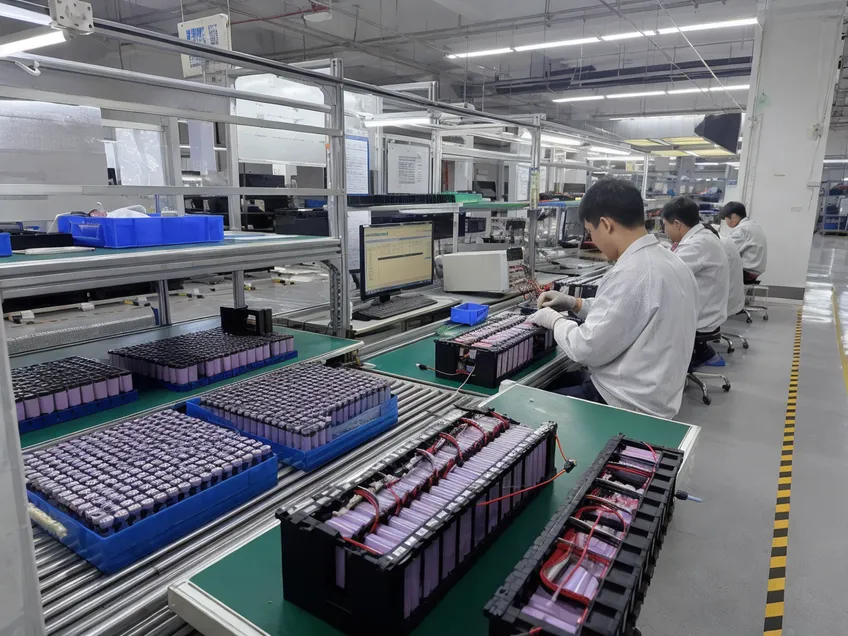
Automated Cell Sorting and Matching
Accepted cells are sorted into matched groups by measured capacity and resistance. For a portable station with 16 cells in series, all 16 need to be within tight tolerance of each other.
Why this matters: Mismatched cells cause the weakest cell to limit the pack — your customer sees reduced runtime after 6 months and blames your product. Proper matching at production prevents this degradation pattern entirely.
In-House BMS Integration
We design and manufacture our BMS boards rather than buying generic modules. For portable power stations, the BMS handles:
- Over-charge protection
- Over-discharge cutoff
- Over-current limiting
- Short-circuit shutdown
- Temperature monitoring
We program the protection thresholds to match the specific cell configuration in each model — a 600 Wh entry unit gets different current limits than a 5,000 Wh high-capacity station.
Why We Don't Use Generic BMS Modules
Generic third-party BMS modules use one-size-fits-all parameters. They work — until a customer in a 45°C climate triggers nuisance shutdowns because the temperature threshold was set for temperate markets.
We tune per model and per market when needed.
Cell Acceptance Tolerances
Functional and Lifecycle Testing
Before packing, every unit goes through a complete verification sequence:
Voltage, frequency, waveform under load
AC, DC, USB-A, USB-C PD negotiation
MPPT tracking and charge rate verification
All protection thresholds verified active
Full charge/discharge cycle measured
Batch-Level Lifecycle Testing
Runs on samples from every production batch — not just during initial type approval:
The commercial result: fewer inconsistent units across your order, fewer after-sales claims in the first 12 months, and stable reorder confidence.
Compliance Paperwork for Battery Export and Market Registration
Lithium batteries are classified dangerous goods for transport. Missing or incorrect documentation means your shipment sits at port — and port storage fees erode your landed margin fast.
As a portable power station supplier with 13 years of export experience, we maintain current documentation for every standard model.
What This Means for Your Import Process
- UN38.3 test summary and MSDS ship with every order — your freight forwarder has what they need without chasing paperwork
- CE and IEC 62133 reports are available for your market registration files in the EU
- If your destination market requires additional local certification (FCC for US, PSE for Japan, BIS for India), our engineering team supports the application with test samples and technical data packages
Important: Product-specific certificates should be confirmed by model before order placement. Not every model carries every regional certification — confirm documents for your destination market before finalizing your order.
Compliance readiness translates directly to fewer port delays, easier reseller documentation, and faster time-to-shelf in regulated markets.
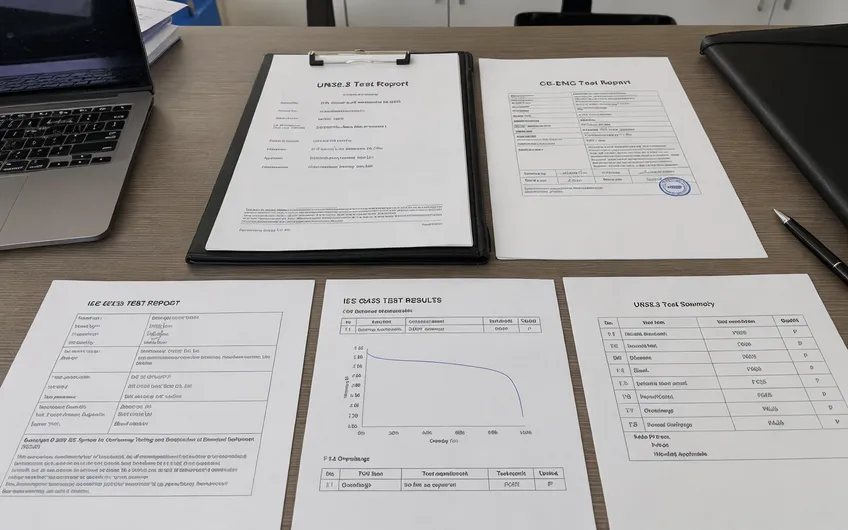
Certifications & Documentation We Hold
| Document | Coverage | Purpose |
|---|---|---|
| ISO ISO 9001:2015 | Manufacturing management system | Batch consistency, traceability, corrective action |
| CE CE | Product safety (EU market) | EU market access and importer compliance |
| IEC IEC 62133 | Battery safety testing | Safety qualification for lithium cells and packs |
| UN UN38.3 | Transport safety testing | Required for air and sea freight of lithium batteries |
| MSDS MSDS | Material safety data | Required by freight forwarders and customs |
Regional certifications (FCC, PSE, BIS) available per model — confirm before order placement.
OEM/ODM Options That Change the Product, Not Just the Label
As a portable solar battery power station manufacturer, we separate customization into two tiers — because "OEM" means different things depending on whether you're swapping a logo or redesigning the inverter output.
The commercial logic: standard customization protects your brand identity at low cost. Technical customization creates SKU differentiation that commodity resellers can't replicate — your margin stays protected because the product isn't available from the next factory on Alibaba with a logo swap.
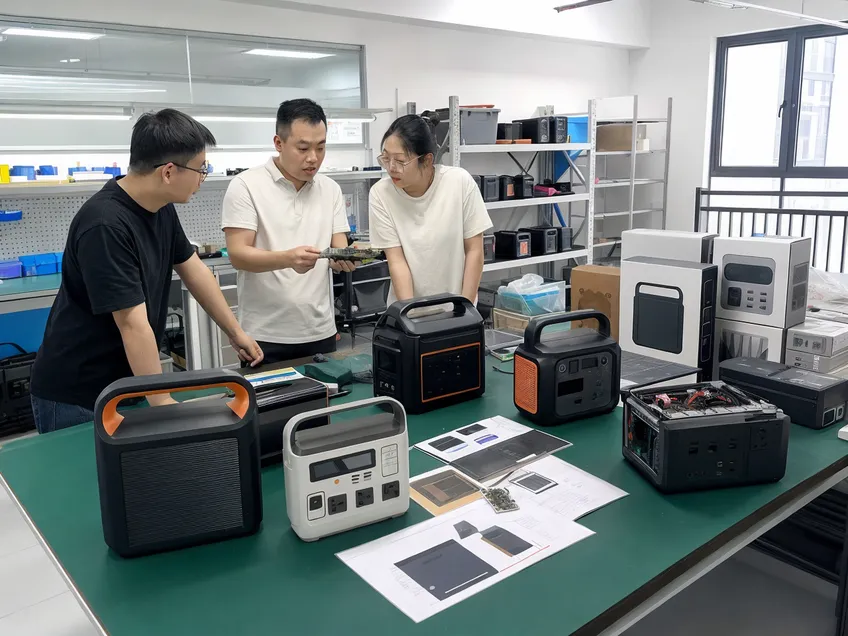
Standard Customization (Low MOQ, Fast Turnaround)
These changes use existing tooling and production processes. MOQ starts at 100 units for standard models:
| Customization | Details |
|---|---|
| Logo and branding | Silk-screen or pad-print on enclosure, custom position |
| Enclosure color | Available from existing color options; custom RAL colors at higher MOQ |
| Carton and packaging artwork | Your brand design on retail box or wholesale carton |
| Manual and labels | Your language, your brand name, your warranty terms |
| Barcode and labeling | UPC/EAN, FBA labels, country-specific compliance marks |
| Plug type | Configured per destination market from standard mold options |
| Warning labels | Market-specific safety warnings in required language |
Technical Customization (Engineering Scope, Higher MOQ)
These changes involve BMS firmware, inverter configuration, or mechanical modifications:
| Customization | Details | MOQ Impact |
|---|---|---|
| Battery capacity | Different cell count or cell capacity | Moderate — uses existing BMS platform |
| Inverter rating | Different power module | Moderate to high |
| AC voltage/frequency | Market-specific inverter output | Low — configured at production |
| BMS parameters | Custom protection thresholds, communication protocols | Low — firmware change |
| Solar input range | Different MPPT controller spec | Moderate |
| Output port layout | Additional or repositioned ports | High — requires enclosure modification |
| Enclosure redesign | New mold for unique product shape | High — tooling investment required |
| New certifications | FCC, PSE, BIS, etc. | Timeline impact — test lab scheduling |
Honest Limits
- New enclosure molds require tooling investment and 45–60 day lead time.
- Non-standard capacity configurations need validation cycling before mass production.
- Firmware changes for BMS communication protocols require your inverter/EMS documentation for compatibility testing.
- We'll scope all of this in the quotation so there are no surprises at production stage.
Packaging and Shipment Details That Protect Landed Margin
A portable solar battery storage product with a lithium pack inside carries shipping constraints that affect your cost structure. Getting packaging wrong means damage claims, customs holds, or retail presentation that doesn't match your brand positioning.
Wholesale and Export Packaging
Standard Export Carton
Reinforced double-wall corrugated, individual foam inserts per unit, stacked on pallets for container loading
Retail-Ready Packaging
Printed color box with product imagery, specs, and your branding — ready for shelf display without repackaging
White-Label Programs
Neutral outer carton with your branded retail box inside — suitable for multi-brand distributors
Palletization
Configured for 20GP or 40HQ container loading; we optimize carton dimensions to maximize container utilization for your specific model mix
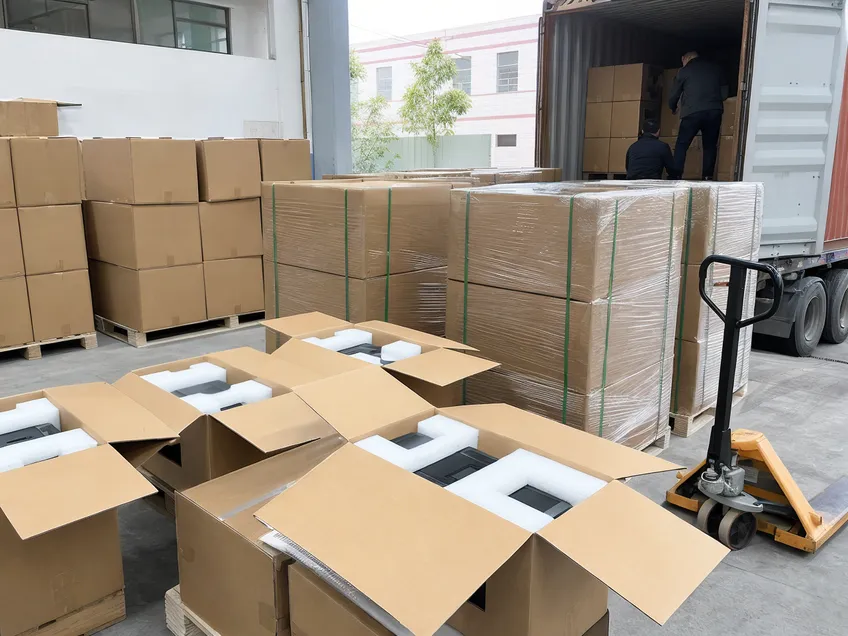
Battery Shipping Compliance
Every shipment includes:
UN38.3 test summary
(per model)
MSDS documentation
Lithium battery shipping labels
(Class 9 where applicable)
Packing list with battery specs
for customs declaration
We coordinate with your freight forwarder on documentation requirements. If you're new to lithium battery shipping, we can recommend forwarders experienced with DG cargo in your destination region — it saves time versus educating a general freight agent.
Regional Packaging Considerations
Africa & South America
Where inland logistics are rough, we reinforce carton construction and add additional corner protection to prevent transit damage on unpaved roads and multi-modal transfers.
E-Commerce Channels
For Amazon FBA and independent stores, we configure barcode labeling, carton weight limits, and package dimensions to meet platform requirements — no repackaging needed at your warehouse.
Choosing Between Power Stations, Chargers, Kits, and Camping SKUs
Our portable solar battery range includes four product types under one category. If you're not sure which format fits your channel, this comparison helps you navigate.
Portable Solar Battery Power Station
Portable Solar Battery Charger
Portable Solar Battery Kit
Portable Solar Battery for Camping
The power station (this page) is the highest-capacity, most feature-complete format — it includes an inverter for AC output, which the charger and basic kit do not. If your buyers need to power AC appliances (tools, small appliances, medical devices), this is the correct product type.
If you're building a product line across multiple channels, we can produce chargers, kits, and power stations on the same production schedule — one purchase order, one shipment, multiple SKUs.
Procurement FAQ for Trial Orders and Repeat Supply
What capacity portable solar battery power station should you stock first?
Start with the mid-range (1,000–2,000 Wh) if you're testing a new market. It covers the widest use-case spread — home backup, outdoor, small commercial — without the high unit cost of the large-capacity tier. Order 100–200 units to test sell-through, then expand into entry-level (for volume retail) or high-capacity (for commercial accounts) based on which segment responds.
What is the difference between a portable solar battery generator and a portable power station?
Functionally, they're the same product — a battery with integrated inverter and solar charging input. "Portable solar battery generator" is a search term buyers use when comparing against fuel generators. The key difference from an actual generator: no fuel, no emissions, no noise, no maintenance schedule. For your product listing, use whichever term your target market searches for. We can print either term on packaging and manuals.
How should solar panel wattage be matched to the power station input?
Match panel wattage to 70–100% of the station's rated solar input. A 1,000 Wh station with 400 W max solar input pairs well with a 200–400 W panel array. Confirm that your panel's open-circuit voltage (Voc) stays below the station's maximum input voltage — exceeding it triggers MPPT protection and stops charging entirely. If you're bundling panels with stations, we can verify compatibility during the quotation stage.
What certifications and documents are needed to import portable power stations?
At minimum: UN38.3 test summary and MSDS for freight clearance. For market access: CE (EU), FCC (US), PSE (Japan), or local equivalents. We provide UN38.3, MSDS, CE, and IEC 62133 documentation for standard models. Additional regional certifications can be arranged — send your capacity and destination market and we'll confirm which documents are ready and which need application.
Can AC voltage, plugs, branding, packaging, and BMS settings be customized?
Yes to all. AC voltage/frequency and plug type are configured at production — not field-changeable, so confirm before ordering. Branding (logo, color, packaging, manual) starts at 100-unit MOQ on standard models. BMS parameter adjustments (protection thresholds, communication protocols) are firmware-level changes our engineering team handles during order setup. Enclosure modifications require higher MOQ and tooling lead time.
What MOQ applies to standard models versus OEM/ODM portable power stations?
Standard models with branding customization: 100 units. Technical customization (capacity change, inverter rating, new BMS parameters): typically 200–500 units depending on engineering scope. Full ODM with new enclosure tooling: 1,000+ units to amortize mold cost.
We'll break down the MOQ by customization tier in your quotation so you can decide which level of differentiation justifies the volume commitment.
Ask an engineer before ordering — we'd rather answer questions upfront than sort out specification mismatches after production.
Contact EngineeringQuote Path for Standard Models or Custom Programs
Ready to move forward? Send us the following and we'll return a technical recommendation with pricing within 48 hours.
What We Need From You
Target capacity range
Wh or kWh
Inverter rated power
W
AC voltage and frequency
For your destination market
Plug type required
Region-specific connector standard
Solar input requirement
Max panel wattage you plan to pair
Branding needs
Logo, color, packaging, manual language
Packaging format
Export carton, retail box, white-label
Quantity
First order + estimated annual volume
Destination market
Country/region
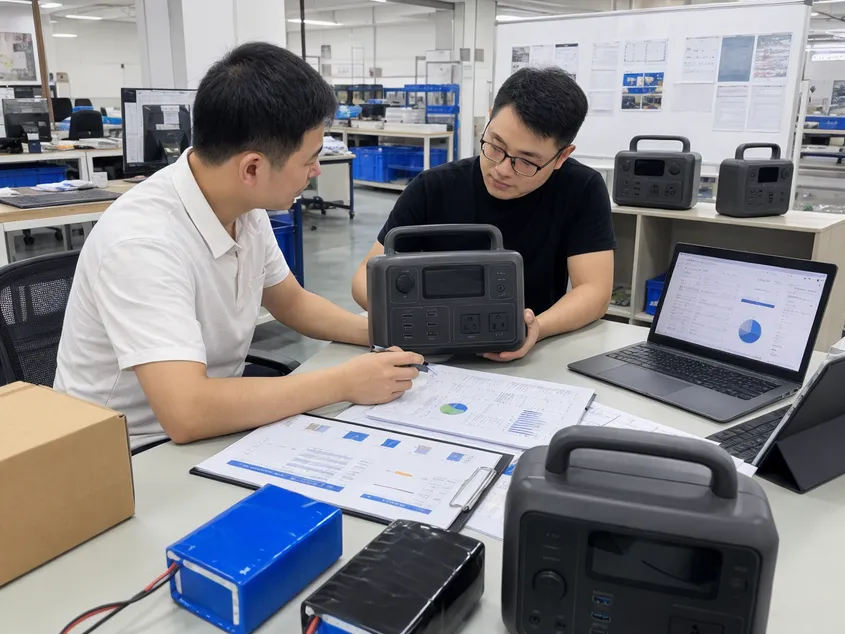
What You'll Receive
We can recommend standard models that ship faster, or scope an OEM/ODM configuration if your channel needs differentiation. Either way, you'll get a clear breakdown of:
- Unit cost breakdown
- Minimum order quantity
- Lead time estimate
- Included documentation