

24V Solar Battery Charger Programs for Distributor and Project Orders
24V solar battery packs engineered for charger-ready deployment — BMS parameters matched to your MPPT controller, inverter, or kit program.
We supply the battery side of your 24V charging system: cell-matched packs, application-tuned BMS firmware, and charge profile documentation so your field return rate stays where your margin needs it.
The Battery That Sits on the Receiving End of Your Charging System
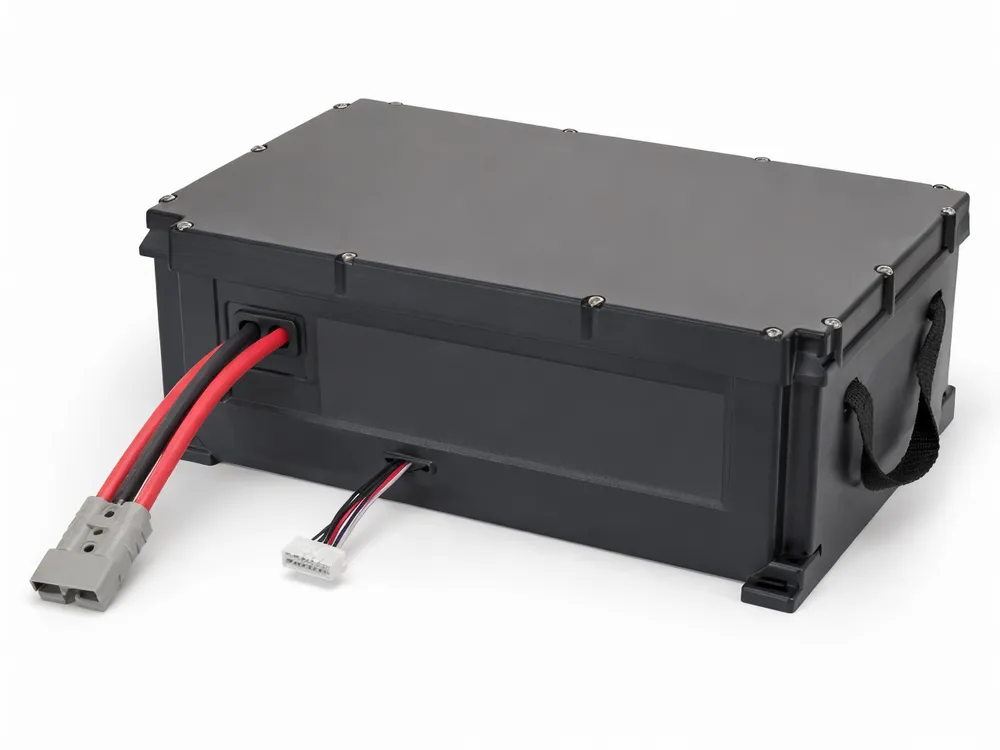
EVANBattery is a 24V solar battery charger manufacturer that supplies battery packs built to integrate cleanly with solar charge controllers, MPPT regulators, hybrid inverters, and bundled kit programs. We don't manufacture standalone chargers or inverters — we make the battery and BMS that sit on the receiving end of your charging system, configured so the two sides talk to each other without the mismatch failures that generate field returns.
If you're sourcing 24V batteries for a charger-paired program — whether that's a solar home kit, an inverter-battery package, or a standalone battery that must accept charge from a specific controller model — this page covers the specifications, chemistry options, compatibility requirements, and OEM scope you need to build your quote request.
For broader 24V category information, see our 24V solar battery series.
What This Page Covers
- Battery-side charging specifications your buyer can quote
- LiFePO4, Gel, and AGM charge profiles that reduce field warranty risk
- MPPT controller, inverter, and kit compatibility details
- Market segments where 24V charging packages move in volume
- OEM/ODM options for 24V solar charger supplier programs
- Production checks, compliance, and export packaging
- Comparison: 24V charger-ready packs vs. 24V/48V systems
Also in this series:
24V 48V Solar Battery — dual-voltage systemsBattery-Side Charging Specifications Your Buyer Can Quote
The table below covers typical charging-relevant specifications across our 24V battery range. These are the parameters your charger, controller, or inverter needs to match — and the values we confirm per-model during the RFQ process.
| Parameter | LiFePO4 (25.6V Lithium) | Gel (24V Lead-Acid) | AGM (24V Lead-Acid) |
|---|---|---|---|
| Nominal Voltage | 25.6V (8S configuration) | 24V (12 cells) | 24V (12 cells) |
| Typical Capacity Bands | 50Ah, 100Ah, 150Ah, 200Ah | 50Ah, 100Ah, 150Ah, 200Ah, 250Ah | 50Ah, 100Ah, 150Ah, 200Ah |
| Recommended Charge Voltage | 29.2V (CC/CV) | 28.2–28.8V (float 27.4–27.6V) | 28.8–29.4V (float 27.2–27.6V) |
| Recommended Charge Current | 0.2C–0.5C (20A–100A for 100Ah) | 0.1C–0.15C (10A–15A for 100Ah) | 0.1C–0.2C (10A–20A for 100Ah) |
| Max Continuous Discharge | 50A–200A (BMS-configured) | 0.2C–0.3C | 0.2C–0.3C |
| BMS Charge Protection | OVP 29.2V, cell OVP 3.65V, OTP 45°C | N/A (external controller manages) | N/A (external controller manages) |
| BMS Discharge Protection | UVP 20V, cell UVP 2.5V, OCP, SCP | N/A | N/A |
| Communication Options | RS485, CAN bus, Bluetooth | N/A | N/A |
| Terminal Options | M8 bolt, Anderson connector, custom | M8 bolt, F12 terminal, custom | M8 bolt, F12 terminal, custom |
| Enclosure | Metal case, ABS plastic, IP65 available | ABS case, standard battery box | ABS case, standard battery box |
| Operating Temp (Charge) | 0°C to 45°C | -10°C to 40°C | -10°C to 40°C |
| Operating Temp (Discharge) | -20°C to 55°C | -15°C to 50°C | -15°C to 50°C |
| Certifications | CE, IEC 62133, UN38.3, MSDS | CE, UN38.3, MSDS | CE, UN38.3, MSDS |
Specifications shown are industry-typical values for this product type. Actual specifications are confirmed per-model during quotation based on your charger/inverter requirements and deployment environment.
Include your controller model, target capacity, and quantity for a matched specification sheet.
LiFePO4, Gel, and AGM Charge Profiles Reduce Field Warranty Risk
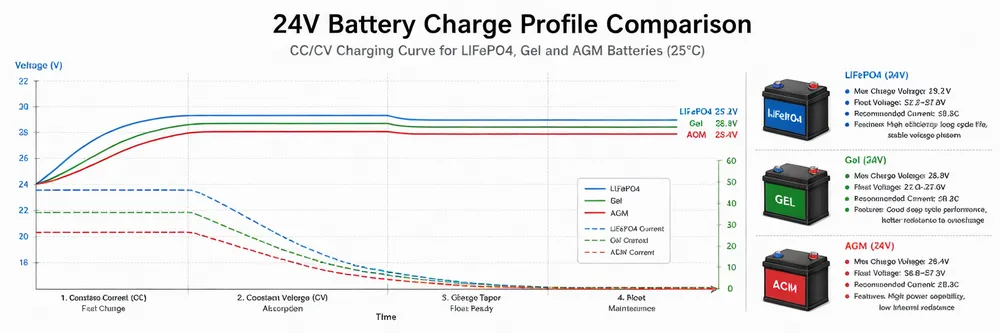
The single most common cause of 24V battery field failure we see across our export markets is charge profile mismatch. A battery paired with the wrong charger settings doesn't explode — it degrades slowly, loses capacity over months, and eventually triggers a warranty claim that costs you more than the original unit margin.
LiFePO4 Charge Behavior
An 8S LiFePO4 pack needs 29.2V charge voltage with a CC/CV profile. The BMS monitors individual cell voltage during charge and triggers balancing above 3.45V per cell.
If your charger delivers only 28.8V (a common gel setting), the pack never reaches full charge — capacity drops 10–15% within the first year, and your end customer reports "the battery doesn't last."
We program BMS charge acceptance parameters to match your specific charger output, so the pack and controller agree on when charging is complete.
Gel Charge Sensitivity
Gel batteries require precise float voltage — too high (above 28.8V) and the gel electrolyte dries out, creating permanent capacity loss. Too low and the battery sulfates.
The tolerance window is narrow: typically ±0.2V. If you're building a 24V solar battery kit with gel chemistry, your charge controller must have a dedicated gel profile, not a generic "lead-acid" setting.
We specify the exact charge parameters on every gel battery datasheet so your downstream installer has no ambiguity.
AGM Charge Tolerance
AGM accepts slightly higher charge voltage than gel (up to 29.4V) and recovers better from occasional overcharge, but still degrades under chronic undercharge.
For budget solar home kits where the end user may connect a basic PWM controller, AGM is more forgiving than gel — a factor worth considering when your after-sales infrastructure is limited.
Field Warranty Data: Three Years of African Off-Grid Shipments
We've tracked warranty data across three years of African off-grid shipments — the battery is the same; the charger setting is the variable.
As a 24V solar charger supplier, we include chemistry-specific charge profile documentation with every shipment, formatted for your installer training materials or end-user manual.
MPPT Controller, 24V Solar Battery Inverter, and Kit Compatibility
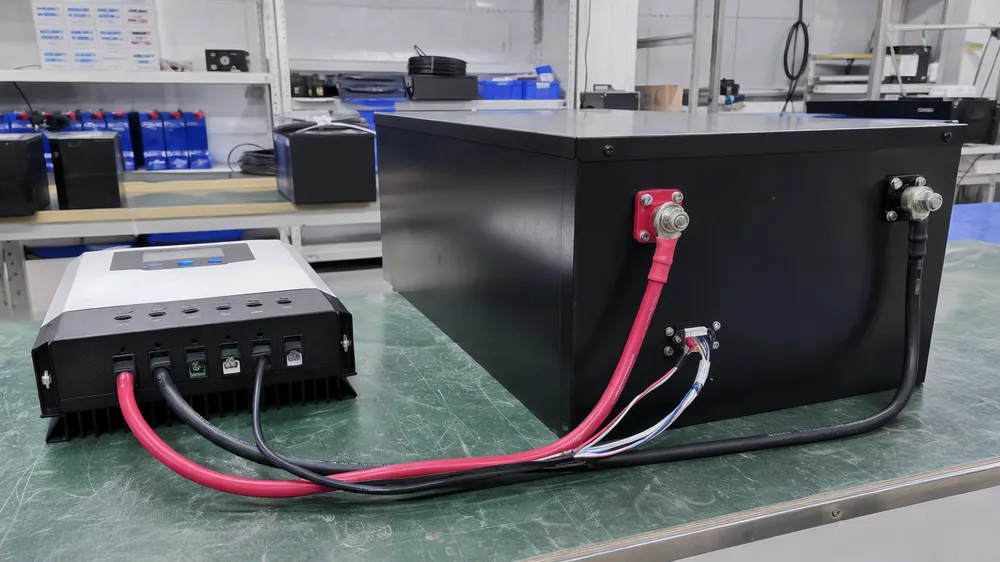
Before we quote a 24V battery for your charger-paired program, we need to understand what's on the other side of the cable. The battery doesn't exist in isolation — it's part of a charging system, and the system parameters determine which BMS settings, terminal configurations, and protection thresholds we build into your pack.
What to Send Us Before Quotation
MPPT Controller Model and Brand
Charge voltage output, max charge current, battery type selection options, and whether it supports lithium profiles.
Inverter or Inverter-Charger Model
DC input voltage range, max charge current from AC, low-voltage disconnect setting, and communication protocol (if battery monitoring is required).
Panel Array Wattage
Determines peak charge current the battery must accept; undersized BMS current rating causes nuisance tripping.
Ambient Temperature Range
Tropical installations need different BMS thermal cutoffs than temperate climates.
Load Profile
Continuous draw, peak draw, and duty cycle determine discharge current rating and BMS OCP threshold.
Communication Requirement
Some 24V solar battery inverter systems require RS485 or CAN bus for battery state-of-charge reporting; others work with simple voltage sensing.
Why This Matters Commercially
When your battery and inverter communicate correctly, the inverter manages charge/discharge within safe limits automatically.
When they don't, the BMS trips on protection, the inverter throws a fault code, and your customer calls you — not the inverter manufacturer. Getting the pairing right at the specification stage eliminates that support cost entirely.
24V Solar Battery Kit Supply
If you're assembling a complete kit — battery, MPPT controller, panel, cabling, and mounting hardware — we supply the battery component with charge parameters documented for your specific controller.
We don't manufacture controllers or panels, but we've paired our packs with most major MPPT brands and can confirm compatibility from existing test data:
For kit assembly logistics, we can ship battery and accessories in a single consolidated carton under your branding.
For wiring layout and connection sequence guidance, see our 24V solar battery wiring diagram guide.
Send Controller & Inverter ModelMarket Segments Where 24V Charging Packages Move in Volume
Every 24V battery we ship is going into a system with a charger on the other end. The question for you is which market segment generates the repeat orders that justify locking in a supply program.
Solar Home System Distributors
~40% of Our 24V OutputThe 24V solar home kit — battery, MPPT controller, panel, and wiring — is the workhorse product for mid-range off-grid markets in Africa and Southeast Asia.
Distributors order 500–2,000 battery units per quarter, paired with a specific controller model. Once the kit design is validated, reorders are identical spec — your supply chain becomes a repeating purchase order rather than a new sourcing exercise each cycle.
We keep standard 24V charger-compatible configurations in rolling production for exactly this pattern.
Off-Grid Rural Electrification Programs
Government and NGO tenders specify complete 24V systems with documented charger compatibility. Winning these contracts requires a battery supplier who can provide charge profile documentation, installer training materials, and consistent batch quality across multi-thousand-unit deliveries.
Your margin on electrification programs comes from zero-defect supply and documentation completeness — not from unit price negotiation.
Telecom and Security Backup
24V DC bus systems for telecom towers, CCTV networks, and remote monitoring stations need batteries that accept charge from rectifiers or solar controllers with specific voltage windows.
This segment values cycle life and temperature tolerance — they'll specify LiFePO4 with RS485 monitoring over gel at half the price because a site visit to replace a failed battery costs more than the premium.
If you supply telecom integrators, your 24V solar battery kit includes the communication interface as standard.
Small Commercial & Agricultural Backup
Pump controllers, cold storage, workshop inverters, and greenhouse systems that run on 24V DC. These buyers often start with a single 24V 200Ah pack paired with a specific inverter model, then scale by adding parallel units.
Your initial sale seeds a repeat expansion pattern — same battery, same charger settings, just more units.
The solar home kit segment alone accounts for roughly 40% of our 24V charger-compatible output.
It's the segment where charger matching matters most, because the end user has no technical knowledge to troubleshoot a mismatch. Getting the battery-controller pairing validated at factory level is what keeps your field return rate near zero.
OEM/ODM Options for 24V Solar Charger Supplier Programs
When you source 24V batteries as a 24v solar charger supplier — bundling battery with charger or controller under your brand — the customization scope extends beyond the battery itself into how the battery integrates with your charging system.
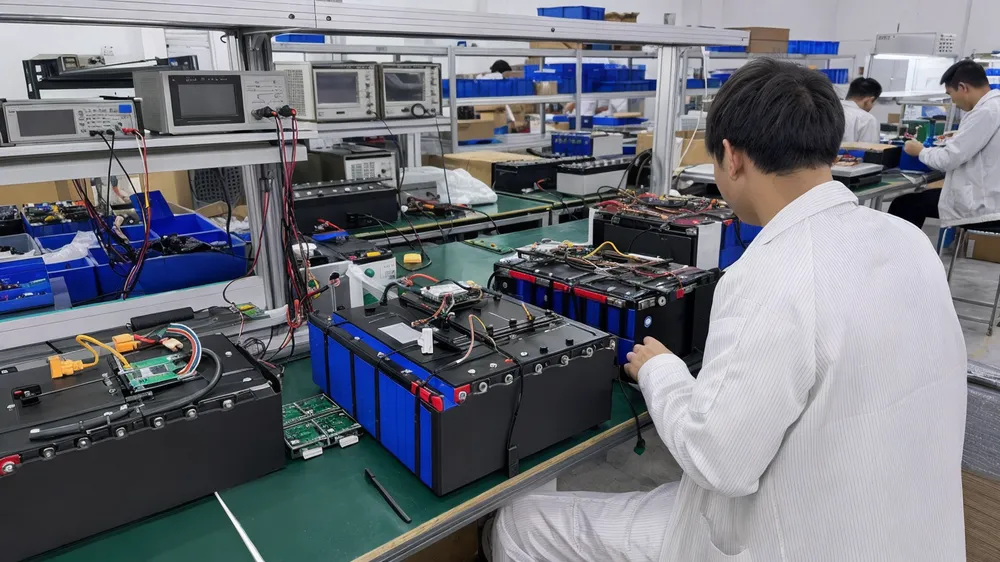
Charge Parameter Customization
We program BMS firmware to match your specific charger or inverter model. Charge voltage, charge current limit, CV-to-float transition threshold, low-temperature charge lockout, and cell balancing trigger point are all configurable per-project. This isn't a generic "lithium mode" — it's your charger's exact output profile programmed into the battery's acceptance logic.
Communication Protocol Matching
RS485 Modbus, CAN bus, or Bluetooth — configured to report SOC, voltage, current, temperature, and protection status to your inverter or monitoring platform. We provide the protocol documentation so your software team can integrate battery telemetry into your system dashboard.
Kit-Ready Packaging
Battery packed with matched accessories (cables, fuses, terminal covers, mounting brackets) in a single branded carton. Your warehouse receives one SKU, not separate components that need assembly before resale.
Capacity and Chemistry Selection
50Ah through 200Ah+ in LiFePO4, gel, or AGM — configured to your market's price point and performance requirements. Need a 24V 100Ah LiFePO4 for a premium kit and a 24V 150Ah gel for a budget line? Both run on our production lines simultaneously.
Branding Scope
Logo, color, model number, serial number format, carton design, user manual (we can translate into your market language), warranty card, and QR code linking to your support portal. Full private-label from battery casing through outer carton.
MOQ Structure
100 units for standard models with label customization. BMS firmware changes on existing hardware hold at 100–200 units. Fully custom cell configurations and new enclosure tooling require volume discussion — we quote the threshold during RFQ so you can plan your landed cost before committing.
Production Checks Behind Stable Charge Acceptance
A battery that charges inconsistently across a batch creates a support nightmare — some units perform perfectly while others trigger charger faults or lose capacity within months. The difference between consistent and inconsistent charge acceptance comes down to what happens during production, not during use.
We've manufactured solar batteries since 2012 — 13+ years of refining the process steps that determine whether a 24V pack accepts charge predictably across its rated life. Our 9,900 m² facility runs 6 production lines with 150 employees, and the 18+ engineers in our R&D team split between cell selection, BMS firmware, and application testing.
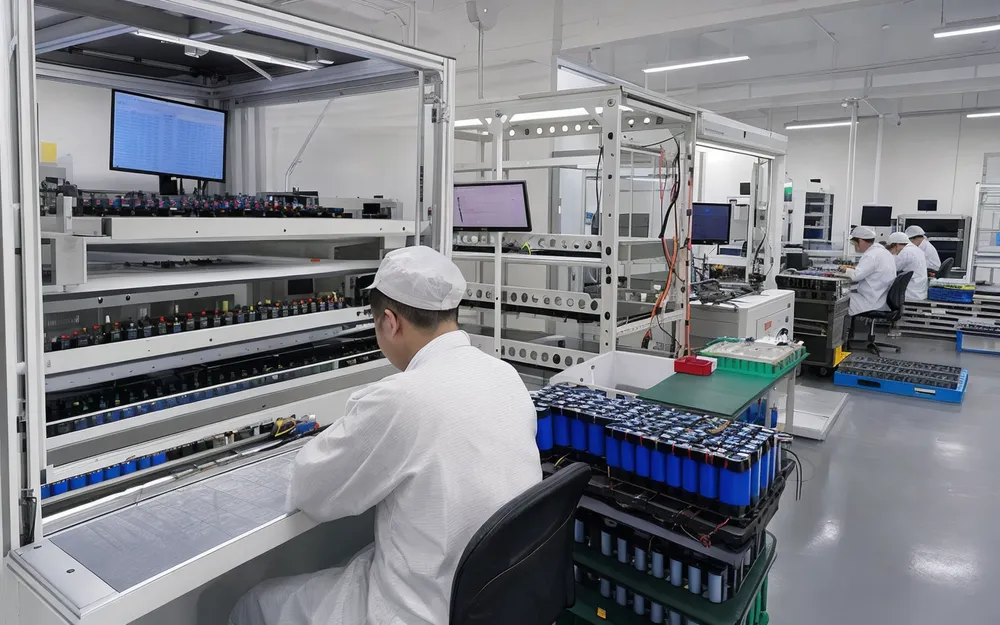
Cell Sorting Determines Charge Uniformity
Our automated sorting system measures every cell's actual capacity and internal resistance, then groups cells within 20mV and 5mΩ. Tight matching means every cell in your pack reaches full charge at the same time — no weak cell hitting OVP early while others are still absorbing. This is the single biggest factor in consistent charge acceptance across a production batch.
We rejected three cell suppliers in 2023 alone because their batch-to-batch variance exceeded our sorting window — tighter incoming standards mean fewer surprises in your field.
BMS Function Testing Before Pack Marriage
Every BMS board passes over-charge, over-discharge, over-current, short-circuit, and temperature protection verification before it's integrated with cells. Protection thresholds are programmed to match your charger's output profile — not factory defaults that may conflict with your system.
Full Charge/Discharge Cycling on Every Batch
After assembly, packs go through complete charge/discharge cycles to verify actual capacity matches rated capacity. Packs that fall outside tolerance get pulled — they don't ship as "B-grade" under a different label.
Temperature Soak Testing
High-temperature (55°C) and low-temperature (-20°C) testing on every production batch confirms that charge acceptance and BMS behavior remain stable across the operating range your installation will actually see.
The Result for You
Predictable charge behavior across your entire order, batch after batch, reorder after reorder. Your field warranty exposure becomes a calculable number, not a variable.
Compliance and Export Packaging Before Shipment
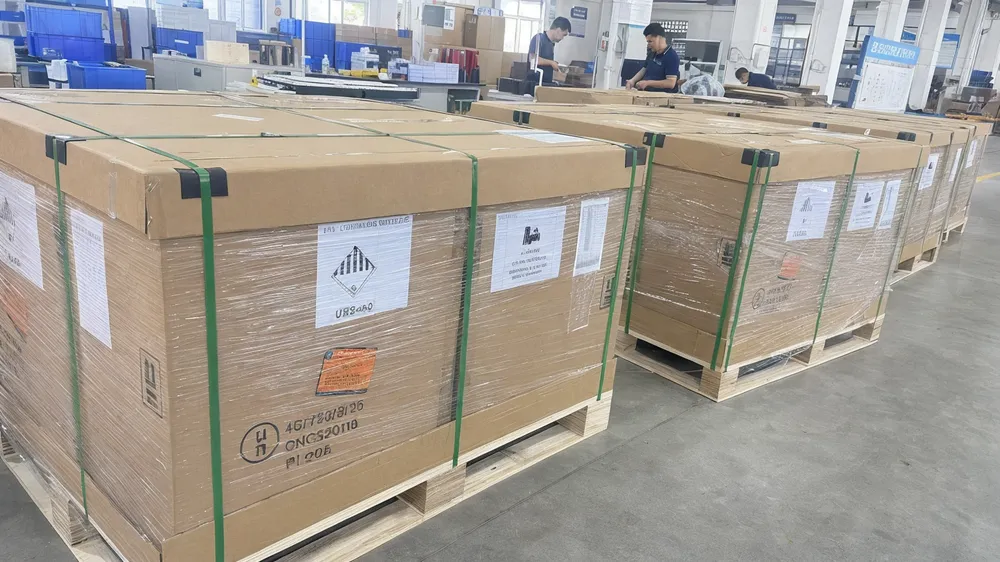
Batteries classified as dangerous goods require specific documentation and packing standards before they can clear export customs, survive ocean freight, and pass your destination port's inspection. We handle this as part of production workflow — your compliance package ships with the product, not as a follow-up email three weeks later.
Certifications Held for 24V Solar Battery Charger Programs
These cover the battery pack itself — if your program includes charger or controller accessories sourced separately, those components carry their own certification requirements.
Export Documentation Package
- UN38.3 test summary
- MSDS (Material Safety Data Sheet)
- CE declaration
- IEC 62133 report
- Commercial invoice with correct HS code
- Packing list with gross/net weights
- Dangerous goods declaration for shipping line booking
For OEM/ODM models, we generate model-specific test reports during development so documentation is ready when your first production order ships.
Packing Standards for 24V Battery Shipments
- Terminal insulation caps on every unit
- Reinforced double-wall cartons rated for actual unit weight (not generic lightweight boxes)
- Foam inserts or molded dividers preventing unit-to-unit contact
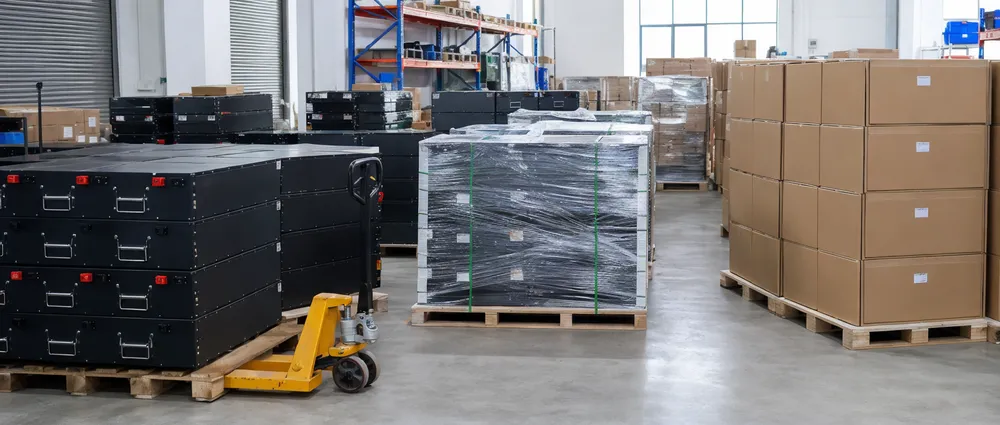
- Palletization with stretch wrap and corner protectors
- UN-compliant markings on outer cartons
We've shipped to over 30 countries — the packing spec reflects what actually survives a 45-day ocean transit plus inland trucking, not what looks good leaving the factory gate.
Labeling for Your Market
Carton labels in your language, with your model numbers, barcodes, and regulatory marks. If your market requires specific safety symbols, voltage warnings, or recycling marks, we include them in the carton artwork during OEM setup.
As a 24V solar charger supplier sourcing from us, your import process starts with complete paperwork — no delays at customs waiting for missing test reports.
Choose Between 24V Charger-Ready Packs and 24V/48V Systems
This page covers 24V batteries configured for charger, controller, and inverter compatibility — the battery side of your 24V charging system. But not every buyer's program stays at 24V.
Stay on This Page
Your program is 24V-specific — solar home kits, 24V inverter packages, telecom backup on 24V DC bus, or any application where the charger/controller is already specified for 24V input.
Your next step is requesting a quote with your charger model and capacity target.
Request a QuoteConsider the 24V/48V Page
Your catalog spans both voltage tiers, your project may scale beyond 5 kW (where 48V becomes more efficient), or you're comparing 24V and 48V for a specific 24V solar battery inverter installation.
Covers dual-voltage supply, shared BMS architecture, and catalog planning across both platforms.
24V/48V ConfigurationsReturn to Category Page
You need the broader 24V overview — chemistry comparison, market segment analysis, or general 24V procurement specifications. The category page covers the full scope.
Start here if you're still deciding voltage architecture or need the full 24V product range.
24V Solar Battery SeriesThe commercial logic:
If your charger or inverter is already specified and you know it's 24V, you're in the right place. If you're still deciding voltage architecture, start at the category level or the 24V/48V comparison.
Questions Buyers Ask Before Quoting a 24V Solar Battery Charger Program
Technical answers to the compatibility and configuration questions that come up most often during quoting — so your engineering team can spec with confidence.
What charge voltage should a 24V LiFePO4 solar battery charger use?
29.2V is the standard full-charge voltage for an 8S LiFePO4 configuration (8 × 3.65V per cell). Your MPPT controller or inverter-charger must be set to LiFePO4 mode — not lead-acid, not gel.
The charge profile is CC/CV: constant current until the pack reaches 29.2V, then constant voltage until current tapers to the cutoff threshold (typically 0.02C–0.05C). Our BMS is programmed to accept this profile and trigger cell balancing above 3.45V per cell.
If your charger cannot output 29.2V or doesn't have a lithium-specific mode, it's not compatible with LiFePO4 — contact us with the charger model and we'll confirm before you order.
Required charger mode: LiFePO4 / Lithium. Lead-acid and gel profiles will not reach 29.2V or will overshoot cell-level limits.
Can the same 24V solar battery charger work for LiFePO4, AGM, and gel batteries?
Not without changing settings. A multi-chemistry charger with selectable profiles can work with all three chemistries, but the correct profile must be active for the connected battery. Mismatched profiles cause permanent damage or chronic capacity loss.
Required charge voltage. Undercharging on gel settings (28.8V max) results in chronic capacity loss.
Charging on AGM settings (29.4V) causes electrolyte dry-out and permanent damage.
Overlaps with LiFePO4 range but uses a different absorption/float profile.
We label every battery with its required charge parameters and include a charger compatibility note in the datasheet — your installer or end user has no excuse for mismatch if the documentation is followed.
What charge current is suitable for 24V 100Ah or 200Ah solar batteries?
LiFePO4 — 0.2C to 0.5C Standard Range
100Ah Pack
20A – 50A
charge current
200Ah Pack
40A – 100A
charge current
Higher charge current fills the battery faster but generates more heat — our BMS includes over-temperature protection that reduces charge current if cell temperature exceeds 45°C.
Gel & AGM — 0.1C to 0.2C Maximum
100Ah Gel Battery
15A – 20A max
charge current
Exceeding Limit
Gassing & electrolyte loss
failure mode
Size your solar array and controller output to stay within these limits — an oversized panel array pushing 60A into a 100Ah gel battery will shorten its life dramatically regardless of controller quality.
How should a 24V solar battery inverter be matched with BMS protection limits?
The inverter's low-voltage disconnect (LVD) setting must be higher than the BMS under-voltage protection (UVP) threshold. The inverter's maximum charge current (in hybrid/charger mode) must not exceed the BMS over-current protection (OCP) threshold.
Correct Protection Hierarchy
Inverter LVD triggers first
Example: Inverter cuts off at 22V
BMS UVP acts as backup only
Example: BMS triggers at 20V
If the BMS triggers first
The inverter loses DC input abruptly and may fault. This is the incorrect hierarchy — the inverter should always protect the battery before the BMS needs to act.
Send us your inverter model during RFQ
We'll set BMS thresholds to create proper protection hierarchy with your specific equipment — ensuring LVD, UVP, and OCP limits are coordinated correctly.
Can EVANBattery supply a 24V solar battery kit with private label packaging?
Yes — we supply the battery component of your kit under full private label: your logo on the battery casing, your model number, your carton design, your user manual, and your warranty card. The battery ships with charge profile documentation matched to your specified controller or inverter.
We don't manufacture the charger/controller/panel components, but we can pack your battery with accessories you supply (or source separately) into a single branded carton for kit distribution.
Private-Label Kit MOQ
MOQ for private-label kits starts at 100 units on standard battery models.
What documents are needed to import 24V solar batteries?
Minimum documentation for most markets:
- UN38.3 test summary (lithium transport classification)
- MSDS (material safety data)
- Commercial invoice with HS code and battery specifications
- Packing list
European Imports
Additionally require CE declaration of conformity and IEC 62133 test report.
Other Markets (Australia, Japan, certain Middle Eastern countries)
May require additional local certification — we support applications with test samples and technical data.
All documentation is provided per-model; OEM/ODM configurations receive model-specific reports before first shipment.
View our certification documents
What MOQ applies to standard and custom 24V battery configurations?
| Configuration Type | MOQ |
|---|---|
| Standard 24V models (existing capacity, chemistry, and enclosure with your label) | 100 units |
| BMS firmware customization on existing hardware (matching your specific charger model) | 100–200 units |
| Custom capacity configuration using existing cell formats | 200–500 units |
| Fully custom enclosure with new tooling | Quoted during RFQ (based on tooling amortization) |
We provide exact MOQ and per-unit cost breakdown during the quotation process so you can calculate landed cost before committing to production.
Get Your MOQ & Cost BreakdownSend Your Controller, Inverter, and Quantity Details for a Factory Quote
You've seen the specifications, chemistry options, and customization scope. The next step is straightforward: tell us what charging system your battery needs to work with, and we'll confirm compatibility, recommend a configuration, and quote your order.
Include in Your Inquiry
-
MPPT controller or inverter-charger model and brand
-
Target battery capacity (Ah or kWh)
-
Chemistry preference (LiFePO4, gel, AGM, or undecided)
-
Expected order quantity (initial + annual estimate)
-
Branding requirements (private label, custom carton, manual language)
-
Destination market and port
-
Communication protocol needs (RS485, CAN, Bluetooth, or none)
We respond within 48 hours with a technical recommendation, BMS configuration confirmation, MOQ, pricing tiers, lead time, and packing specification.
Explore related products
Back to 24V Solar Battery