

24V Solar Battery Packs Direct From Factory
LiFePO4 25.6V and lead-acid 24V configurations — 50Ah through 200Ah+, with in-house BMS design, cell sorting, and export documentation handled before your container loads.
Lithium and lead-acid manufactured under one roof since 2012.
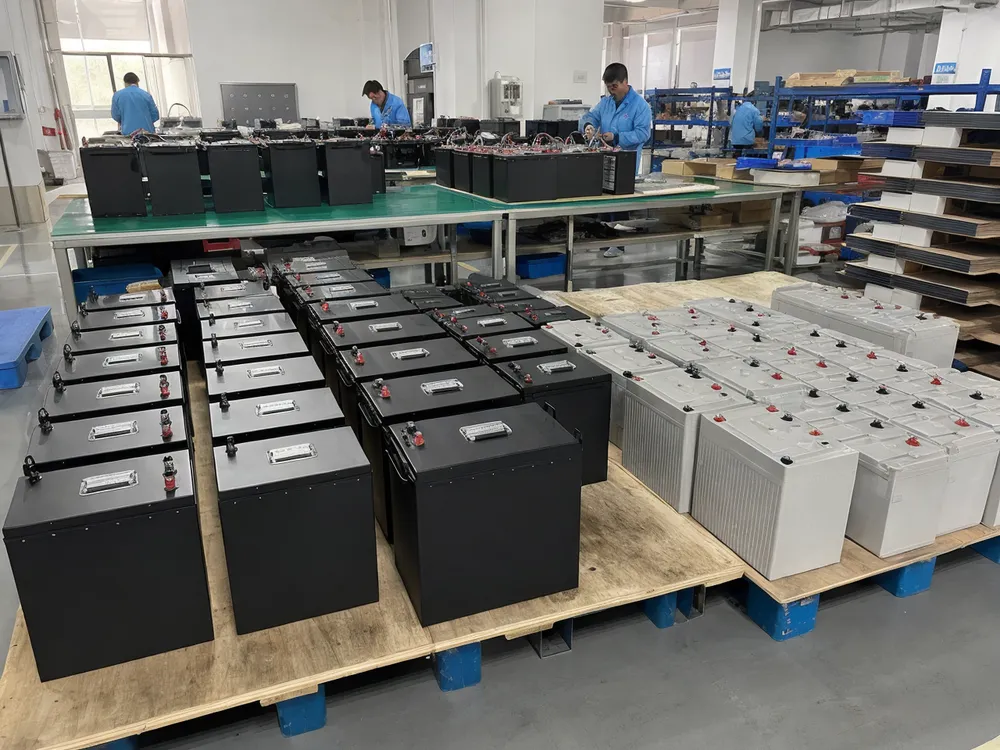
13+ Years
Solar Battery Mfg
6 Lines
Production Lines
2M+
Units/Year Capacity
ISO · CE · IEC
Full Compliance Stack
24V Solar Batteries for Mid-Scale Storage Programs
We manufacture 24V solar batteries for distributors, kit assemblers, and project contractors who supply mid-scale storage — solar home systems in the 2–5 kWh range, weak-grid inverter packages, telecom backup, and light commercial installations where 12V is undersized but 48V adds unnecessary system cost.
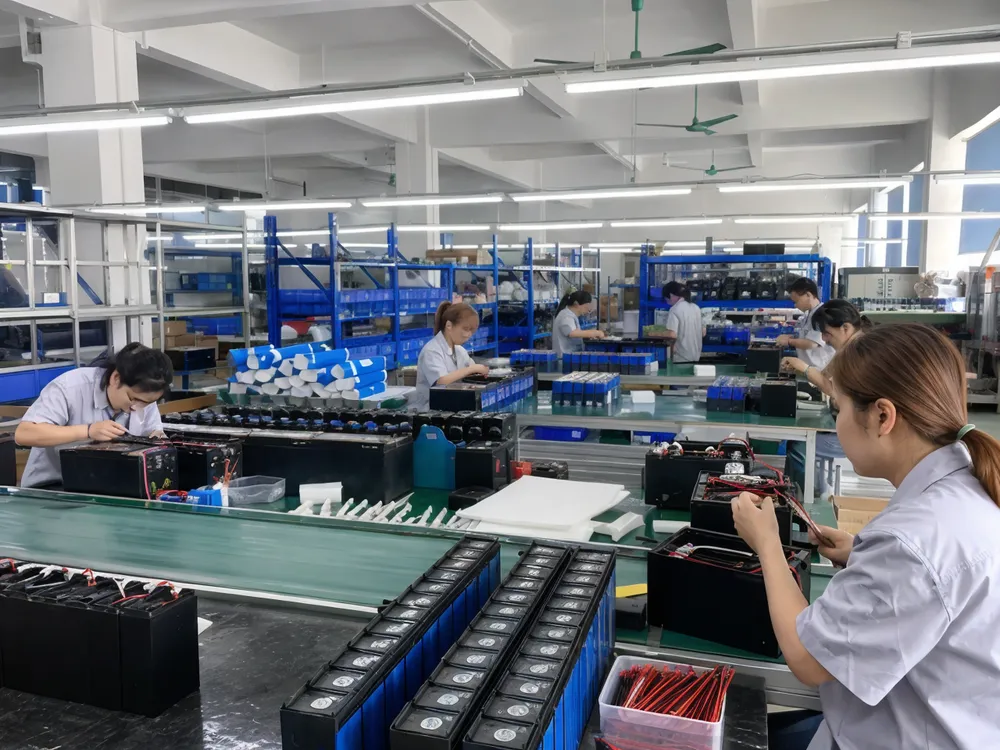
Our factory has produced solar batteries since 2012. The 24V category runs on 6 production lines inside a 9,900 m² facility in Zhongshan, Guangdong, with 150 employees covering cell sorting, pack assembly, BMS integration, and full lifecycle testing.
We hold ISO 9001:2015, CE, IEC 62133, UN38.3, and MSDS documentation — the compliance stack your import process requires before a single unit clears port.
Ready to quote? If you already know your chemistry, capacity, inverter model, and order quantity, send your specification for a factory quote. If you're still deciding between 24V and another voltage tier, keep reading — the next section covers when 24V protects your landed cost better than 12V or 48V.
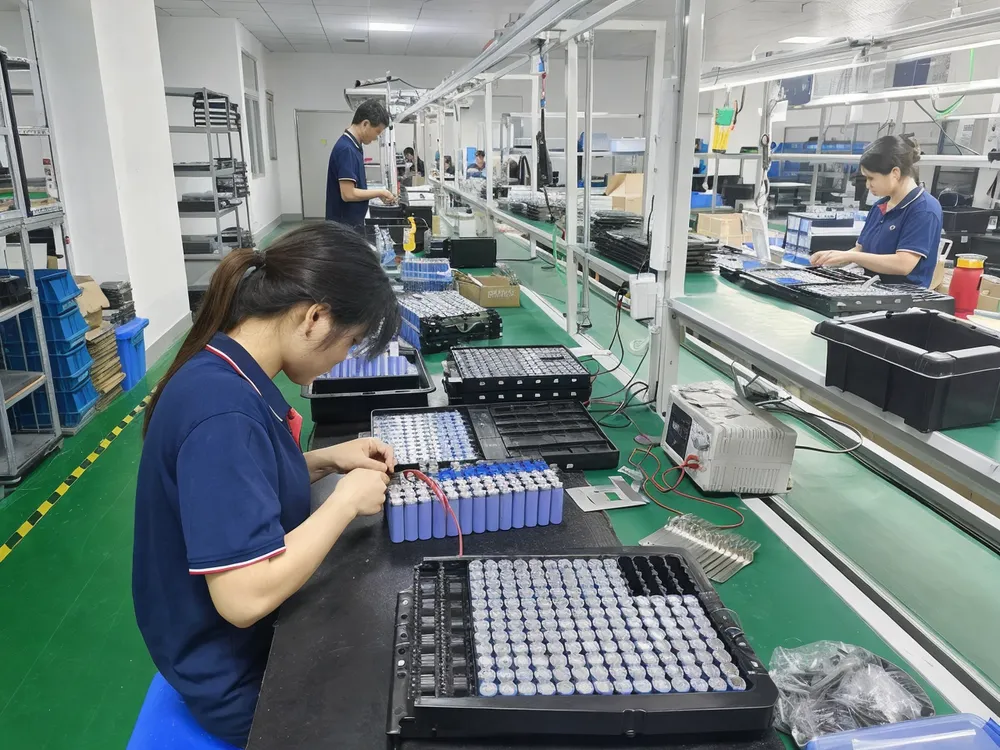
9,900 m²
Factory Floor
150
Employees
When 24V Protects Cost Better Than 12V or 48V
Voltage selection is a commercial decision before it's a technical one. The wrong tier doesn't just create wiring headaches — it locks you into an inverter ecosystem, a cable cost structure, and a price point that may not fit your target market.
Here's how we see it after 13 years of shipping across five regions: 12V works for entry-level kits under 1.5 kWh where the buyer's end customer is price-first and the load is lighting plus phone charging. 48V works for systems above 5 kWh where the inverter demands higher DC bus voltage and the installation is permanent. 24V sits in the middle — and for most solar home and weak-grid programs in Africa, Southeast Asia, and South America, the middle is where the volume lives.
The commercial logic: a 24V system halves the current draw compared to 12V at the same power output, so your cable cross-section drops and your BMS current rating stays within standard component ranges. But it doesn't require the 48V-class inverters that cost more and limit your buyer's retail price point. For a 3 kWh solar home kit, 24V hits the sweet spot between system cost and performance headroom.
We've watched distributors try to push 48V into price-sensitive rural markets and then switch back to 24V within two reorder cycles — the inverter cost delta killed their margin.
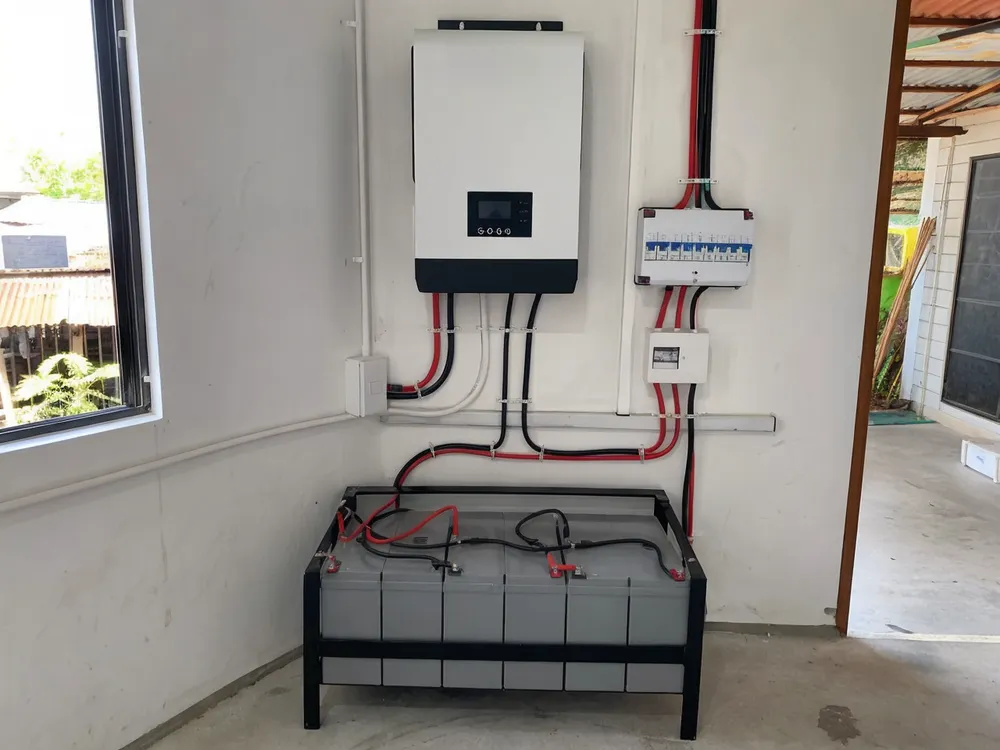
Voltage Tier Comparison for B2B Sourcing
| Voltage Tier | Best Commercial Fit | Risk If Misapplied | Quote Inputs Needed |
|---|---|---|---|
| 12V | Entry solar home kits, portable systems, single-appliance loads under 1 kW | High current at moderate loads → thicker cables, higher BMS cost, limited scalability | Chemistry, Ah, load profile, target retail price |
| 24V | Mid-size solar home, weak-grid inverter packages, telecom backup, DC pump/lighting systems 1–5 kW | Fewer inverter options than 48V in some markets; requires matched charger profile | Chemistry, Ah, inverter model, charge profile, destination market |
| 48V | Commercial storage, rack-mounted systems, high-power inverters above 5 kW | Higher component cost, overkill for small residential, fewer budget inverter options | Chemistry, kWh target, inverter brand/model, rack or standalone |
If your program spans both voltage tiers — say a 24V residential line and a 48V commercial line — we supply both from the same factory, so your documentation, BMS firmware style, and packing standards stay consistent across SKUs.
24V Product Routes You Can Source Through This Category
This category page covers three sourcing paths. Each one connects to a dedicated page with deeper product-level detail:
Standard 24V Solar Battery Packs
This is the parent category for all 24V battery sourcing: LiFePO4 25.6V packs and lead-acid 24V gel/AGM configurations across capacity bands from 50Ah to 200Ah+. If you know your spec, send your 24V battery specification and we'll confirm model availability, MOQ, and lead time.
Current Page24V Solar Battery Charger
For buyers building complete 24V packages that include chargers, MPPT controllers, or inverter-charger combos. Covers charger compatibility, charge profile matching, and kit assembly options. If you're bundling battery + charger as a single SKU for your market, start there.
View charger options24V 48V Solar Battery
For distributors who want a voltage ladder (24V entry, 48V premium) or project buyers comparing both platforms for a specific installation. Covers dual-voltage supply, shared BMS architecture, and how to plan a catalog that scales from residential to light commercial.
Compare voltage tiers| Product Path | Buyer Use | Quote Data Needed | Commercial Value |
|---|---|---|---|
| 24V Solar Battery (this page) | Core battery pack sourcing for 24V programs | Chemistry, Ah, BMS requirements, quantity, destination | Anchor SKU for mid-range solar storage catalog |
| 24V Solar Battery Charger | Complete kit assembly, charger/inverter pairing | Charger type, charge profile, connector, branding | Single-supplier kit reduces sourcing handoffs |
| 24V 48V Solar Battery | Voltage ladder catalog, project comparison | Both voltage specs, inverter models, volume split | Broader catalog from one factory, consistent quality |
Procurement Spec Range for 24V Battery Quotes
The table below covers the specification envelope we manufacture across the 24V category. These are ranges — your actual quote will lock to specific values once we confirm chemistry, capacity, BMS configuration, and enclosure.
| Parameter | LiFePO4 (Lithium) | Gel / AGM (Lead-Acid) |
|---|---|---|
| Nominal Voltage | 25.6V (8S LiFePO4) | 24V (12 cells series) |
| Capacity Range | 50Ah – 200Ah+ | 50Ah – 250Ah |
| Usable Energy (planning) | 90–95% DoD | 50–60% DoD (gel), 50% DoD (AGM) |
| Cycle Life (planning) | 3,000–6,000 cycles at 80% DoD | 500–800 cycles at 50% DoD |
| Max Continuous Discharge | 50A – 200A (BMS-dependent) | 0.2C – 0.3C typical |
| Charge Voltage | 29.2V (standard CC/CV) | 28.2–28.8V (gel), 28.8–29.4V (AGM) |
| BMS Protections | OVP, UVP, OCP, SCP, OTP, cell balancing | N/A (external charge controller manages) |
| Terminals / Connectors | M8 bolt, Anderson, custom | M8 bolt, F12 terminal, custom |
| Enclosure Options | Metal case, ABS plastic, IP65 rated | ABS case, standard battery box |
| Communication | RS485, CAN, Bluetooth (optional) | N/A |
| Operating Temperature | -20°C to 55°C (discharge), 0°C to 45°C (charge) | -15°C to 50°C |
| Certifications | CE, IEC 62133, UN38.3, MSDS | CE, UN38.3, MSDS |
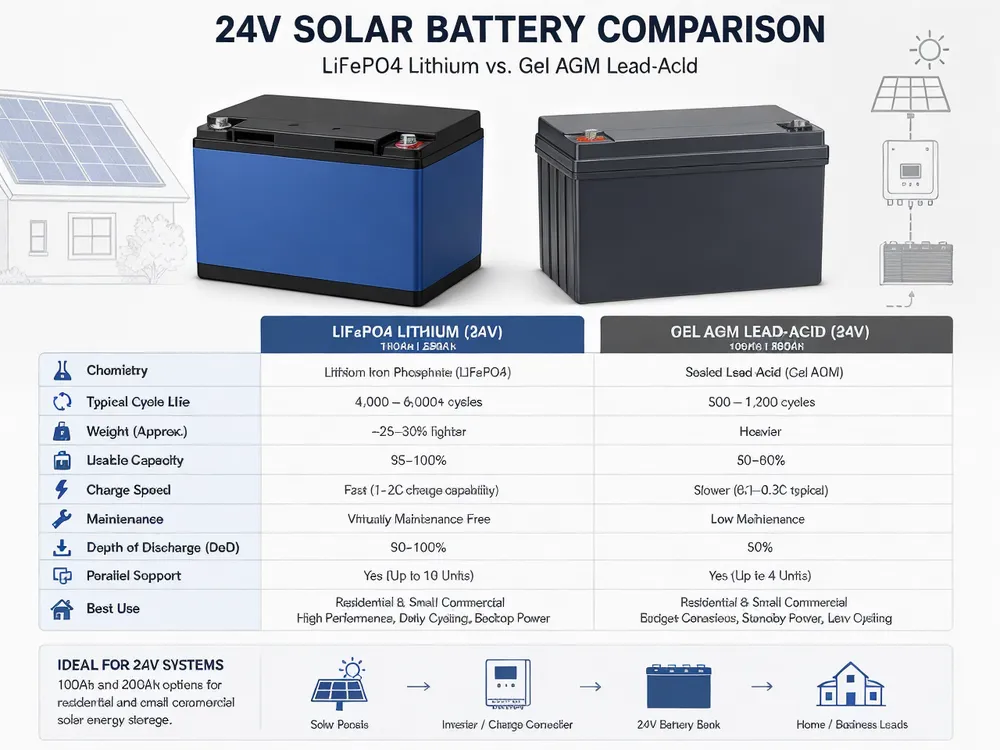
Common Procurement Comparisons
- 100Ah solar battery — entry residential kits
- 200Ah solar battery — higher-capacity solar home and small commercial systems
Exact dimensions, parallel configuration limits, peak current ratings, and charge curve parameters are confirmed during RFQ based on your inverter/charger model and installation environment.
Send your specification — we'll return a matched technical datasheetChemistry Choices That Shape Warranty Cost
The chemistry decision isn't about which technology is "better" — it's about which one protects your margin in your specific market. We manufacture both, so this isn't a sales pitch for one over the other. It's the trade-off map we walk through with every new 24V buyer.
LiFePO4 (25.6V Lithium)
Long LifecycleHigher upfront unit cost, but 3,000–6,000 cycle life at 80% DoD means your warranty exposure drops dramatically on a per-cycle basis.
Deeper usable capacity (90–95% vs. 50%) means a 100Ah lithium pack delivers roughly the same usable energy as a 200Ah gel pack — so your freight cost per usable kWh is lower.
BMS protection prevents the abuse failures that generate field returns.
For markets where your end customers expect 5–10 year product life and you're building a brand reputation, LiFePO4 is the chemistry that keeps warranty claims off your desk.
Gel / AGM (24V Lead-Acid)
Low Entry CostLower entry cost per unit, familiar replacement market, and no BMS complexity.
Useful in price-sensitive off-grid programs where the buyer's customer is comparing against no electricity at all — the purchase decision is driven by upfront affordability, not lifecycle cost.
More sensitive to deep discharge and charging quality, so your field return rate depends heavily on whether the end system includes a properly configured charge controller.
We see the highest gel warranty issues in markets where cheap PWM controllers are paired with batteries that need proper voltage regulation.
When Mixed Catalog Supply Makes Sense
If you distribute across multiple price tiers — say a premium LiFePO4 solar battery line for urban residential and a budget gel solar battery line for rural off-grid — sourcing both from one 24V solar battery manufacturer simplifies your supply chain.
Same factory, same documentation format, same shipping coordination, same account manager. We run lithium and lead-acid on separate production zones specifically so we can serve dual-chemistry distributors without cross-contamination risk.
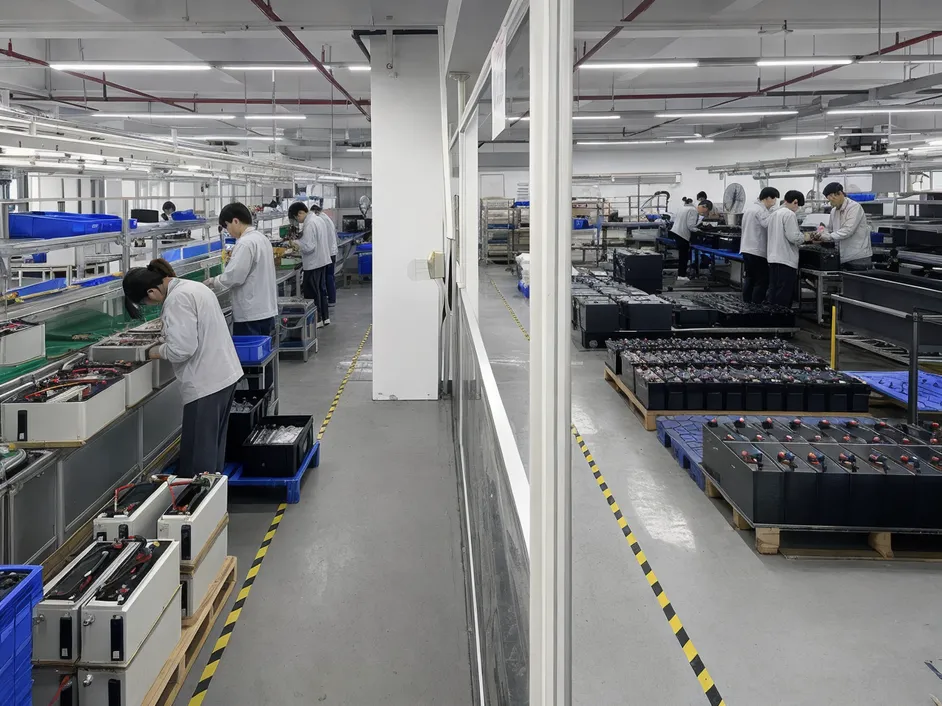
Charger Matching, BMS Settings, and Cell Sorting Reduce Field Returns
The most expensive battery is the one that comes back. We've tracked the failure modes that generate warranty claims across our export markets, and the pattern is consistent: the battery itself rarely fails in isolation. It fails because something in the system around it was mismatched.
Wrong Charge Profile
The single largest cause of premature 24V lithium pack failure. A LiFePO4 pack charged with a lead-acid profile (28.8V instead of 29.2V) never reaches full charge, loses capacity over months, and eventually triggers low-voltage BMS cutoff that the end user interprets as a dead battery.
We program our BMS charge parameters to match specific inverter/charger models — tell us what your system uses, and we'll confirm compatibility before production. For buyers building kits, our 24V Solar Battery Charger page covers the pairing logic in detail.
Cell Imbalance — The Slow Killer
If cells within a pack drift in capacity or internal resistance, the weakest cell hits protection limits first, reducing the pack's effective capacity.
Our automated sorting system groups cells within 20mV voltage and 5mΩ internal resistance before they enter pack assembly. This isn't a spot check — every cell in every pack goes through the sorter. The result: consistent capacity across your entire batch, and predictable degradation curves that match your warranty period planning.
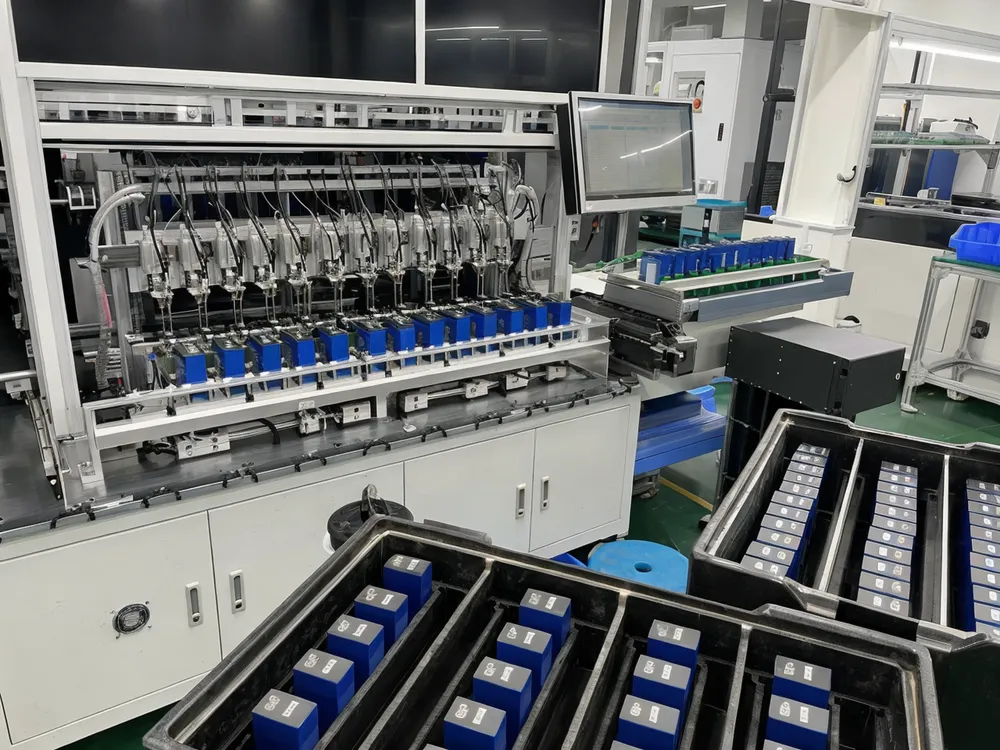
BMS Protection Thresholds
Protection parameters need to match the application, not just the cell chemistry. A 24V pack going into a tropical off-grid installation needs different temperature cutoffs than one going into a European garage.
We design and manufacture BMS boards in-house, so protection parameters — over-voltage, under-voltage, over-current, short-circuit, and temperature limits — are set for your specific deployment environment. Generic third-party BMS modules use one-size-fits-all thresholds that either cut off too early (annoying your end users) or too late (damaging cells).
Our QC Sequence for 24V Packs
Every step generates data tied to the batch number on your carton. If a field issue surfaces six months later, we can trace it back to the specific cell lot and BMS firmware version.
Incoming Cell Inspection
Automated Cell Sorting & Matching
Pack Assembly
BMS Integration & Function Test
Capacity Verification
Charge/Discharge Cycling
High-Temp Soak (55°C)
Low-Temp Discharge (-20°C)
Safety Testing
Final Inspection & Packing
For wiring guidance and system integration details, see our 24V Solar Battery Wiring Diagram Guide.
Market Segments Where 24V SKUs Move Repeatedly
We don't think about applications the way a consumer does. We think about which market segments generate repeat orders — because that's what matters to you as a buyer building a distribution business or a project pipeline.
Solar Home Kit Assemblers
The 24V battery is the core component in mid-range solar home kits (2–5 kWh). Kit assemblers in Africa and Southeast Asia order 24V LiFePO4 or gel packs in 100Ah and 200Ah configurations, pair them with MPPT controllers and panels, and sell complete systems through dealer networks.
This is a repeatable, seasonal-reorder segment — once your kit design is locked, you reorder the same battery spec every quarter. We keep standard 24V configurations in rolling production specifically for this pattern.
Rural Electrification & Weak-Grid Dealers
Government and NGO electrification programs specify 24V systems for village-level installations. Dealers who win these contracts need reliable supply at consistent quality — because a field failure in a remote village means a truck roll that costs more than the battery.
The 24V tier fits the 1–3 kW inverter range that powers lighting, fans, phone charging, and small appliances. Your margin on these programs comes from supply reliability and zero-defect delivery, not from premium pricing.
Telecom & Light Infrastructure Backup
Telecom towers, rural clinics, water monitoring stations, and security systems still run significant 24V DC bus architectures. This segment values cycle life and temperature tolerance over cost-per-Ah — they'll pay more for a LiFePO4 pack that survives 5,000 cycles in a 45°C equipment cabinet.
If you supply this segment, specify your operating temperature range and duty cycle when you request a quote.
Agricultural & Small Commercial Sites
Pump controllers, greenhouse monitoring, cold storage backup, and small workshop inverter loads that exceed what a 12V solar battery can deliver but don't justify a full 48V solar battery system.
These buyers often start with a single 24V 200Ah pack and scale by adding parallel units — so your initial sale becomes a repeat expansion order.
Distributor SKU Ladder
If you carry 12V as your entry tier and 48V as your commercial tier, 24V fills the mid-range gap. Sourcing all three voltage tiers from one manufacturer means consistent quality standards, unified documentation, and simpler logistics coordination. Your catalog looks complete without managing three separate supplier relationships.
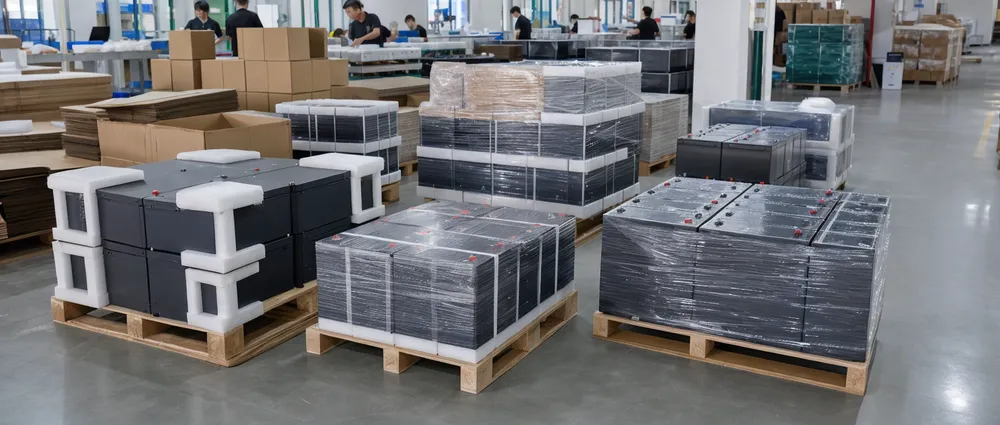
OEM/ODM Scope for 24V Distributor Battery Programs
We handle OEM/ODM across the full customization spectrum — from a label swap on a standard 24V pack to a ground-up custom cell configuration with proprietary BMS firmware. Here's what's on the table:
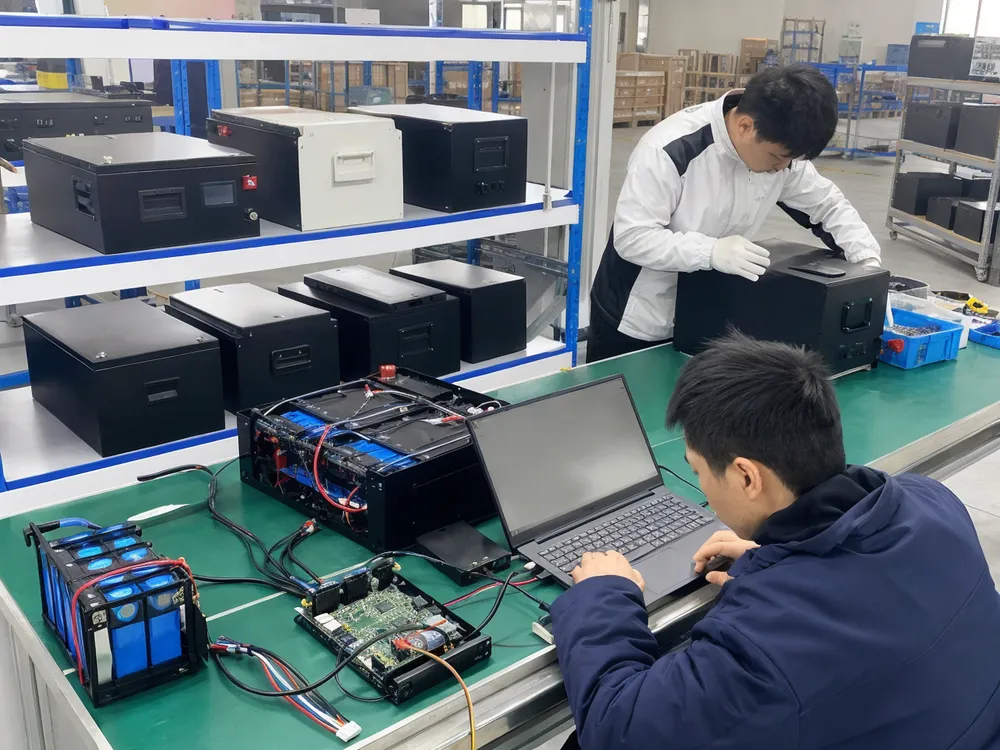
Branding and Packaging
Your logo, color scheme, model number, carton design, user manual, and warranty card. This is the lowest-complexity OEM path — we apply your branding to an existing 24V model with no engineering changes. Standard MOQ: 100 units.
Capacity and Voltage Configuration
Need a 24V 150Ah pack because your inverter's sweet spot is 3.84 kWh? Or a 24V 80Ah for a compact solar home kit? We configure cell count, parallel strings, and BMS parameters to hit your target. If the configuration matches an existing cell arrangement, MOQ stays low. Fully custom cell layouts require enough volume to justify validation testing — we'll quote the threshold upfront.
BMS Customization
Communication protocol (RS485, CAN, Bluetooth), protection thresholds, charge/discharge curves, low-temperature charging cutoff, and compatibility with specific inverter brands. Our in-house BMS engineering team programs firmware per-project rather than using generic modules, so your pack integrates cleanly with your system architecture.
Enclosure and Mechanical
Metal vs. ABS, IP rating, mounting bracket design, terminal position, connector type, ventilation, and form factor. If you're designing a wall-mounted residential unit or a rack-insert module, send us your dimensional constraints and we'll confirm feasibility.
Charger Pairing
Bundle a matched charger or MPPT controller with your 24V battery as a single SKU. One supplier, one shipment, guaranteed compatibility — no finger-pointing between battery and charger vendors when a field issue arises.
The Buyer Value
Test a new 24V SKU at 100 units, validate it with your customers, then scale to container volumes without changing suppliers or re-qualifying. Your private-label catalog grows without adding sourcing complexity.
Tell us your target retail segment, inverter/charger model, monthly volume expectation, branding scope, and destination market.
Export Documents, Packing, and Landed-Cost Planning
Battery shipments carry compliance, weight, and documentation requirements that affect your landed cost and customs clearance timeline. We handle this as part of production — not as an afterthought when the container is already at port.
Documentation We Provide
- UN38.3 test summary — required for lithium battery transport classification
- MSDS — material safety data sheet for customs and warehouse handling
- CE declaration of conformity
- IEC 62133 test report
- ISO 9001:2015 certificate
These documents are maintained current for every standard model. For OEM/ODM configurations, we generate model-specific documentation during the development cycle so it ships with your first order.
Battery-Specific Packing
- Terminal insulation caps on every unit (prevents short-circuit during transit)
- Reinforced double-wall cartons rated for the actual unit weight
- Foam dividers or molded inserts between cells
- Palletization with stretch wrap and corner protectors
- Carton marks showing UN number, proper shipping name, and handling orientation
We've seen too many claims from buyers whose previous supplier packed 30 kg batteries in single-wall cartons with no terminal protection — the damage rate on those shipments runs 3–5%.
Landed-Cost Planning Inputs
We don't publish fixed container quantities because loading depends on your final model mix — a 24V 100Ah LiFePO4 in an ABS case has different dimensions and weight than a 24V 200Ah gel in a steel enclosure.
Once your order spec is confirmed, we provide:
This lets you calculate freight cost per unit accurately before confirming the order.
Export Markets We Ship To Regularly
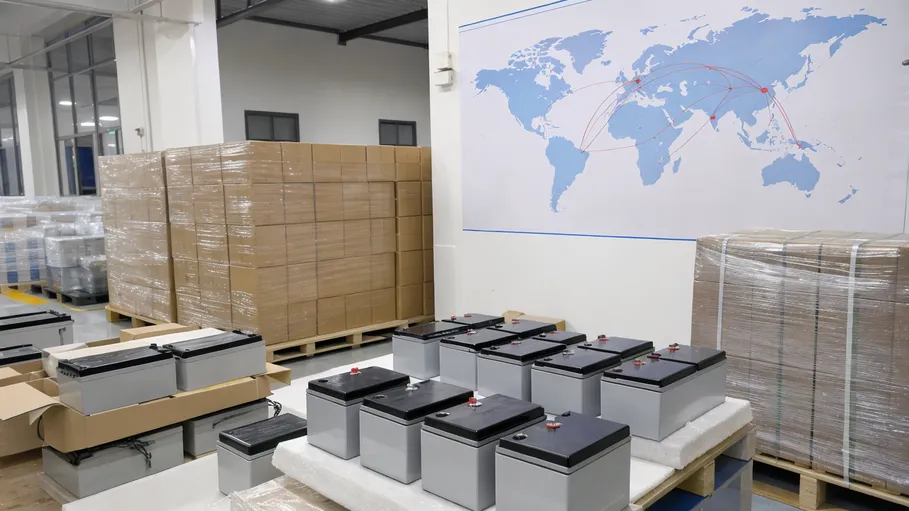
Each region has specific labeling, documentation, and packing preferences we've learned through repeat shipments.
Request a quote with your destination port and we'll include a packing and loading estimate alongside the unit price.
Get Packing & Loading EstimateFAQ for 24V Solar Battery Sourcing
Common technical and commercial questions from distributors, system integrators, and procurement teams evaluating 24V solar battery options.
What is the difference between a 24V solar battery and a 25.6V LiFePO4 battery?
They refer to the same system voltage tier. "24V" is the nominal system designation used in solar installations and inverter specifications. "25.6V" is the actual nominal voltage of an 8-series LiFePO4 cell configuration (8 × 3.2V = 25.6V).
When you see a 24V inverter or charge controller, it's designed to work with a 25.6V lithium pack. Lead-acid 24V systems use 12 cells at 2.0V nominal for a true 24.0V.
In practice: When you request a "24V solar battery" from us, we confirm whether you need lithium (25.6V) or lead-acid (24.0V) and match accordingly.
When should a buyer choose 24V instead of 12V or 48V for a solar system?
Choose 24V when your system power range is 1–5 kW and your target market is price-sensitive enough that 48V inverter cost hurts your margin, but the loads exceed what 12V can deliver efficiently.
The 24V tier halves current draw versus 12V (reducing cable cost and BMS current rating), while keeping inverter and component costs below 48V-class equipment.
Most solar home kits in the 2–5 kWh range and weak-grid backup systems in Africa, Southeast Asia, and South America land on 24V for this reason.
Is LiFePO4 or gel better for 24V solar battery wholesale programs?
It depends on your market's price sensitivity and warranty tolerance.
- 3,000–6,000 cycles at 80% DoD
- 90%+ usable capacity
- Low warranty claim rate
- Lower cost-per-cycle over product life
- Best for urban/premium channels
- 500–800 cycles at 50% DoD
- Lower upfront unit cost
- Suitable for price-first markets
- Buyer's customer prioritizes affordability over longevity
- Best for rural/budget channels
Many of our distributors carry both: LiFePO4 for urban/premium channels and gel for rural/budget channels. We manufacture both chemistries, so you can source your full 24V catalog from one supplier.
What charger settings should match a 24V lithium solar battery?
A 24V LiFePO4 pack (25.6V nominal) requires a charge voltage of 29.2V with CC/CV profile. The charge controller or inverter-charger must be set to "lithium" or "LiFePO4" mode — never "lead-acid" or "gel" mode, which uses lower charge voltages (28.2–28.8V) and will chronically undercharge the lithium pack.
Critical Setting Mismatch Warning
Using lead-acid or gel charger profiles (28.2–28.8V) on a LiFePO4 pack causes chronic undercharge and accelerated capacity loss — the #1 cause of early field failure we see across export markets.
Correct Setting
LiFePO4 / Lithium mode
Charge voltage: 29.2V (CC/CV)
Incorrect Setting
Lead-acid / Gel mode
Charge voltage: 28.2–28.8V (undercharges)
Our BMS is programmed to match specific charger profiles. When you send your specification, include your inverter or charge controller model and we'll confirm compatibility or recommend settings.
For complete charger pairing options, see our 24V Solar Battery Charger page.
What causes early failure in 24V solar battery packs?
The top causes we see across our export markets:
Charge profile mismatch
Lithium packs on lead-acid charger settings, leading to chronic undercharge and capacity loss.
Poor cell matching
Cells with different internal resistance create imbalance, causing the weakest cell to hit BMS cutoff early.
Undersized BMS current rating
Peak loads exceed the BMS over-current threshold, triggering nuisance shutdowns that end users interpret as failure.
High ambient temperature without adequate BMS thermal protection
Accelerates degradation in tropical installations.
Missing or low-quality terminal connections
Resistance at terminals generates heat under load.
How Our Production Process Addresses Each Cause
Our production process addresses each of these through automated cell sorting, application-matched BMS programming, and full-load testing before shipment.
What documents are needed to import 24V lithium solar batteries?
At minimum: UN38.3 test summary (transport classification), MSDS (material safety data for customs and handling), and a commercial invoice with correct HS code and battery specifications. For European markets, add CE declaration of conformity and IEC 62133 test report.
Some markets require additional local certification — we support the application process with test samples and technical data packages. All standard models ship with current documentation; OEM/ODM models receive model-specific reports during development.
What is EVANBattery's MOQ for 24V solar battery orders?
100 units for standard 24V models (both LiFePO4 and gel/AGM). This applies to existing configurations with no engineering changes.
For OEM/ODM orders with custom capacity, BMS settings, branding, or enclosure modifications, MOQ depends on complexity — a label change on a standard model holds at 100 units, while a fully custom cell configuration requires higher volume to justify validation. We quote the exact MOQ during the RFQ process so you can plan landed cost before committing.
Send Your 24V Battery Specification for a Factory Quote
You've read the category overview. Now tell us what you need and we'll respond with a model match, technical recommendation, MOQ confirmation, packing estimate, and quotation.
Include in Your Inquiry
- Chemistry preference (LiFePO4, gel, AGM, or undecided)
- Nominal voltage and Ah/kWh target
- Inverter or charger model (for compatibility confirmation)
- Charge profile requirements
- Terminal type and connector preference
- Enclosure preference (metal, ABS, IP rating, form factor)
- Branding needs (OEM label, custom carton, manual)
- Order quantity (initial + estimated annual)
- Destination port or country
- Required compliance documents
We'll return a detailed response covering model availability, BMS configuration, pricing tiers, lead time, packing specification, and documentation status.
No. 38, Tongxing 1st Road, Jiafuwei Industrial Zone, Caosan Village, Guzhen Town, Zhongshan City, Guangdong Province, China