US Battery Supply Is Easy Until the Order Needs to Repeat
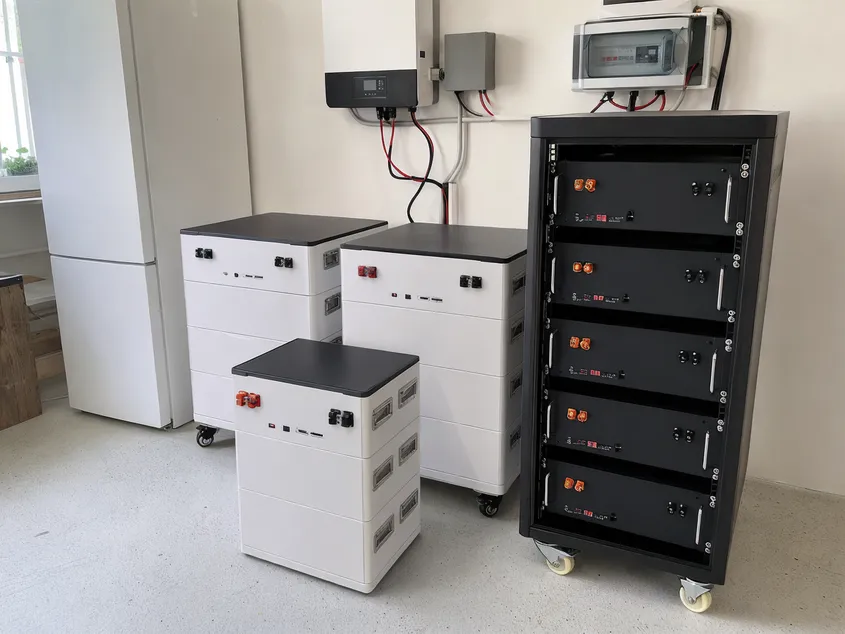
Sourcing one home solar battery storage system in the USA is straightforward — call a distributor, check branch stock, get it on a truck. The friction starts when you need the same battery across 20, 50, or 200 installs and your margin depends on predictable unit cost, matching documentation, and a supplier who can actually repeat the same spec without surprises.
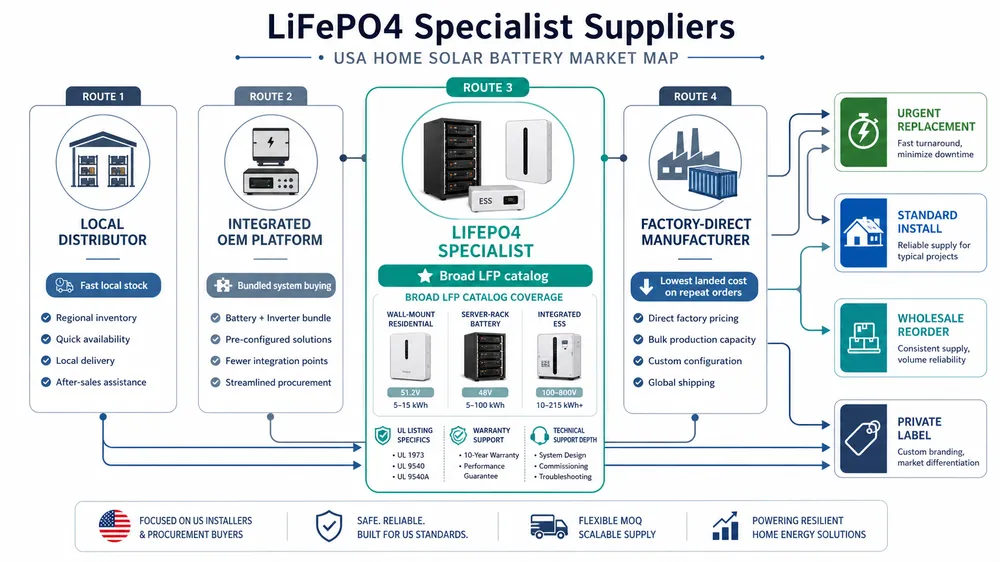
This list covers 10 residential solar battery suppliers with verified US-market access. Each one falls into one of three sourcing models: domestic distributor with branch inventory, integrated OEM platform with a closed ecosystem, or LiFePO4 specialist with open inverter pairing. The profiles are based on official company pages — no claims about unpublished wholesale pricing or real-time branch stock levels.
If you're building a repeat Home Solar Battery Storage program and need to compare convenience against economics, this is the sourcing landscape you're working with.
The Shortlist Criteria That Protect Margin, Permits, and Warranty Exposure
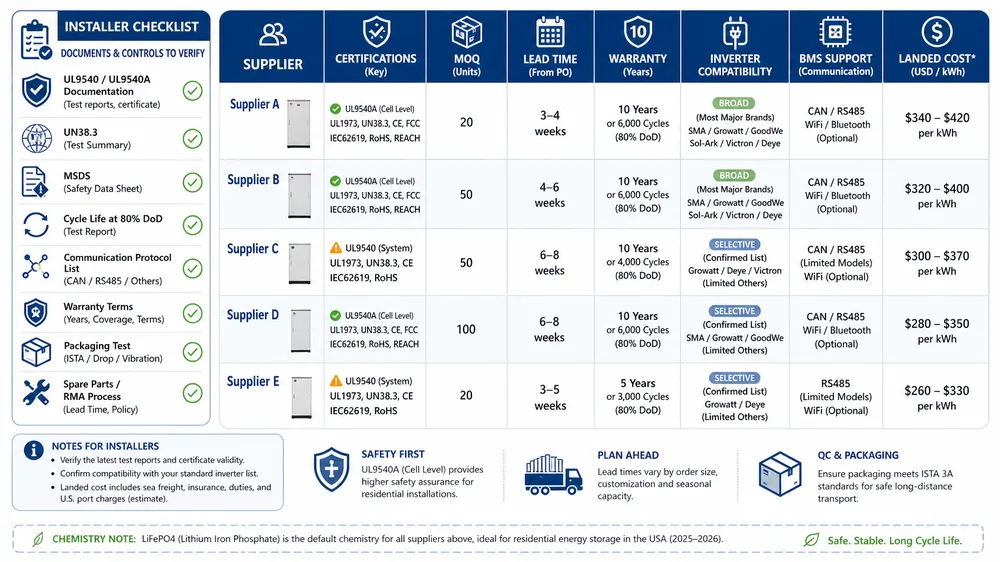
Before comparing supplier names, lock down what you're actually evaluating. A battery that passes inspection, pairs cleanly with your inverter, and ships with complete documentation is worth more than a battery that costs $40 less but creates a truck roll six months later.
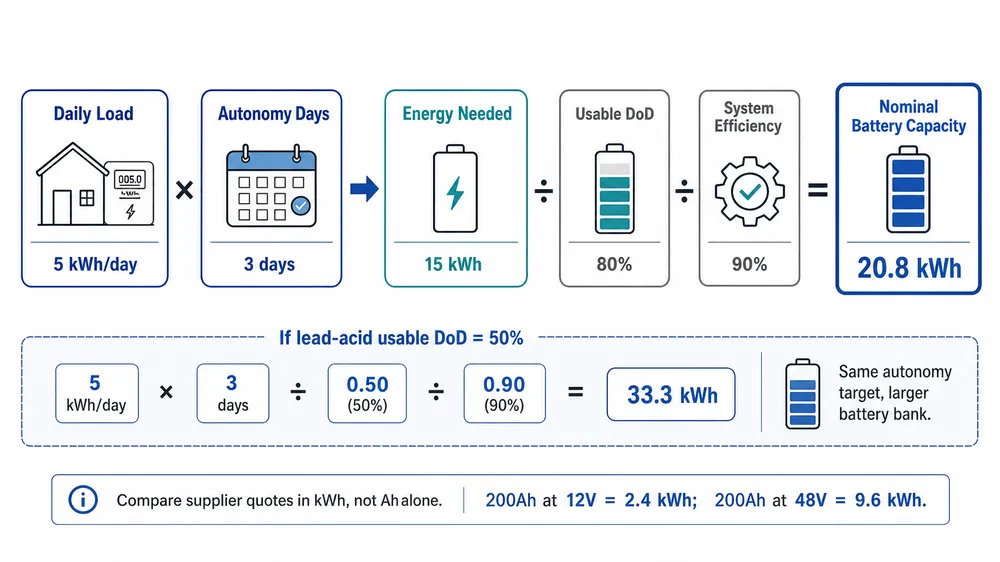
LiFePO4 is the default chemistry for residential storage in 2025–2026. Thermal stability, cycle life above 6,000 cycles at 80% DoD, and no thermal runaway risk under normal conditions make it the only chemistry most inspectors and homeowners are comfortable with. Lead-acid still appears in budget off-grid channels, but if you're quoting grid-tied residential backup, LiFePO4 home battery suppliers are where the market has settled.
Here's what to verify before any supplier makes your shortlist:
| Criterion | What to ask | Why it affects your margin |
|---|---|---|
| Certifications | UL 9540A test report, UL 1973 listing, UN38.3 for imports | Failed inspection = delayed commissioning, unpaid install labor |
| Inverter compatibility | Published compatible inverter list or open CAN/RS485 protocol | Mismatched comms = truck roll, firmware troubleshooting on your dime |
| BMS communication | Proprietary vs open protocol, firmware update path | Locked BMS limits your inverter options on future jobs |
| Warranty route | Who handles RMA — supplier, distributor, or you? | Unclear warranty = you absorb the replacement cost and labor |
| Lead time | Branch stock vs production queue vs ocean freight | Late battery = delayed project close, financing penalty risk |
| MOQ and reorder | One-off project buy vs account wholesale vs container volume | Higher volume commitment = lower unit cost, but ties up capital |
| Private-label / OEM | Custom branding, voltage/capacity changes, enclosure options | Your brand on the battery = margin control and customer retention |
| Landed system cost | Battery + inverter pairing + freight + cert paperwork + warranty reserve | The real number is never just the battery price |
(A note from experience: the single biggest margin killer I see with residential installers isn't the battery price itself — it's the truck roll for a warranty issue that the supplier won't own. Clarify the RMA process before you place the first order, not after the homeowner calls.)

10 US-Available Home Solar Battery Storage Suppliers to Shortlist
These 10 companies serve the US residential installer market through different sourcing routes. The grouping reflects how you'd actually buy from them — not a popularity ranking.
Domestic Distributor Channels
1. Greentech Renewables — greentechrenewables.com
- Supplier type: National solar and storage distributor with branch locations.
- Best fit: Installers who need same-week product availability from a local branch and prefer account-based purchasing across multiple battery brands.
- Storage angle: Carries multiple residential battery brands through branch inventory. Product selection varies by location and account status.
- Commercial strength: Nationwide branch network, installer account programs, logistics support, and multi-brand access under one distributor relationship.
- Verify before committing: Which battery brands are stocked at your nearest branch, lead time for non-stock items, and whether volume pricing requires a formal account tier.
2. BayWa r.e. Solar Systems — solar-distribution-us.baywa-re.com
- Supplier type: US solar and energy storage distributor backed by a European parent company.
- Best fit: Installers who want distributor-level logistics with access to European and US battery brands, particularly in markets where BayWa r.e. maintains warehouse coverage.
- Storage angle: Distributes residential and commercial energy storage components alongside solar modules and inverters.
- Commercial strength: Multi-warehouse distribution, project support services, and access to brands that may not have direct US sales teams.
- Verify before committing: Regional warehouse coverage for your service area, minimum order for free freight, and whether the specific battery SKU you need is a stocked item or special-order.
3. Soligent — soligent.net
- Supplier type: US wholesale clean energy distributor.
- Best fit: Installers and EPCs looking for wholesale pricing on storage components with a single-source distributor relationship covering solar, storage, and racking.
- Storage angle: Lists energy storage as a core product category alongside modules, inverters, and mounting systems.
- Commercial strength: Wholesale positioning, broad product catalog, and installer-facing purchasing tools.
- Verify before committing: Actual home battery storage distributors USA inventory depth for residential-scale batteries, account requirements, and whether your preferred battery brand is available through their catalog.
Integrated OEM Platforms
4. Tesla Energy — tesla.com/powerwall
- Supplier type: Integrated home battery OEM with a closed ecosystem.
- Best fit: Installers serving homeowners who specifically request Tesla by name, or projects where the Powerwall's integrated inverter and gateway simplify system design.
- Storage angle: Powerwall 3 is a fully integrated battery + inverter unit. The ecosystem is closed — you install Tesla's hardware with Tesla's monitoring.
- Commercial strength: Brand recognition drives homeowner demand, which can shorten your sales cycle. Integrated design reduces component-matching decisions.
- Verify before committing: Certified installer requirements, allocation and lead time in your region, and whether the closed ecosystem limits your ability to service or expand the system later.
5. Enphase Energy — enphase.com
- Supplier type: Integrated inverter and battery OEM.
- Best fit: Installers already using Enphase microinverters who want a single-vendor monitoring and warranty path for the full solar-plus-storage system.
- Storage angle: IQ Battery series uses LFP chemistry in a modular, scalable configuration designed to pair with Enphase microinverter systems.
- Commercial strength: Tight inverter-battery integration, installer training programs, and a monitoring platform homeowners recognize.
- Verify before committing: Whether IQ Battery availability matches your project timeline, pricing through your distributor vs direct Enphase channel, and system sizing limits for larger homes.
6. SolarEdge Technologies — solaredge.com
- Supplier type: Integrated inverter and battery OEM.
- Best fit: Installers using SolarEdge optimizers and inverters who want to add storage without introducing a third-party battery and the compatibility questions that come with it.
- Storage angle: SolarEdge Home Battery is a stackable LFP unit designed for the SolarEdge Home ecosystem. DC-coupled architecture.
- Commercial strength: Single-vendor design tool, warranty path, and monitoring. Stackable capacity lets you size to the home without overselling.
- Verify before committing: Compatibility with your existing SolarEdge inverter model, installer portal access for ordering, and regional availability of the specific battery capacity you need.
7. FranklinWH — franklinwh.com
- Supplier type: Whole-home energy management and battery OEM.
- Best fit: Installers positioning whole-home backup as a premium offering, particularly where the homeowner wants managed energy routing across solar, grid, battery, and generator inputs.
- Storage angle: aPower battery units with the FranklinWH gateway manage multiple energy sources. The system is designed for full-home backup rather than partial-load shedding.
- Commercial strength: Premium positioning supports higher install pricing. Installer center with training and support resources.
- Verify before committing: Gateway requirements, installer certification process, and whether the system's premium price point matches your target customer segment.
8. Generac — generac.com
- Supplier type: Backup-power ecosystem supplier expanding into solar storage.
- Best fit: Installers in markets where Generac's generator brand recognition creates cross-sell opportunities for solar battery backup, or where the dealer network provides local support infrastructure.
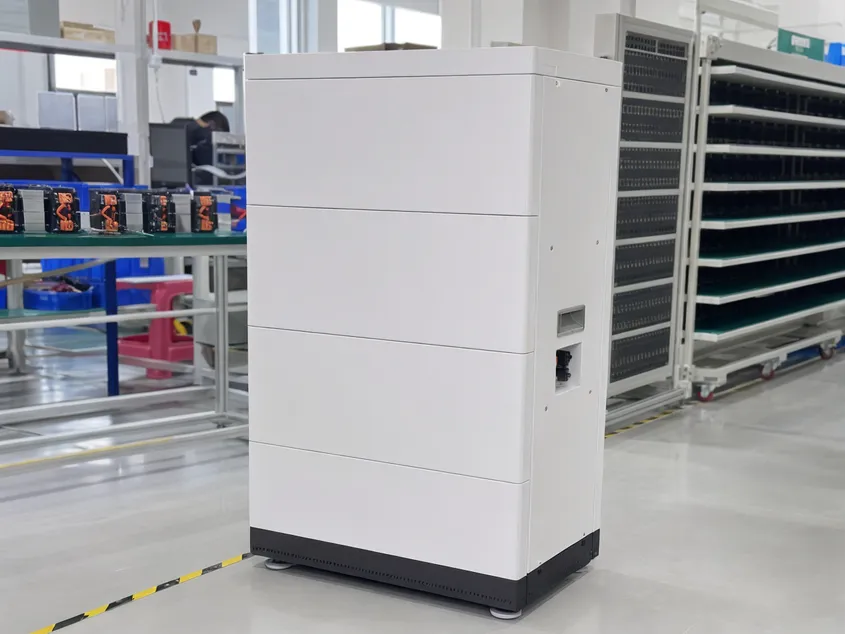
- Storage angle: PWRcell 2 is a modular battery cabinet system. Generac's positioning bridges traditional backup power and solar storage.
- Commercial strength: Existing dealer/installer network, brand trust in the backup-power segment, and homeowner familiarity with the Generac name for reliability.
- Verify before committing: PWRcell 2 availability and lead time, dealer program requirements, and whether the modular cabinet sizing fits your typical residential project scope.
LiFePO4 Specialist Suppliers
9. Fortress Power — fortresspower.com
- Supplier type: LiFePO4 battery specialist focused on residential and commercial storage.
- Best fit: Installers who want open-architecture LFP batteries that pair with multiple inverter brands, particularly for projects where battery capacity and cycle life are the primary selling points.
- Storage angle: eForce series — stackable LFP whole-home storage with installer-facing monitoring tools. Designed for inverter-agnostic pairing.
- Commercial strength: Open compatibility list, LFP-focused engineering, and monitoring/support tools built for the installer rather than the homeowner.
- Verify before committing: Specific inverter compatibility for your preferred brands, warranty terms and RMA process, and distributor pricing vs direct purchasing options.
10. EG4 Electronics — eg4electronics.com
- Supplier type: LiFePO4 battery and energy storage system supplier.
- Best fit: Installers and integrators looking for competitively priced LFP batteries — wall-mounted, rack-mounted, and all-in-one ESS units — with open inverter pairing and direct purchasing options.
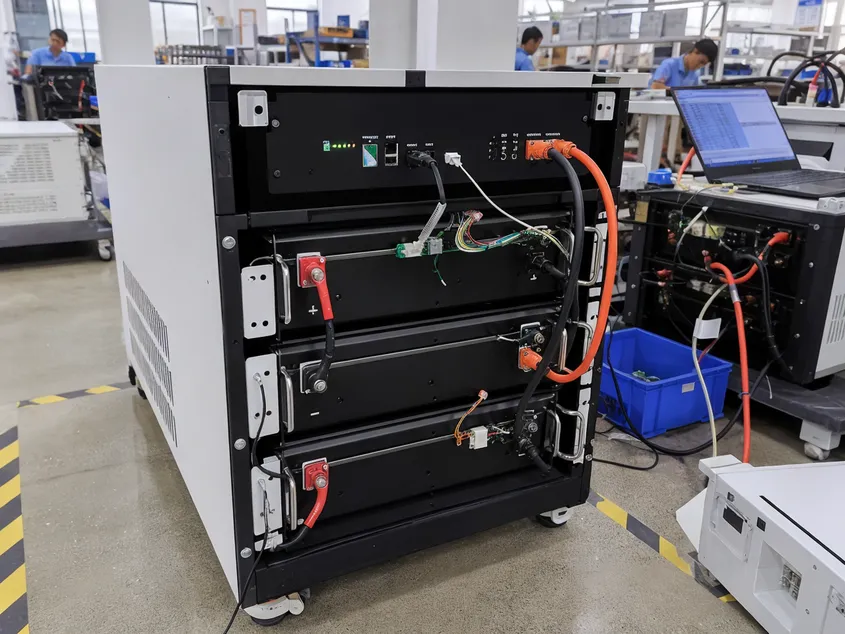
- Storage angle: Broad LFP battery catalog covering wall-mount residential units, server-rack batteries, and integrated ESS products. Multiple voltage and capacity configurations.
- Commercial strength: Competitive hardware pricing, direct sales channel, growing installer community, and a product range that covers budget-conscious residential through light commercial.
- Verify before committing: Certification status for your jurisdiction (UL listing specifics), warranty support infrastructure, and whether their direct-sales model provides the technical support depth you need for complex installs.
Where Domestic Convenience Pays for Itself
The 10 suppliers above share one thing: they all have some form of US-market access that lets you buy without managing international freight, customs clearance, or import documentation yourself. That convenience has real value in specific scenarios.
Local distributor stock wins when:
- You need a replacement battery this week because a unit failed during commissioning and the homeowner's financing clock is ticking.
- You're installing a platform for the first time and want local technical support during the learning curve.
- The local inspector is familiar with a specific brand's UL listing and you don't want to introduce documentation they haven't seen before.
- Your project volume is 1–5 units and the per-unit premium is smaller than the cost of managing an import shipment.
Integrated OEM ecosystems win when:
- The homeowner specifically requests a brand, and fighting that preference costs you the deal.
- Single-vendor warranty simplifies your post-install liability.
- The installer training and certification program gives your team confidence on the first few jobs.
(Worth noting: the convenience premium on domestic battery supply typically runs 25–40% above factory-gate pricing for equivalent LFP specs. On a single install, that's absorbed into the project margin. On 50+ installs per year, it becomes a line item worth examining.)
None of this is a criticism — it's the economics of intermediation. A distributor carries inventory risk, provides credit terms, and handles logistics. That service costs money. The question is whether your order pattern justifies paying for it on every unit.
Where Factory-Direct Sourcing Changes the Battery Math
Once your residential install volume becomes predictable — say 100+ batteries per year of the same configuration — the economics shift. The distributor's convenience premium compounds across every unit, and the services you're paying for (brand discovery, one-off logistics, technical hand-holding) are services you no longer need.
This is where factory-direct solar battery wholesale enters the picture. Not as a replacement for your local distributor on emergency jobs, but as a parallel sourcing channel for your repeat SKUs.
We've been manufacturing solar batteries since 2012 — nothing else, just batteries and BMS systems. Our facility in Zhongshan runs 9,900 m² with 6 production lines and 150 people focused entirely on solar energy storage. Annual capacity is 2,000,000 units. That single-product focus means our automated cell sorting lines, BMS firmware, and pack assembly processes have been refined across 13 years of production runs, not bolted onto a broader electronics operation.
What that translates to for your sourcing program:
- 100-unit MOQ for standard models — you can test a SKU across 20–30 installs before committing to container volume. Most domestic distributors won't offer custom terms at that scale; most factories won't ship below 500.
- In-house BMS design with 18+ engineers — if your preferred inverter uses CAN bus at a specific baud rate or requires a particular battery protocol, we match it at the firmware level. US resellers can't customize communication protocols; they sell what the factory programmed.
- Automated cell sorting ensures capacity matching within ±1.5% across every pack in your batch, so your field performance data stays consistent from install #1 to install #100.
- Full export documentation in one package: ISO 9001:2015, CE, IEC 62133, UN38.3, MSDS — your customs broker and local AHJ get what they need without chasing paperwork across three vendors.
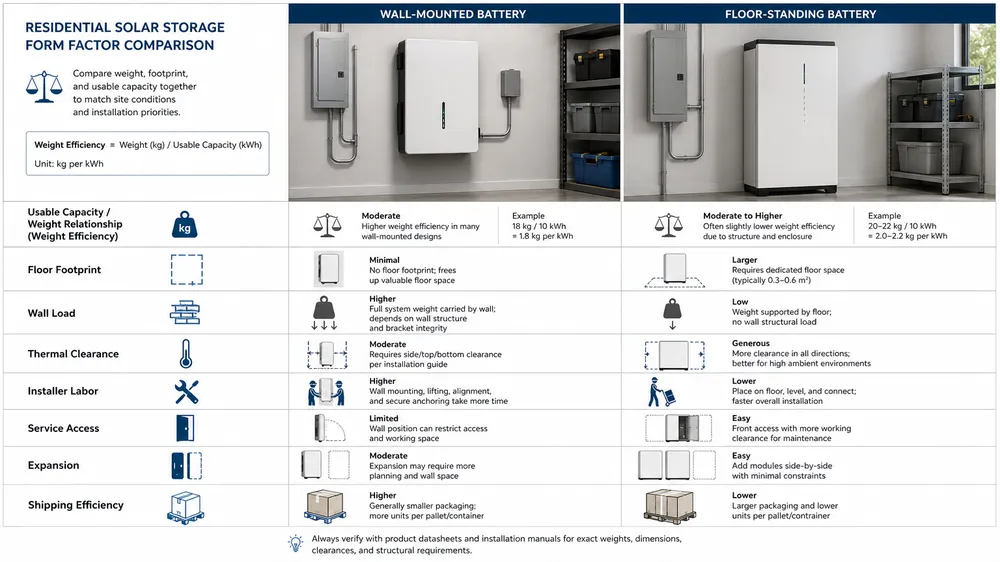
The wall mounted solar battery format is our most common residential configuration for US-bound orders — compact enclosure, pre-wired BMS, and a form factor that mounts in a garage or utility closet without custom racking. For installers building a private-label program or needing voltage/capacity configurations outside standard catalog options, our OEM ODM solar battery process covers custom branding, enclosure color, capacity variants, and protocol matching under one engineering team.
(For context: our typical US installer buyer starts with 100–200 units of a standard 48V/100Ah wall-mount, validates field performance over 3–4 months, then moves to branded packaging and a 500-unit reorder cycle. The first order tests the product; the second order tests the relationship.)
Match the Supplier Route to the Order Scenario
The right supplier depends on what you're buying, how often, and what you need around the battery itself. Here's the decision logic:
| Order scenario | Best-fit route | Why |
|---|---|---|
| Urgent replacement (1–3 units, this week) | Domestic distributor (Greentech, BayWa r.e., Soligent) | Branch stock, no freight wait, known product |
| Standard branded residential install | Integrated OEM (Tesla, Enphase, SolarEdge, FranklinWH, Generac) | Homeowner brand preference, single-vendor warranty, training support |
| Open inverter pairing, best battery economics | LiFePO4 specialist (Fortress Power, EG4) | Inverter-agnostic, competitive LFP pricing, flexible system design |
| Repeat wholesale SKU (100+ units/year) | Factory-direct manufacturer (EVANBattery) | Lowest landed unit cost, batch consistency, documentation package |
| Private-label battery program | Factory-direct with OEM/ODM (EVANBattery) | Your brand, your spec, your margin — no middleman markup |
| Cost-sensitive bid with predictable demand | Compare distributor landed cost vs factory-direct landed cost | Run the numbers on both; the breakeven is usually around 50–80 units depending on freight and duties |
For home solar battery backup projects where the sizing is standardized across a subdivision or multi-home development, factory-direct sourcing typically delivers 20–35% lower per-unit cost compared to buying the same LFP capacity through a US distributor — assuming you're ordering 100+ units and can plan 6–8 weeks of ocean freight lead time.
If you're evaluating both routes simultaneously, request a quote with your target voltage, capacity, quantity, and inverter model. We'll return a landed-cost estimate so you can compare directly against your current distributor pricing.
Procurement FAQ for Installers Comparing Battery Suppliers
What certifications should a residential installer check before buying home solar batteries?
At minimum: UL 9540A fire safety testing for the installed system, UL 1973 for the battery itself, and FCC Part 15 for electronics. For imported batteries, UN38.3 transport certification and MSDS are required for legal shipping. If your AHJ hasn't seen a specific brand before, having the full test report — not just the certificate — speeds up permit review significantly.
Is LiFePO4 better than lead-acid for residential solar battery storage?
For grid-tied residential backup, LiFePO4 is the standard choice. Cycle life of 6,000+ at 80% depth of discharge, no thermal runaway risk under normal operation, and energy density that fits wall-mount enclosures. Lead-acid (gel or AGM) still makes sense for budget off-grid cabins where upfront cost matters more than cycle life and the system can accommodate the larger footprint. For any installer quoting suburban residential backup, LiFePO4 home battery suppliers are where you should be looking.
Should installers buy through a US distributor or direct from a battery factory?
Both routes have a place. US distributors win on speed, credit terms, and local support — ideal for your first 10–20 installs with a new platform or any emergency replacement. Factory-direct wins on unit economics, customization, and documentation control once your volume is predictable. Most installers doing 100+ residential batteries per year benefit from running both channels: distributor for urgent fills, factory-direct for their primary repeat SKU.
What order volume makes factory-direct solar battery wholesale worth considering?
The practical threshold is around 100 units per order. Below that, the freight cost per unit and the logistics overhead of managing an import shipment eat into the savings. At 100+ units of a standard configuration, factory-direct pricing typically delivers 25–35% below US distributor cost for equivalent LFP specs — enough to meaningfully improve your quote competitiveness or your per-install margin.
Why does BMS communication matter when choosing a home battery supplier?
The BMS talks to your inverter. If the communication protocol doesn't match — wrong CAN ID mapping, incompatible baud rate, missing SOC reporting — the system either won't commission or will throw faults in the field. Integrated OEM platforms solve this by locking you into their inverter. Open-architecture batteries solve it by publishing compatibility lists. Factory-direct manufacturers solve it by matching the BMS firmware to your specific inverter model before the batteries ship. The worst outcome is discovering the mismatch on-site during commissioning.