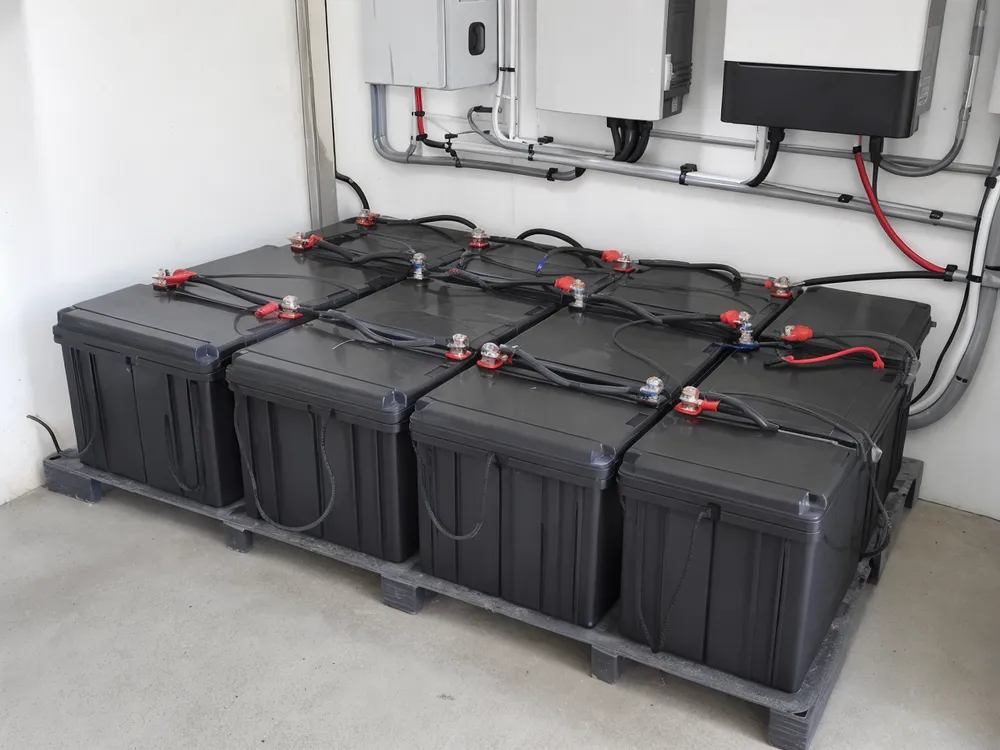
The First Sourcing Risk Is the Wrong Comparison
If you're comparing "AGM vs VRLA solar battery," you're already working from a flawed premise — and that wording on an RFQ can cost you money before a single unit ships.
AGM is not the opposite of VRLA. AGM (Absorbed Glass Mat) is one construction method inside the VRLA (Valve-Regulated Lead-Acid) family. Gel is the other. Both are sealed, both are valve-regulated, both qualify as maintenance-free solar batteries. The vrla agm difference is not category vs category — it's parent vs child.
The commercially useful comparison is AGM VRLA vs gel VRLA. When a supplier quotes you "VRLA battery" without specifying the electrolyte design, you don't know which one you're getting. That ambiguity creates charge-profile mismatches, shortened field life, and warranty claims that fall into a gray zone nobody wants to arbitrate.
Here's the quick verdict: specify AGM VRLA or gel VRLA on every purchase order. Never accept a generic "VRLA" or "sealed lead-acid" label for bulk solar battery procurement. The construction determines the charge voltage, the cycling behavior, the heat tolerance, and ultimately whether your installed batteries last 4 years or 7 in the field.
We've shipped both types across Africa, Southeast Asia, and the Middle East since 2010. The failures we see almost always trace back to one root cause: the buyer didn't lock the exact battery construction at the RFQ stage, and the charge controller settings didn't match what arrived.
Classification Matrix for Sealed Lead Acid Battery Types
Before you can write a correct specification, you need to see where each sealed lead acid battery type sits in the family tree. This table maps the relationship and flags the buyer-side consequence of each classification.
| Battery Type | Sealed? | Electrolyte Design | Maintenance | Charge Profile | Buyer Consequence |
|---|---|---|---|---|---|
| Flooded lead-acid | No | Free liquid electrolyte | Requires water top-up | Standard | Low unit cost, high maintenance labor, not suitable for sealed enclosures |
| AGM VRLA | Yes | Electrolyte absorbed in glass mat separators | Maintenance-free | AGM-specific voltage window | Fast recharge, good high-current behavior, moderate heat tolerance |
| Gel VRLA | Yes | Silica-gel immobilized electrolyte | Maintenance-free | Gel-specific voltage window (lower) | Better deep-cycle and heat performance, slower charge acceptance |
| Generic "VRLA" or "sealed lead-acid" quote | Yes | Unspecified | Claimed maintenance-free | Unknown until you ask | You cannot set charge controller correctly; warranty terms are unenforceable |
The critical point: when a supplier labels something "maintenance free solar battery," that tells you it's sealed — but it doesn't tell you whether the electrolyte is absorbed in glass mat or immobilized in gel. Those two designs need different charge voltages. Install an AGM battery on gel charge settings and you'll undercharge it. Install a gel battery on AGM charge settings and you'll overcharge it, accelerating dry-out and cutting years off the service life.
(We test every batch at both the AGM and gel charge profiles during QC — it's the fastest way to confirm the electrolyte design matches the label on the carton.)
For deeper specification detail on AGM construction and its solar cycling characteristics, see our AGM Solar Battery page.
The Specification Table Buyers Should Actually Compare
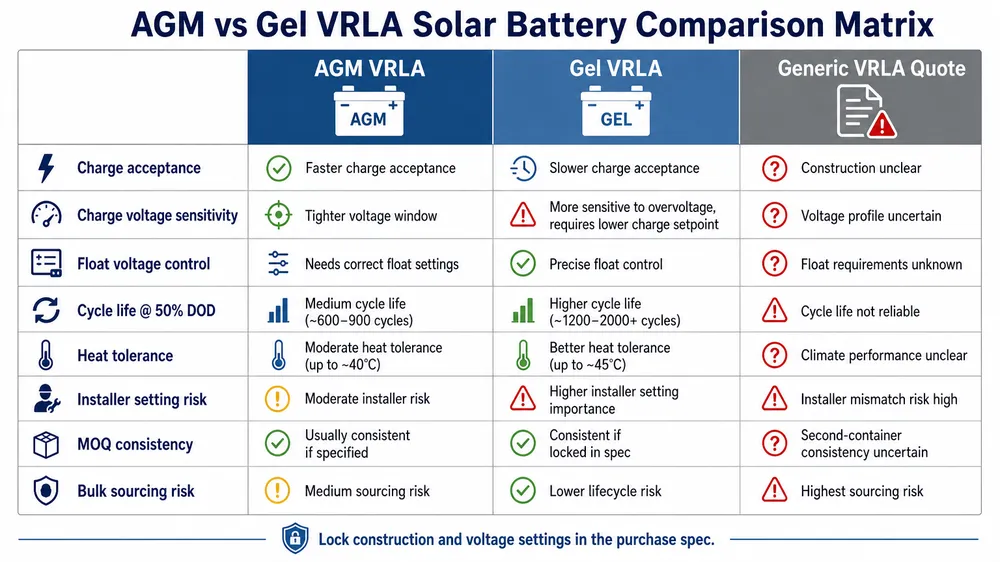
This is the head-to-head comparison that belongs in your sourcing file. We're comparing AGM VRLA, gel VRLA, and what happens when you accept a vague VRLA quote without locking the construction.
| Specification | AGM VRLA | Gel VRLA | Vague "VRLA" Quote |
|---|---|---|---|
| Recommended DOD | 30–50% for optimal cycle life | 50–60% achievable with correct charging | Unknown — you're guessing |
| Cycle life at 50% DOD | Typically 400–600 cycles (model-dependent) | Typically 600–1000 cycles (model-dependent) | Cannot verify without construction disclosure |
| Charge acceptance | Higher — recovers faster from discharge | Lower — requires slower, controlled charging | Mismatched controller settings likely |
| Float charge voltage (12V) | 13.5–13.8V typical | 13.5–13.7V typical (narrower window) | Wrong setting guaranteed if type unknown |
| Cycle charge voltage (12V) | 14.4–14.7V typical | 14.0–14.2V typical | Overcharge or undercharge risk |
| Operating temperature | -20°C to +50°C typical | -20°C to +55°C typical, better hot-climate stability | Unverified thermal rating |
| Internal resistance | Lower — better for high-current loads | Higher — less suited to surge discharge | Unpredictable |
| Warranty claim exposure | Clear if AGM spec is locked | Clear if gel spec is locked | Supplier can dispute any claim |
| MOQ and reorder consistency | Standard SKU, easier to stock | May require application-specific selection | Substitution risk on repeat orders |
Every row in this table translates to a commercial decision. Cycle life at 50% DOD determines your warranty reserve calculation. Charge voltage determines whether you need to specify controller settings to your installer network. MOQ consistency determines whether your second container matches your first.
The vrla agm difference that matters most for your margin isn't the chemistry lecture — it's the voltage window. A 0.5V error in charge setting doesn't show up in month one. It shows up in month 18 when capacity drops below usable threshold and your customer calls asking for a replacement under warranty.

Hidden Costs Start When the Quote Says Only "VRLA"
The expensive mistake in agm battery vs vrla battery sourcing isn't choosing the wrong type. It's accepting a quote that doesn't specify the type at all.
Here's how that plays out in practice. You receive a quote for "12V 100Ah VRLA solar battery." Price looks competitive. You order a container. The batteries arrive, you distribute them to your installer network, and the installers connect them to solar charge controllers programmed for AGM charging — because that's what your previous supplier shipped.
But this batch is gel. The charge voltage is 0.5V too high. Nothing fails immediately. Six months later, electrolyte loss accelerates. At 14 months, capacity has dropped 30%. Your end customers start reporting systems that can't hold overnight load. Now you're facing:
- Replacement freight: shipping new units to remote installation sites costs 3–5× the original per-unit logistics
- Distributor warranty reserve: you need to set aside margin for claims you can't push back to the supplier (because the PO said "VRLA," and technically gel is VRLA)
- Installer labor: every site visit to swap a battery costs your channel partner money and patience
- Lost repeat orders: the distributor who bought 500 units won't reorder if their field failure rate exceeds 8%
- Project penalty risk: if you're supplying into a tender-based solar program, early battery failure triggers contractual penalties
We run independent QC on every production batch — cycling verification at rated DOD and 55°C thermal soak testing — specifically because we've seen what happens downstream when a factory ships batteries that technically meet the label but don't match the application. Our QC reports travel with the shipment, so you have documentation that matches your charge controller specification before the container loads.
(The 55°C soak isn't arbitrary — it simulates a sealed battery cabinet in direct sun across equatorial Africa. If the battery holds capacity after 72 hours at that temperature, it'll handle the field.)
Climate Decides Whether AGM Protects Margin or Gel Protects Field Life
The maintenance free solar battery that works in Germany won't necessarily survive in Nigeria. Climate is the single largest variable in sealed lead-acid battery life, and it's where the AGM vs gel VRLA decision becomes non-negotiable.
Tropical and equatorial climates (West Africa, Southeast Asia, Central America): Ambient temperatures regularly exceed 40°C. Battery cabinets in direct sun can reach 55–60°C internally. At these temperatures, AGM batteries lose electrolyte faster because the absorbed glass mat has less thermal buffering than gel. Gel VRLA handles sustained heat better — the silica matrix slows evaporation and maintains ionic conductivity longer. If your market is daily-cycle off-grid solar in hot climates, gel VRLA typically delivers 30–40% more usable cycles before capacity drops below 80%.
Desert and arid climates (Middle East, North Africa, Australian outback): Extreme daytime heat combined with rapid nighttime cooling creates thermal cycling stress. Gel's advantage holds here, but only if the charge voltage is set correctly. We've seen gel batteries fail faster than AGM in desert installations where the charge controller was left on factory-default AGM settings — the overcharge accelerated dry-out instead of preventing it.
Temperate climates (Europe, northern China, parts of South America): Temperature stays within 10–35°C for most of the year. AGM VRLA performs well here because the thermal stress is manageable and the faster charge acceptance means the battery recovers fully during shorter winter daylight hours. For residential backup and hybrid solar systems in temperate zones, AGM is usually the stronger commercial choice — lower unit cost, faster recharge, and adequate cycle life for moderate DOD applications.
The wrong voltage window accelerates failure in any climate. But in hot climates, the penalty is 2–3× worse because heat and overcharge compound each other. If you're building inventory for tropical markets, specify Gel Solar Battery construction and confirm the charge profile with your controller supplier before you commit to volume.
Container Loading and Documentation Need the Exact Battery Declaration
Sealed lead acid battery types share the same basic shipping classification — non-spillable, sealed lead-acid — but your export documentation still needs to declare the exact construction. This isn't about regulatory drama. It's about preventing delays that cost you warehouse days and demurrage fees.
Container planning realities: AGM and gel VRLA batteries in the same voltage and capacity class typically share similar case dimensions and weight. The container loading calculation depends more on carton reinforcement, pallet configuration, and SKU mix than on whether the electrolyte is glass-mat or gel. A standard 20GP container holds approximately 800–1,200 units of 12V 100Ah batteries depending on pallet arrangement and carton stacking strength. We provide pallet loading diagrams with every bulk quote so you can verify fit before booking freight.
Documentation that matters: MSDS (Material Safety Data Sheet) is required for all sealed lead-acid shipments. The MSDS must correctly identify the battery construction — AGM or gel — because the electrolyte composition differs. CE marking, IEC 62133 testing, and ISO 9001:2015 process certification apply to both types equally. UN38.3 transport testing is primarily relevant if you're shipping lithium batteries or mixed lithium/lead-acid containers; standalone AGM or gel VRLA shipments under IATA/IMDG classify as non-spillable sealed lead-acid and follow a simpler documentation path.
(One note on customs: some import markets apply different HS codes to "accumulators" based on declared chemistry and application. Getting the battery type wrong on the commercial invoice doesn't usually change the duty rate, but it can trigger a customs query that holds your container for 5–10 days while you provide clarification documents.)
We handle export documentation for both AGM and gel VRLA shipments across our standard markets — Europe, Africa, Southeast Asia, South America, and the Middle East. The paperwork package includes MSDS, test reports, and packing declarations matched to the exact battery type in the container.
Scenario Winner Map for Bulk Buyers
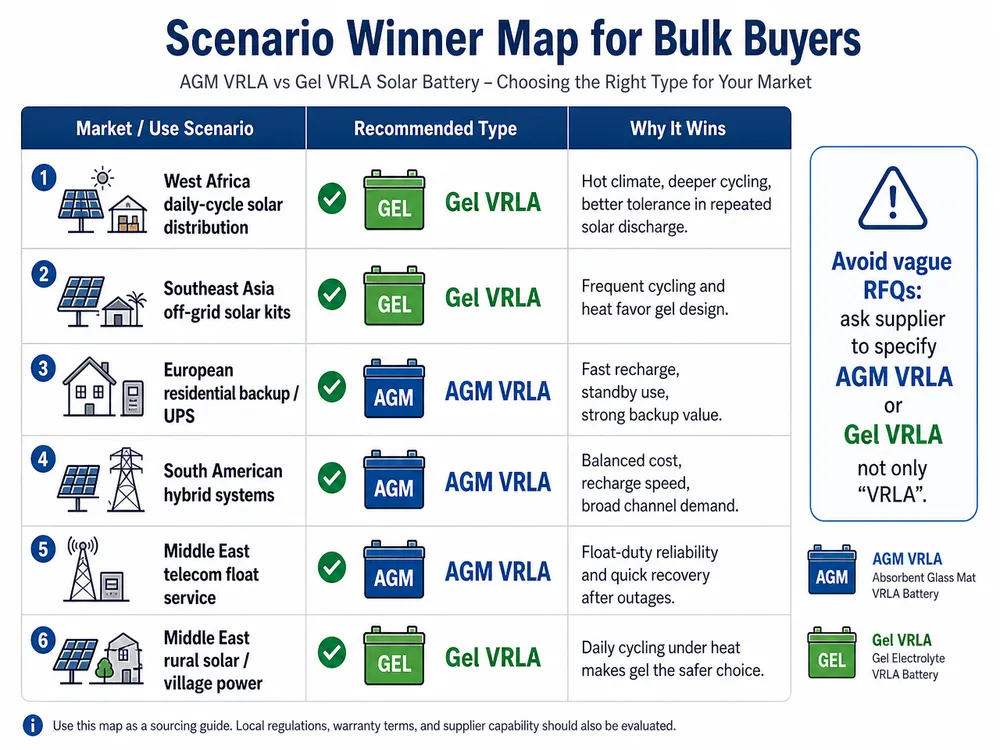
Stop comparing specs in the abstract. Here's which sealed battery type wins for each real sourcing scenario, and why.
| Buyer Scenario | Winner | Commercial Reason |
|---|---|---|
| Temperate residential backup inventory | AGM VRLA | Faster recharge during short winter days, lower unit cost, broad compatibility with standard charge controllers. Easier to stock as a general-purpose sealed battery SKU. |
| Tropical daily-cycle off-grid solar | Gel VRLA | Superior heat tolerance and deeper cycling capability. 30–40% more usable cycles at 50% DOD in sustained heat. Fewer field replacements protect your warranty reserve. |
| Telecom float backup (occasional discharge) | AGM VRLA (unless heat dominates) | Float profile suits AGM's faster recovery. But if the telecom cabinet sits in unshaded equatorial sun, gel's thermal stability wins. Ask about the installation environment before specifying. |
| Price-sensitive solar home system resale | Depends on controller quality | If the end-user's charge controller has adjustable voltage settings and the installer configures it correctly, gel delivers better lifecycle value. If controllers are fixed-setting and cheap, AGM's tolerance for slight overcharge makes it the safer bet for your warranty exposure. |
| Mixed distributor catalog | Stock both, segment clearly | Carry AGM as your standard maintenance-free solar battery SKU for temperate and moderate-climate accounts. Position gel as the hot-climate and deep-cycle upgrade at a justified price premium. Clear segmentation prevents your sales team from quoting the wrong type. |
The market framing matters. If you're building distribution in West Africa or Southeast Asia, gel VRLA should be your lead SKU for daily-cycle solar. If you're supplying European residential backup or South American hybrid systems, AGM VRLA is usually the volume play. Middle East splits by application — telecom float goes AGM, rural solar goes gel.
RFQ Checks That Prevent AGM and VRLA Specification Substitution
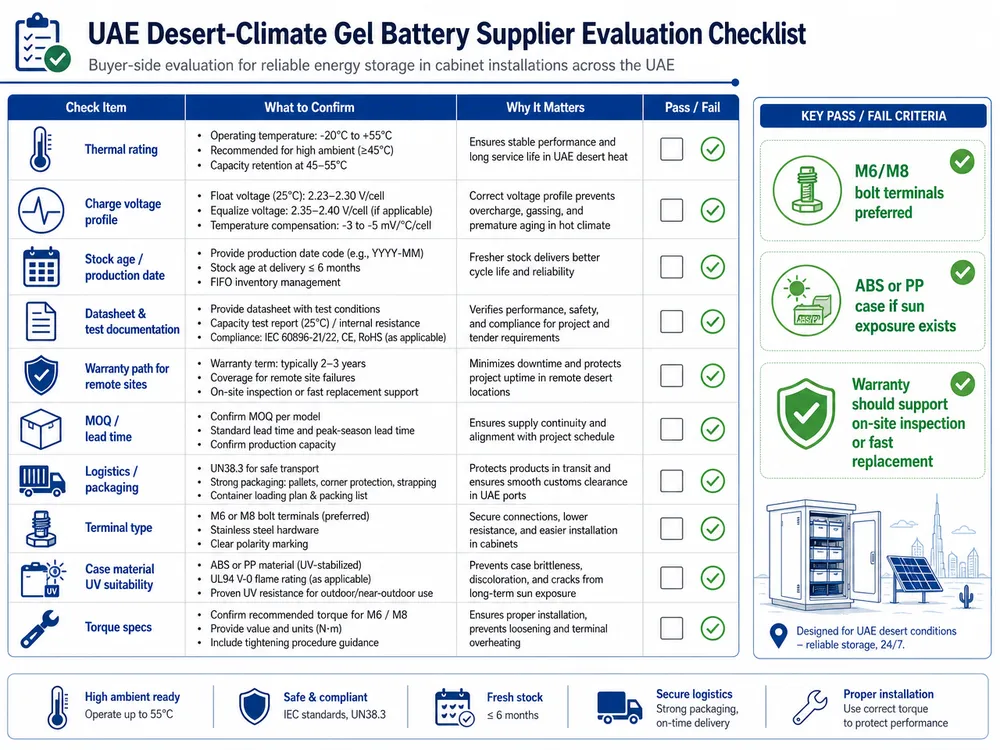
Before you place a bulk order for either type, your RFQ should lock these parameters. If a supplier can't answer them clearly, the quote isn't ready for a purchase order.
Request in writing:
- Exact construction: "AGM VRLA" or "gel VRLA" — not "VRLA," not "sealed lead-acid," not "maintenance-free"
- Voltage and Ah rating: nominal voltage, rated capacity at C10 or C20 discharge rate, and which rate the Ah figure refers to
- DOD and cycle-life test conditions: cycle count at what DOD percentage, at what temperature, per what test standard (IEC 61427 for solar cycling is the reference)
- Charge voltage ranges: float voltage and cycle voltage for the specific model, not generic "lead-acid" ranges
- Operating temperature range: rated minimum and maximum, and whether cycle-life data was tested at 25°C only or includes elevated-temperature verification
- Carton and pallet loading data: units per carton, cartons per pallet, pallets per 20GP, gross weight per pallet
- MSDS and export documents: confirm availability before order, not after production
- Sample policy and MOQ: EVANBattery standard MOQ is 100 units for standard models — low enough to validate a new SKU in your market before committing to container volume
If you need custom voltage configurations, capacity ratings, or private-label packaging, that falls under OEM ODM Solar Battery programs. We handle custom specs from 50Ah residential units through rack-mounted commercial storage — the MOQ adjusts based on customization scope.
The point of this checklist isn't bureaucracy. It's that every line item you lock at the RFQ stage is one fewer argument during warranty arbitration. When the agm battery vs vrla battery construction is specified on the PO, the charge profile is documented, and the test conditions are referenced, there's no gray zone left for either party.
For buyers ready to submit specifications, you can send your voltage, capacity, climate zone, and volume requirements through our Request Quote page.
Buyer Questions That Change the Final Battery Type
Is AGM the same as VRLA battery?
No. AGM is one type of VRLA battery. VRLA is the sealed, valve-regulated lead-acid category. AGM (glass mat electrolyte absorption) and gel (silica-gel electrolyte immobilization) are the two construction methods within that category. When someone quotes you "VRLA" without specifying AGM or gel, you don't have enough information to set charge parameters or predict field life.
Which sealed lead acid battery type is better for off-grid solar?
For daily-cycle off-grid solar in hot climates, gel VRLA typically delivers more usable cycles and better heat tolerance. For moderate-climate backup systems with shallow cycling, AGM VRLA offers faster recharge and lower unit cost. The deciding factors are your installation climate, daily depth of discharge, and charge controller voltage settings.
Does AGM or gel VRLA last longer at 50% DOD?
Gel VRLA generally achieves higher cycle counts at 50% DOD — typically 600–1000 cycles versus 400–600 for AGM, though exact numbers are model-specific. The trade-off is charge speed: gel requires slower, more precisely controlled charging. If your charge infrastructure can't maintain the correct gel voltage window, AGM may deliver better real-world longevity despite lower lab ratings.
Can AGM and gel VRLA use the same solar charge controller settings?
No. AGM typically requires 14.4–14.7V cycle charge and 13.5–13.8V float (for 12V systems). Gel requires 14.0–14.2V cycle charge and 13.5–13.7V float. Using AGM settings on a gel battery causes overcharge and accelerated electrolyte loss. Using gel settings on an AGM battery causes chronic undercharge and sulfation. Your charge controller must be programmed for the exact battery type installed.
What documents are needed for sealed lead-acid solar battery import?
At minimum: MSDS identifying the exact battery chemistry and construction, CE or relevant market certification, IEC 62133 safety test report, commercial invoice with correct HS code and battery type declaration, and packing list with weight and dimensions. For lithium batteries or mixed shipments, UN38.3 transport certification is additionally required. For standalone sealed lead-acid (AGM or gel), the non-spillable battery classification under IATA/IMDG DGR applies.
What should be checked before bulk ordering maintenance-free solar batteries?
Confirm the exact construction (AGM or gel), verify the charge voltage specification matches your deployed controllers, request cycle-life test data at your intended DOD and operating temperature, confirm MSDS and export documentation availability, and validate MOQ and lead time for your order size. If the supplier cannot specify whether the battery is AGM or gel construction, treat that as a disqualifying response — you cannot manage field performance or warranty terms without that information.