UAE Gel Battery Sourcing Starts With Heat, Not the Supplier Name
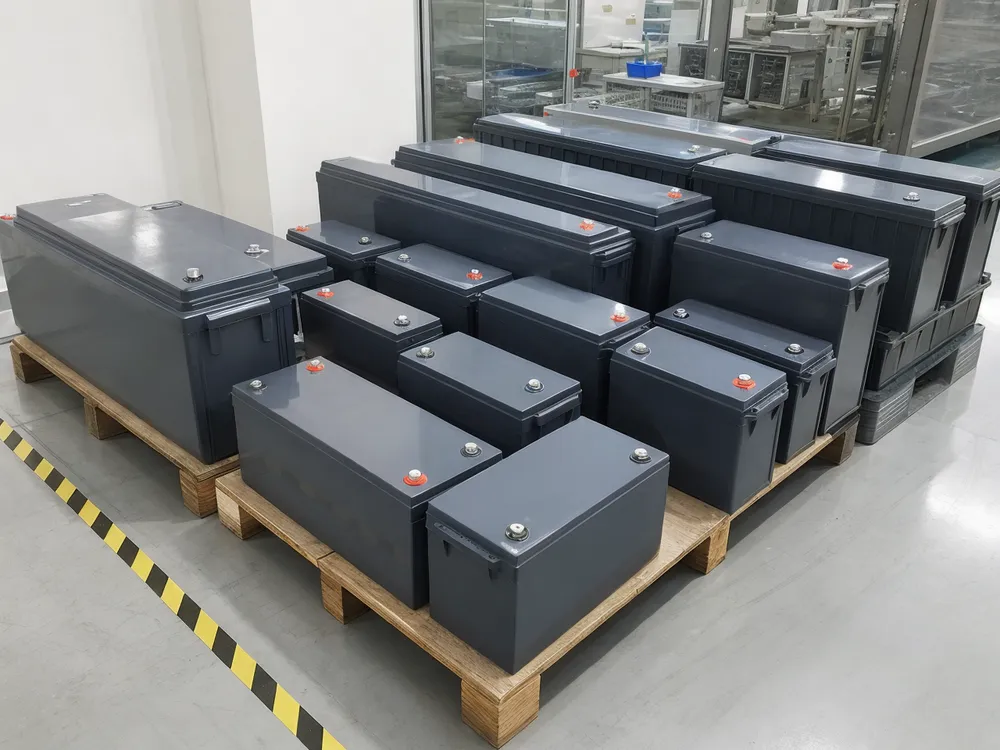
Your gel solar battery will spend its service life inside a rooftop cabinet, a ground-mounted enclosure, or a telecom shelter where ambient air regularly exceeds 45°C. The supplier name on the invoice matters less than what happens to the electrolyte at that temperature over 1,500 charge-discharge cycles.
Gel chemistry handles desert heat better than flooded lead-acid — the immobilized electrolyte resists stratification and reduces water loss. But "handles better" is not the same as "immune." Field failures we see from Middle East returns almost always trace back to three causes: charge voltage set too high for gel (above 14.1V on a 12V block at 25°C without temperature compensation), batteries sitting in a warehouse for 8-12 months before installation without maintenance charge, or cabinets with zero ventilation pushing internal temperatures past 60°C.
This article is a sourcing shortlist — 10 verified UAE-accessible gel solar battery suppliers — followed by the evaluation criteria and trade-off logic you need to protect project margin and reduce field replacement risk.
How This Top 10 Shortlist Was Verified
Every supplier on this list has an official company website with a publicly visible gel battery or VRLA solar battery product page. We did not pull names from a single directory or marketplace listing and call it research.
Verification method:
- Each company was confirmed through its official domain, not just a third-party mention
- Inclusion required visible evidence of gel, VRLA gel, or deep-cycle gel battery products
- Solar, off-grid, UPS, or energy storage application relevance was checked
- UAE presence was confirmed through Dubai office, Jebel Ali warehouse, showroom, or UAE-wide distribution statements
What this list does not claim:
- It does not rank suppliers by factory capability or product quality — that requires your own RFQ and sample testing
- It does not guarantee current stock availability, pricing, or lead times
- It does not replace your due diligence on datasheets, warranty terms, and production dates
Before issuing a PO to any supplier on this list, request: current production date on the battery label, full datasheet with charge-voltage window, cycle-life data at elevated temperature, and written warranty terms including the claim process for UAE-installed units.
Desert-Climate Checks That Separate Project-Grade Gel Batteries From Shelf Stock
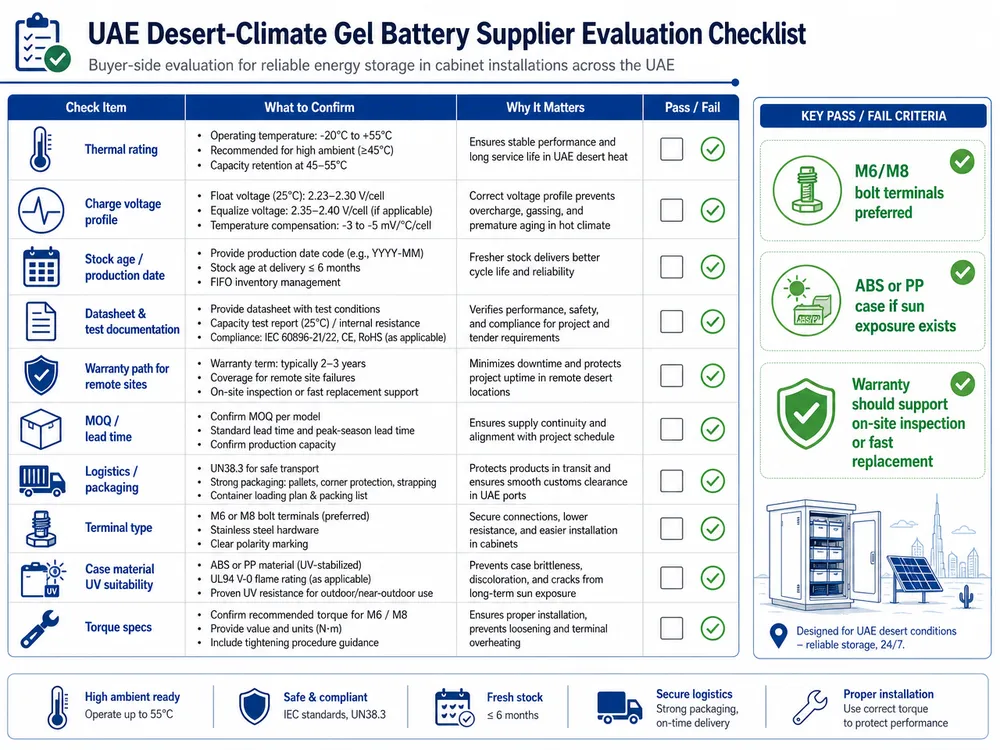
A gel battery rated for "wide temperature range" on a generic datasheet is not the same as a battery verified for continuous float service at 50°C ambient. Here is what to check — and what to ask — before you commit volume to any VRLA gel battery supplier in the UAE.
Operating temperature and capacity derating
Published operating range should show the upper limit explicitly. A battery rated -20°C to +60°C tells you the casing survives. What you actually need is the capacity correction curve: at 40°C, most gel batteries deliver 102-105% of rated Ah. At 55°C, capacity may look fine short-term, but calendar life drops by roughly 50% for every 10°C above 25°C reference. Ask for the Arrhenius-based life projection, not just the operating range.
Charge-voltage window for gel chemistry
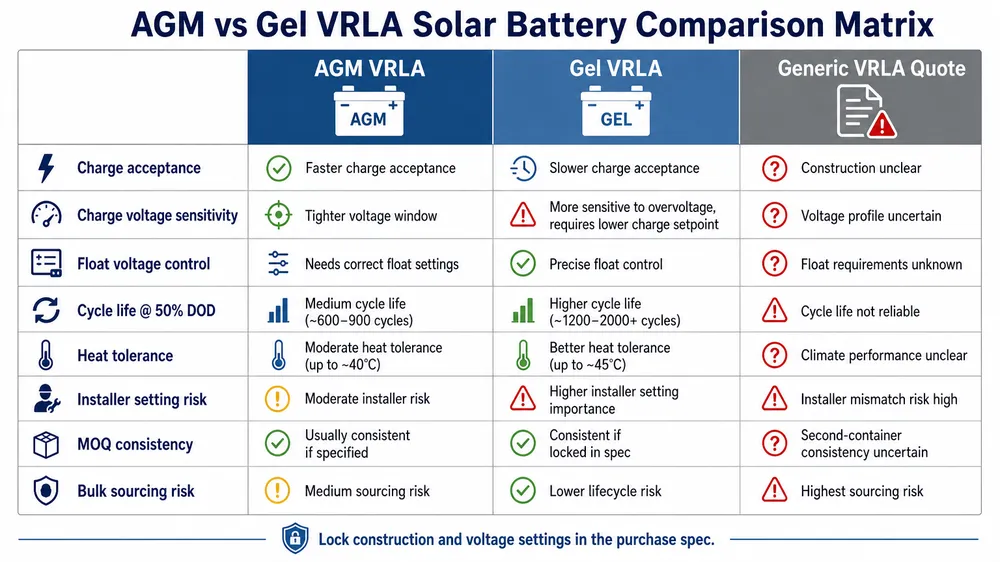
Gel electrolyte is less tolerant of overcharge than AGM. Float voltage for a 12V gel block should sit between 13.5V and 13.8V at 25°C. Cyclic charge voltage: 14.0-14.4V maximum. If your charge controller does not have a dedicated "gel" setting with temperature compensation (-3mV/°C/cell is typical), you will cook the electrolyte and see premature dry-out within 18 months. (We've seen entire telecom sites in Saudi Arabia lose 40% of battery capacity in year two because the rectifier was set to AGM voltage profiles.)
Stock age and pre-delivery recharge
Lead-acid batteries self-discharge. A gel battery stored at 30°C+ loses roughly 3-5% capacity per month without maintenance charge. If your supplier delivers batteries manufactured 9 months ago and stored in a non-climate-controlled Jebel Ali warehouse, you are starting with degraded capacity on day one. Ask for the production date stamped on the case and confirm whether the supplier performs pre-delivery voltage checks.
Terminal type, torque, and container material
For desert cabinet installations, specify: bolt terminal (M6 or M8) rather than push-on tabs, ABS or PP case material rated for UV if any sun exposure exists, and proper torque specs to prevent thermal-cycling looseness. These details matter more than they appear on paper — a loose terminal connection in a 55°C cabinet creates resistance heating that accelerates corrosion.
Warranty path for remote sites
A 3-year warranty means nothing if the claim process requires shipping a 30kg battery back to a Dubai office. Confirm: on-site inspection option, replacement timeline, and whether warranty covers capacity fade below 80% or only total failure. For 12V gel solar battery specifications, voltage and terminal details are covered in depth separately.

Top 10 Gel Solar Battery Suppliers in the UAE — Sourcing Shortlist
The following 10 companies have verified gel battery or VRLA solar battery product pages and UAE market presence. This is a discovery shortlist, not a quality ranking.
1. Radiant Solar DMCC
Location signal: Dubai (DMCC registered) Product evidence: Solar batteries page lists deep-cycle gel VRLA options in 12V and 2V configurations with published operating range of -25°C to +60°C. Best fit: Project contractors sourcing gel batteries alongside solar panel and inverter packages. What to ask: Specific gel battery brand/manufacturer behind the listing, current stock production dates, and whether they hold inventory or order per project.
2. Maxima Solar
Location signal: Dubai solar battery retailer/distributor Product evidence: Battery page lists Digital Solar Gel and OPzV 2V GEL batteries for solar PV and UPS applications. Best fit: Buyers who want to inspect product locally and need smaller quantities with Dubai pickup or delivery. What to ask: OPzV gel cell availability in 2V/1000Ah+ configurations for larger storage banks, lead time on non-stock capacities, and bulk pricing structure.
3. Aurra Energy
Location signal: Dubai-based, claims UAE-wide supply coverage Product evidence: Official page lists GEL batteries and VRLA AGM batteries for solar energy systems and deep-cycle applications. Best fit: Buyers needing a local distributor with both gel and AGM options for comparison testing across UAE emirates. What to ask: Which manufacturer's cells they distribute, whether datasheets include temperature-corrected cycle-life data, and minimum order for project pricing.
4. PAS Solar (PAS International Trading LLC)
Location signal: Dubai showroom, UAE solar equipment distributor Product evidence: Official page lists RITAR GEL and lead-acid batteries with after-sales support context and bulk buying references. Best fit: Buyers who want a recognized brand (RITAR) with local showroom access and after-sales support infrastructure. What to ask: RITAR gel model availability for 12V 100Ah-250Ah solar deep-cycle, warranty claim process through PAS vs. direct with RITAR, and project volume discounts.
5. NBS Groups
Location signal: UAE online solar battery supplier Product evidence: Collection page lists multiple solar deep-cycle gel batteries from NBS, Samsun, Su-mak, and Sunride brands. Best fit: Buyers comparing multiple gel battery brands through a single UAE channel, especially for smaller orders or quick online price checks. What to ask: Which brands carry full datasheets with gel-specific charge profiles, stock rotation policy, and whether they support project-volume RFQs beyond retail pricing.
6. Magnizon Power Systems
Location signal: JAFZA (Jebel Ali Free Zone) Dubai regional office Product evidence: Official page lists MG Series deep-cycle GEL batteries for solar and backup applications. Best fit: Buyers who value Jebel Ali proximity for logistics and want a branded gel battery line with regional office support. What to ask: MG Series gel battery cycle-life data at 40°C+, container-load pricing, and whether JAFZA stock is held or made-to-order.
7. Naif Falcon Trading
Location signal: Dubai/Jebel Ali warehousing, B2B solar distributor Product evidence: Official page states gel and AGM battery distribution for B2B solar customers with warehousing capability. Best fit: B2B buyers needing Jebel Ali warehouse access for staged project deliveries or re-export to other Gulf states. What to ask: Gel battery brands carried, MOQ for project pricing, warehouse storage conditions (climate-controlled or ambient), and re-export documentation support.
8. Al Nisba Trading LLC
Location signal: UAE branches including Dubai/Jebel Ali Product evidence: Official page lists VRLA batteries, gel batteries, solar applications, and deep-cycle use cases. Best fit: Buyers sourcing VRLA gel batteries across multiple UAE locations who need branch-level support. What to ask: Gel-specific product range vs. general VRLA, available capacities for solar deep-cycle duty, and whether they provide installation-site delivery with production date verification.
9. ARD UR Batteries Trading LLC
Location signal: Dubai, Al Hamriyah Port area Product evidence: Official page lists Wallington High Power Gel Battery with Dubai contact details. Best fit: Buyers in the Sharjah/Dubai corridor looking for a local battery trading company with gel product access. What to ask: Full gel battery range beyond the listed model, datasheet availability, bulk order lead time, and whether they handle project-scale quantities or primarily retail/small-trade.
10. AMPS Middle East / Eastman World
Location signal: UAE/Dubai office, battery brand/distributor Product evidence: Official page lists deep-cycle gel batteries for solar backup use with UAE office details. Best fit: Buyers who want a branded gel battery line with Middle East regional office support and potential multi-country distribution. What to ask: Eastman gel battery thermal performance data, UAE stock depth, container-load pricing for repeat orders, and warranty administration through the Dubai office.
Common thread across all 10: Most of these suppliers operate as distributors, brand agents, or trading companies rather than battery manufacturers. That is normal for the UAE market — it is a trading hub, not a cell production base. The practical implication: your supplier's value is in stock access, local support, and logistics convenience. The battery's quality still traces back to whoever manufactured the cells.
Where UAE Local Supply Protects Schedule and After-Sales Risk
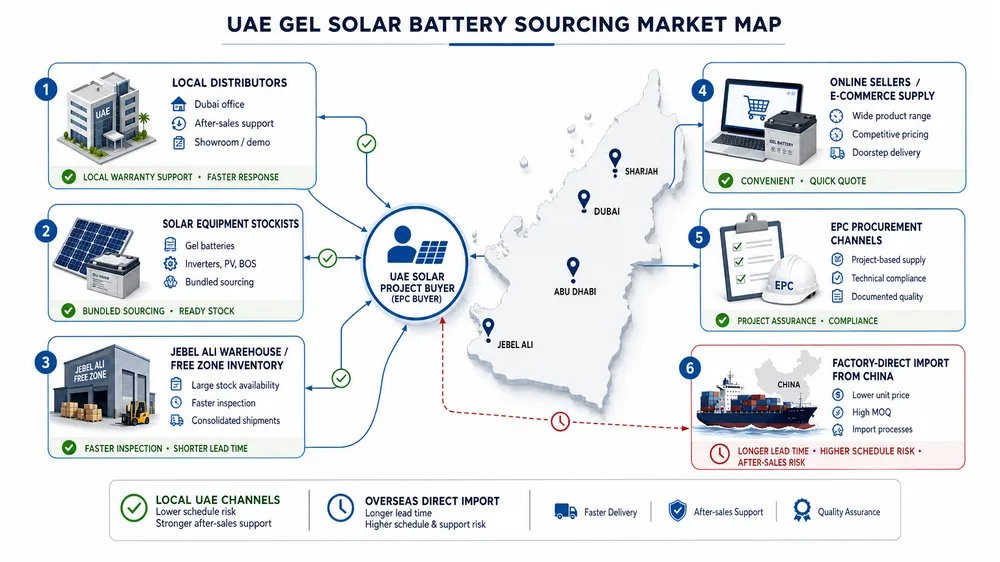
Local gel battery suppliers in Dubai serve a real function that factory-direct import cannot replicate for every scenario.
When local supply is the right answer:
- Emergency replacement: A telecom tower battery bank fails in July. You need 20 units delivered to a site in Ras Al Khaimah within 48 hours. No import route solves this.
- Pilot system validation: You are testing a new 5kW off-grid configuration and need 4 gel batteries to validate the charge controller settings before committing to a 200-unit project order.
- Showroom inspection: Your client wants to see and touch the product before approving the specification. A Dubai showroom visit closes the deal faster than a factory video call.
- Mixed-component procurement: You are sourcing panels, inverters, racking, and batteries for a single EPC package. A local solar distributor who bundles everything simplifies your procurement paperwork.
- Warranty proximity: If a battery fails at month 14, a local distributor with a Dubai office can inspect, approve, and replace faster than an international claim process.
| Scenario | Best supply route | Why |
|---|---|---|
| Emergency replacement (< 72 hours) | UAE stockist with warehouse inventory | Speed overrides cost |
| Pilot / trial system (4-20 units) | Local distributor or low-MOQ factory trial | Validation before commitment |
| Repeat project supply (100-500+ units) | Compare factory-direct landed cost | Economics shift at volume |
| Private-label program | Factory-direct | Customization requires manufacturer access |
| Full EPC package | Local solar distributor | Single-source convenience |
Where Local Convenience Can Reduce Project Margin
The 10 suppliers above provide genuine value — but that value has a cost structure you should understand before locking in repeat orders.
Distributor markup layers:
Most UAE gel battery suppliers purchase from Chinese or Indian manufacturers at FOB price, add freight, import duty (5% on HS 8507.20 for lead-acid accumulators), warehousing, and their own margin. By the time the battery reaches your project site, the landed cost typically carries 25-45% above the original factory gate price. That range is not a criticism — it covers real services (stock holding, local support, credit terms). But on a 500-unit repeat order, that margin layer compounds into serious money.
Stock age risk:
A distributor holding 200 gel batteries in a Jebel Ali warehouse needs to move them. If demand is slower than expected, those batteries sit. Every month at 35°C+ ambient storage costs capacity. You may receive batteries with a production date 6-10 months old — still within "acceptable" range on paper, but already carrying measurable sulfation. (We test incoming cells at our factory and reject anything over 60 days from production for premium orders. The difference in initial capacity between a 30-day-old cell and a 9-month-old cell stored at 35°C is measurable on the first discharge.)
Limited customization:
Local distributors stock what sells in volume: 12V 100Ah, 12V 150Ah, 12V 200Ah. If your project needs 12V 250Ah with specific terminal orientation, a custom label for your brand, or a non-standard case dimension for an existing cabinet, the local channel cannot help. You are buying what they have, not what you need.
Cost-per-cycle calculation inputs:
Before committing to any supply route, calculate:
- Unit price (AED or USD)
- Battery weight (affects freight per Wh)
- Cycle-life assumption at your actual installation temperature (not 25°C lab data)
- Freight cost per unit to project site
- Import duty and VAT on CIF value
- Warranty reserve (cost of one replacement per X units over project life)
- Installation labor for replacement if early failure occurs
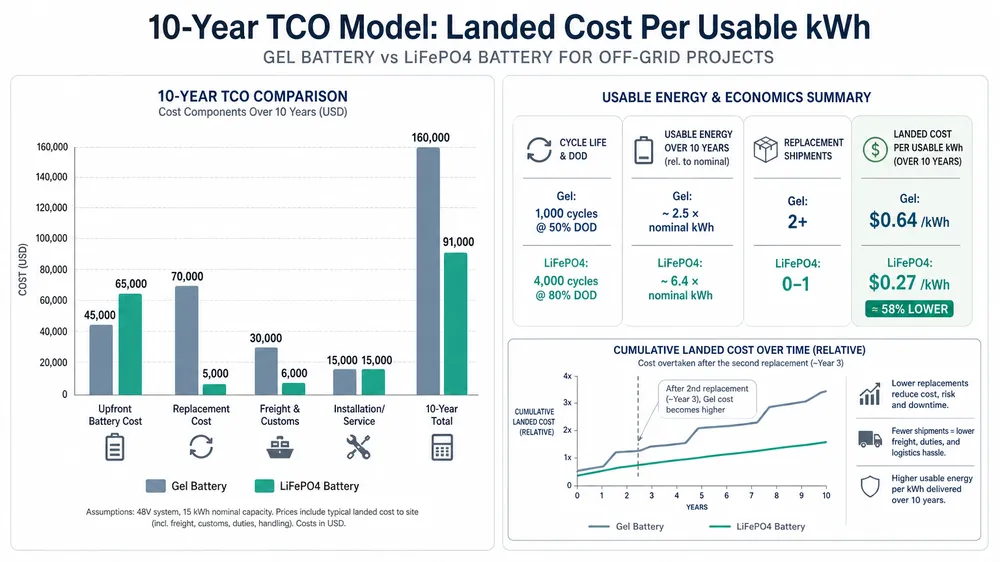
The cheapest unit price is not the cheapest project cost. A battery that costs 15% less but delivers 30% fewer cycles at 50°C ambient is the more expensive choice.
Factory-Direct Import Fits Repeat UAE Projects With Controlled Specs
For buyers placing repeat orders of 100+ units per project — solar street lighting, telecom backup, off-grid residential, or containerized storage — factory-direct sourcing from a gel battery manufacturer changes the economics.
We have been manufacturing gel solar batteries since 2012. Our 9,900 m² factory in Zhongshan runs 6 production lines with 150 staff and produces 2,000,000 battery units annually. The Middle East is not a new market for us — we have been shipping gel batteries to Gulf and African buyers for over a decade, so the logistics path, documentation requirements, and climate-specific testing are already built into our production workflow.
What factory-direct access gives you that a distributor cannot:
Our automated cell sorting lines match internal resistance within ±5mΩ across every battery in your batch. Consistent cell matching means consistent field performance — you do not get one battery lasting 6 years and another failing at 3 in the same installation. For UAE projects specifically, we run a 55°C high-temperature soak test on gel production batches destined for Middle East and African markets. This is not a standard test that every factory performs — it adds time to the QC cycle, but it catches electrolyte migration issues and seal integrity problems before the battery ships.
Our engineering team (18+ engineers across lithium and lead-acid divisions) can adjust voltage configurations, capacity ratings, terminal types, and case dimensions for your project requirements. MOQ starts at 100 units for standard models — low enough for a project contractor to test a new supplier without committing to a full container. OEM labeling and custom BMS configurations are available for distributors building their own brand in the Gulf market.
Certifications: ISO 9001:2015, CE, IEC 62133, MSDS documentation, and non-spillable lead-acid transport declarations. For gel solar battery sourcing at the category level, or deep cycle gel solar battery specifications for project-cycle duty, those pages cover the technical range in detail.
China-to-UAE Logistics and Compliance Checks Before Bid Submission
If you are pricing a factory-direct gel battery import into your project bid, these are the line items to confirm before you submit numbers.
Packaging and loading:
Gel lead-acid batteries are heavy. A 12V 200Ah gel block weighs approximately 55-65kg depending on plate design. Carton packaging must include foam corner protection and pallet strapping rated for the weight. A standard 20GP container holds roughly 400-500 units of 12V 200Ah gel batteries depending on pallet configuration — confirm exact loading plans with your freight forwarder before finalizing quantity per shipment.
Jebel Ali clearance timeline:
Standard clearance for non-hazardous goods through Jebel Ali runs 3-7 working days assuming documentation is complete. Gel VRLA batteries classified as non-spillable lead-acid are not Class 9 dangerous goods for sea freight (unlike lithium batteries). However, your broker should confirm the current UAE customs treatment and any additional inspection requirements.
Import duty and VAT:
HS code 8507.20 covers lead-acid accumulators. UAE import duty is typically 5% on CIF value. VAT at 5% applies on top. Confirm current rates through the UAE Federal Customs Authority or your licensed broker — rates and exemptions can shift. Factor both into your landed cost calculation before comparing against local distributor pricing.
Documentation for gel lead-acid (not lithium):
Gel VRLA batteries require: MSDS (Material Safety Data Sheet), non-spillable battery declaration per IATA/IMDG standards, and commercial invoice with correct HS code. UN38.3 testing is a lithium battery requirement — it does not apply to standard gel lead-acid shipments unless your order includes mixed lithium products. Do not let a freight forwarder charge you for lithium-class documentation on a pure gel lead-acid shipment.
Freight cost volatility:
Sea freight rates between South China and Jebel Ali fluctuate. Budget a range rather than a fixed number, and confirm spot rates at order confirmation rather than at quotation stage. For gel solar battery lifespan considerations and how they affect warranty reserve calculations, that analysis is covered separately.
Which Sourcing Route Fits Your UAE Project Volume
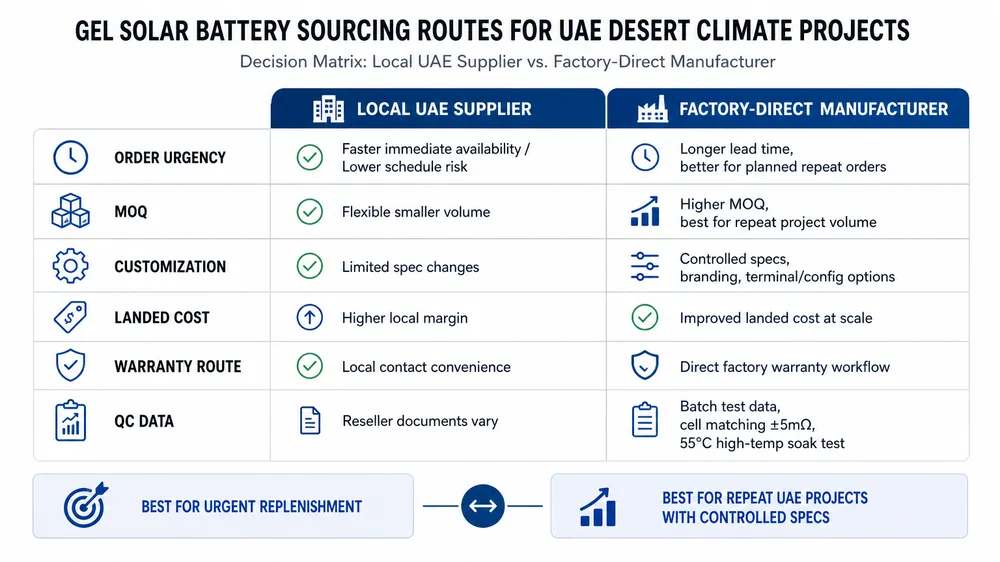
Your decision is not "local vs. import" as a binary. It is "which route fits this specific order's constraints."
Emergency replacement or urgent small batch (< 50 units, needed within 1-2 weeks): Use a UAE stockist from the list above. Pay the convenience premium. Your project timeline is worth more than the per-unit savings.
Pilot system or new-supplier trial (20-100 units): Either route works. A local supplier gives you faster access for validation. A factory trial order (our MOQ starts at 100 units for standard gel models) lets you test the actual production quality and thermal performance data before scaling.
Repeat project procurement (100-500+ units per order, multiple times per year): This is where factory-direct economics become compelling. At 200+ units per order, the distributor margin you eliminate typically exceeds the freight and import duty combined. You also gain specification control — exact voltage, capacity, terminal configuration, and labeling matched to your project requirements.
Private-label distribution program: Factory-direct is the only viable route. No local distributor will relabel another brand's product for your distribution business. You need manufacturer access for custom branding, packaging, and potentially adjusted BMS parameters.
Full EPC solar package (panels + inverters + batteries + racking): If your client expects a single-source package with unified warranty, a local solar distributor may simplify your procurement. But if batteries represent a significant cost line and you are deploying the same configuration across multiple sites, splitting the battery procurement to factory-direct while sourcing other components locally can improve your overall project margin.
For buyers ready to compare factory-direct pricing against their current local supply cost, a quote request with your voltage, Ah capacity, quantity, and installation temperature range gives us enough to return a landed-cost comparison within 48 hours.
FAQ for UAE Gel Solar Battery Procurement
Can gel solar batteries operate in UAE ambient temperatures above 45°C?
Yes — gel batteries tolerate high ambient temperatures better than flooded lead-acid because the immobilized electrolyte resists evaporation and stratification. However, continuous operation above 40°C accelerates calendar aging. At 50°C ambient, expect roughly 50% reduction in design life compared to 25°C reference conditions. The battery will function, but your replacement cycle shortens. Specify batteries with published high-temperature cycle data, not just an operating range claim.
What charge-voltage data should a supplier provide for VRLA gel batteries?
At minimum: float voltage at 25°C (typically 13.5-13.8V for a 12V block), cyclic charge voltage (14.0-14.4V), temperature compensation coefficient (standard is -3mV/°C/cell or approximately -18mV/°C for a 12V 6-cell battery), and maximum charge current as a percentage of C10 capacity. If a supplier cannot provide these four numbers from the manufacturer's datasheet, they likely do not have direct access to the factory's technical team.
How can you check whether a local gel battery stock batch is fresh?
Check the production date code stamped or printed on the battery case — usually on the top label or side sticker. Calculate months since production. For gel batteries stored at UAE ambient warehouse temperatures (30-40°C), anything beyond 6 months from production should be voltage-tested before acceptance. Request the open-circuit voltage reading: a fully charged 12V gel battery should read 12.8-13.0V. Below 12.6V after claimed full charge suggests sulfation from extended storage.
Is a local UAE distributor or factory-direct supplier better for 100-500 unit orders?
At 100 units, the decision is close — local supply saves you import logistics complexity, but factory-direct starts showing cost advantage. At 200+ units, factory-direct typically wins on landed cost, specification control, and production freshness (batteries ship within weeks of manufacture rather than sitting in warehouse stock). The break-even depends on your specific freight lane cost and whether you need custom specifications that local stock cannot provide.
What documents should you request before importing gel lead-acid batteries into the UAE?
MSDS (Material Safety Data Sheet), non-spillable lead-acid battery declaration per IATA/IMDG packing instruction, commercial invoice with HS code 8507.20, packing list with battery weights, and CE or IEC test reports if your project requires them. Do not confuse gel lead-acid documentation with lithium battery requirements — UN38.3 testing certificates are for lithium cells only and do not apply to gel VRLA shipments.