

Solar Battery System for RV
12V and 24V LiFePO4 packs with integrated BMS and optional Bluetooth, built for RV distributors, camper van converters, and mobile power resellers.
Compact form factor, vibration-conscious assembly, and brand-label readiness from a solar battery system for RV manufacturer with 13+ years of pack production behind every batch.
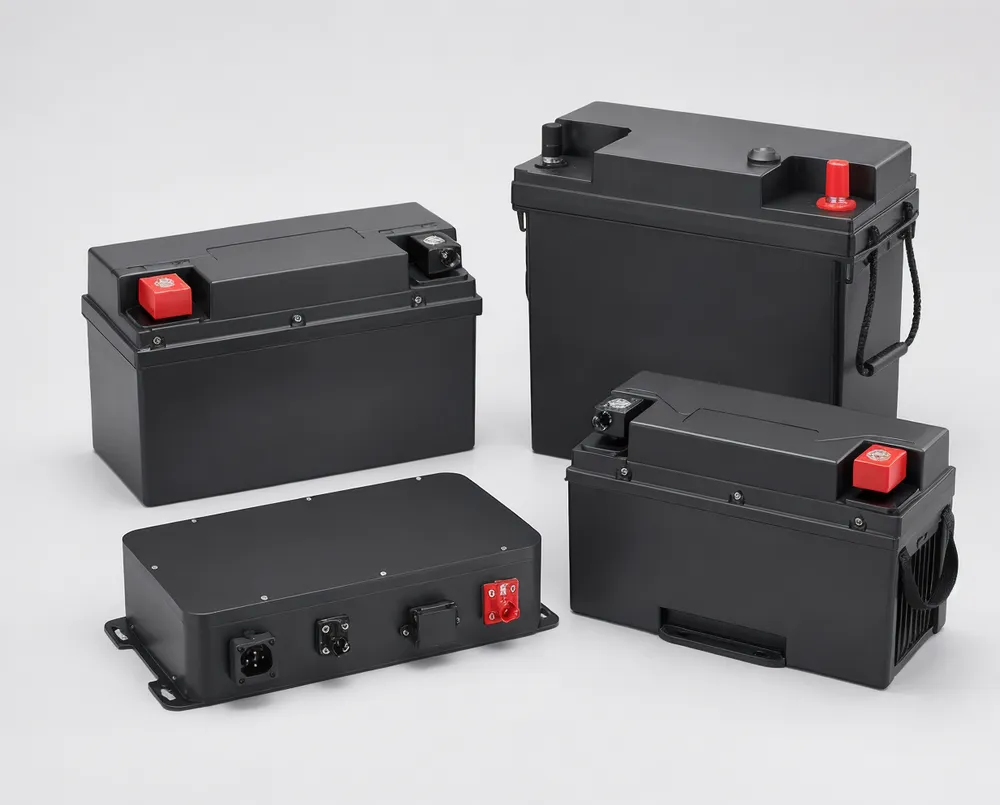
We build solar battery systems for RV and mobile applications — LiFePO4 battery packs in 12V and 24V configurations, with integrated BMS protection, optional Bluetooth monitoring, and the documentation package your import process requires. This is not a residential storage battery repackaged with an "RV" label. The cell arrangement, BMS protection logic, enclosure format, and packing method are designed around what mobile applications actually demand: compact dimensions, vibration tolerance, irregular charge patterns from solar and alternator sources, and seasonal reorder cycles that don't require container-volume commitments.
As an RV solar battery system supplier, we work with aftermarket distributors, camper van conversion shops, caravan OEMs, and marine-light retailers who need 2–5 SKUs they can brand, stock, and reorder without re-engineering each time. Our 100-unit MOQ on standard models fits the test-and-scale pattern these channels run.
We've been shipping mobile solar battery system configurations since 2016 — the RV/marine segment grew out of our off-grid 12V production, not the other way around.
Purpose-Built for Mobile
Cell arrangement, BMS logic, and enclosure format designed for vibration, irregular charge patterns, and compact compartments.
Brand-Label Ready
2–5 SKUs you can brand, stock, and reorder without re-engineering. OEM documentation included.
100-Unit MOQ
Fits the test-and-scale pattern for aftermarket distributors and conversion shops. No container-volume commitments required.
12V and 24V RV Battery Specifications for RFQ Screening
Here's the specification coverage for our solar battery system for RV range. Use this to check whether our production parameters match your requirements before sending an inquiry — exact values depend on model selection and any OEM configuration.
Electrical Parameters
| Parameter | Typical Range / Options |
|---|---|
| Voltage platforms | 12.8V (4S), 25.6V (8S) |
| Cell chemistry | LiFePO4 (lithium iron phosphate) |
| Capacity bands | 50Ah, 100Ah, 150Ah, 200Ah, 300Ah (12V); 100Ah, 150Ah, 200Ah (24V) |
| Energy range | 0.64 kWh – 3.84 kWh per unit (model dependent) |
| Recommended charge voltage | 14.2–14.6V (12V); 28.4–29.2V (24V) |
| Continuous discharge current | 50A–200A (model dependent) |
| Peak discharge | Up to 1.5× continuous for 30 seconds (model dependent) |
Protection & Monitoring
| Parameter | Typical Range / Options |
|---|---|
| BMS protections | Over-charge, over-discharge, over-current, short-circuit, high/low temperature |
| Communication / monitoring | Bluetooth (optional), LED SOC indicator (standard) |
| Low-temperature charge cutoff | 0°C (BMS-controlled, prevents lithium plating) |
| Self-discharge | <3% per month at 25°C |
Mechanical & Environmental
| Parameter | Typical Range / Options |
|---|---|
| Enclosure format | Steel or aluminum case, sealed IP65-rated options available |
| Terminal options | M8 bolt, Anderson connector, or custom terminal layout |
| Cycle life | 3,000–6,000 cycles at 80% DOD (cell grade dependent) |
| Operating temperature | -20°C to 55°C (discharge), 0°C to 45°C (charge) |
Compliance & OEM
| Parameter | Typical Range / Options |
|---|---|
| Certifications available | ISO 9001:2015, CE, IEC 62133, UN38.3, MSDS |
| OEM/ODM | Label, color, manual, carton, BMS parameters, Bluetooth app branding |
| Standard MOQ | 100 units (standard models) |
0.64–3.84 kWh
Energy per unit
3,000–6,000
Cycles at 80% DOD
100 units
Standard MOQ
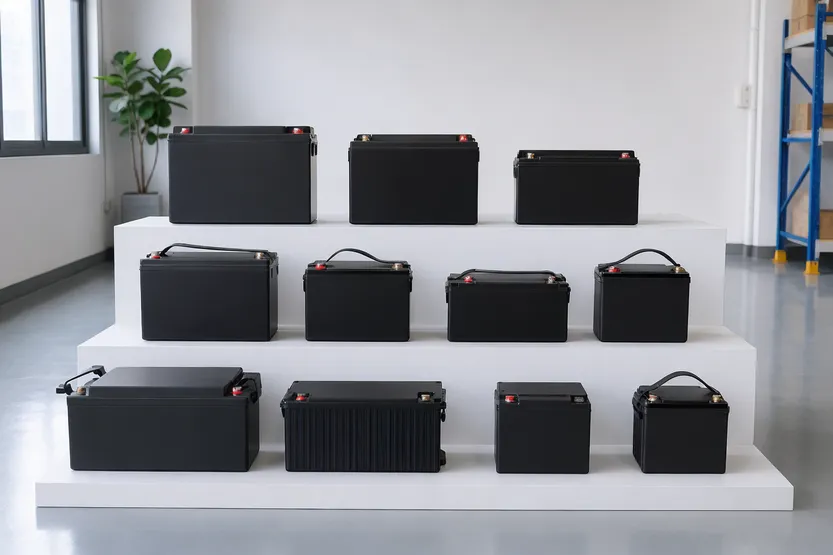
Specifications shown are industry-standard values for LiFePO4 RV battery systems. Actual specifications vary by model and configuration. Contact us for detailed product datasheets.
Send your voltage, Ah requirement, and target market — we'll match you to a specific model and return a datasheet within 48 hours.
Request a Matched DatasheetWhere RV and Mobile Solar Battery SKUs Generate Repeat Revenue
Every application below is a market segment where our buyers build repeat programs. Your sourcing decision should be driven by which channels you can profitably serve — not by which end-user lifestyle sounds appealing.
RV Aftermarket Distributors
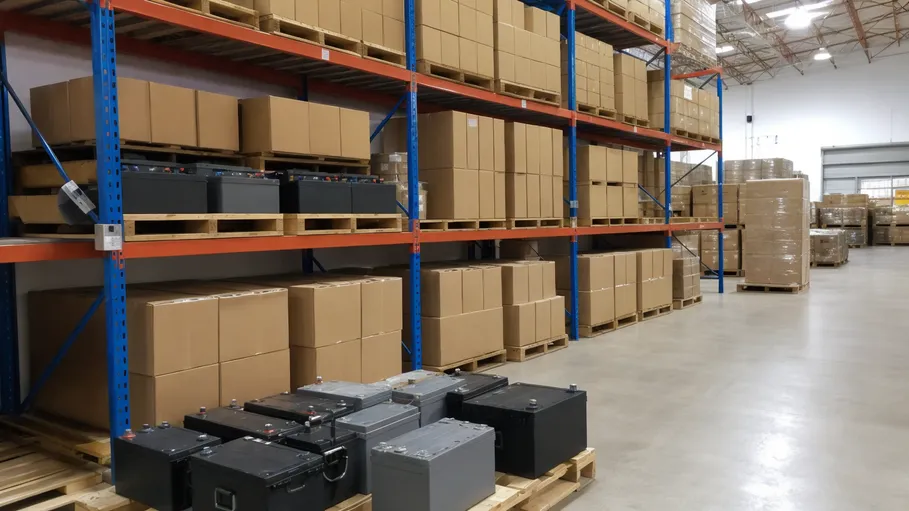
The largest volume channel for mobile solar battery systems. Aftermarket RV buyers upgrade from lead-acid to LiFePO4 for the weight savings (typically 60-70% lighter at equivalent capacity) and the cycle life advantage.
Distributors typically carry 2-3 SKUs — a 12V 100Ah entry point, a 12V 200Ah for full-timers, and occasionally a 12V 300Ah or 24V option for larger rigs.
Seasonal demand peaks before summer travel season, so your reorder timing matters. Our 100-unit MOQ and 15-25 day lead time on standard models let you stock before peak without over-committing.
Camper Van Conversion Builders
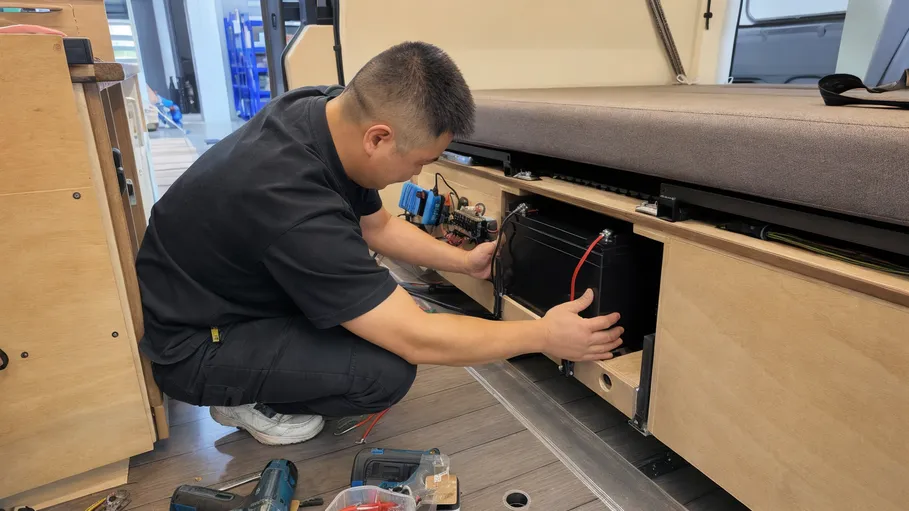
Conversion shops install 1-4 batteries per build and need consistent supply across a build season. They care about compact dimensions (fitting under bench seats or in side cabinets), terminal position (cable routing in tight spaces), and BMS behavior with MPPT controllers and DC-DC chargers.
We configure terminal layout and provide installation dimension drawings so your conversion customers can design their electrical layout around a known battery footprint.
Caravan and Motorhome OEMs
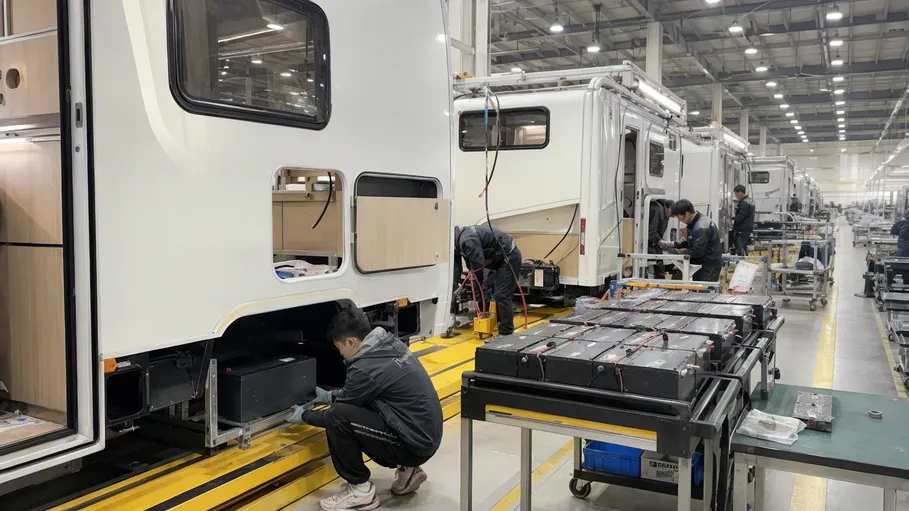
Vehicle manufacturers integrating batteries at the factory level need consistent batch quality, brand-neutral or private-label packaging, and documentation that satisfies their vehicle certification process.
Orders are typically quarterly, 200-1,000 units, with strict dimensional and weight specifications.
Our automated cell sorting ensures pack-to-pack consistency across a production run — your assembly line doesn't stop because unit #347 doesn't match unit #1.
Marine-Light and Mobile Power Retailers
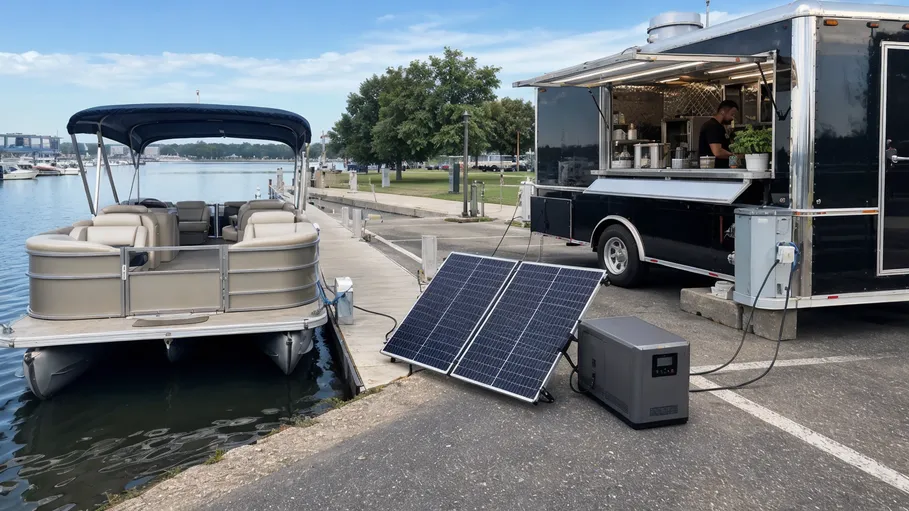
Pontoon boats, small sailboats, food trucks, mobile medical units, construction site power — any application where the battery moves and charges from solar. These buyers often cross-sell RV and marine under one catalog.
The same 12V LiFePO4 pack works in both environments; the difference is in the marketing, not the hardware.
We can produce the same electrical product with different labels for your RV and marine SKUs — same BOM, different branding, one purchase order.
Off-Grid Service and Work Vehicles
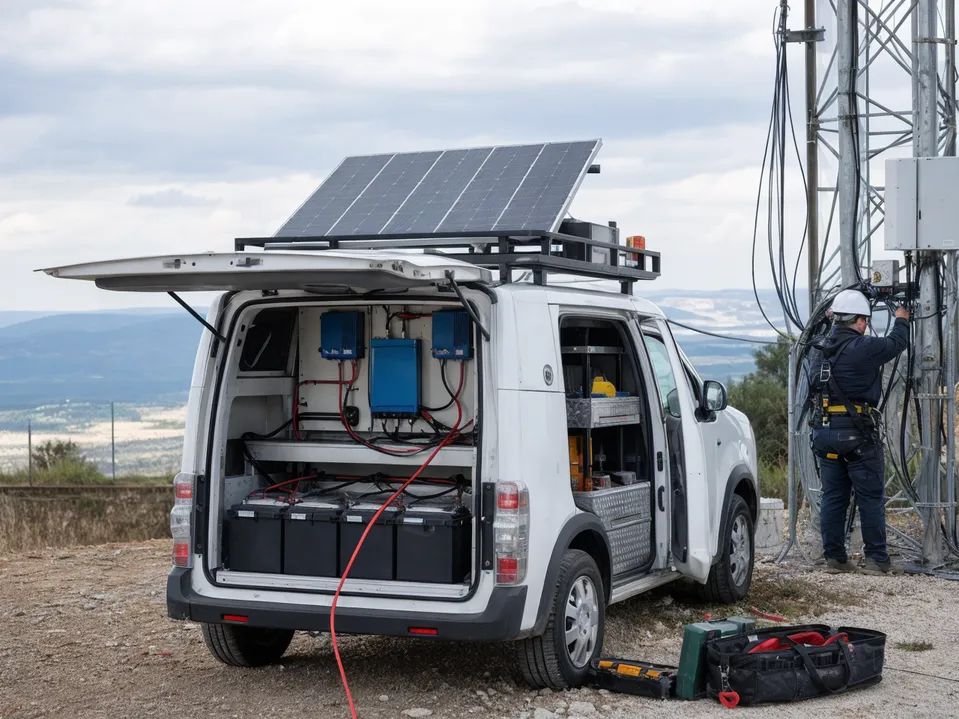
Utility trucks, mobile telecom maintenance vehicles, and field service vans that run equipment from battery power during stops. Orders are smaller per buyer but come from commercial fleet programs with multi-year reorder patterns.
The 24V platform is more common here because the loads are heavier.
BMS Protection and Cell Matching That Reduce Mobile Warranty Claims
Mobile applications stress batteries differently than stationary installations. The battery vibrates constantly, charges irregularly from both solar panels and vehicle alternators, sits in compartments with limited airflow, and experiences temperature swings from desert afternoons to mountain mornings. Every one of these conditions accelerates failure in a poorly built pack. As a solar battery system for RV manufacturer, this is where our production process earns its keep.
Constant Vibration
Irregular Charging
Limited Airflow
Temperature Swings
Cell Sorting for Mobile Consistency
We sort incoming cells by actual measured capacity and internal resistance — not the supplier's printed label. For RV packs, we use tighter matching bins than our stationary products (within 15mV and 3mΩ across a pack) because mobile vibration can amplify small imbalances into thermal hotspots over time.
When cells are well-matched from day one, they age together under cycling stress rather than one weak cell dragging the pack down and triggering premature BMS shutdowns that your customer calls you about.

BMS Logic Tuned for Mobile Charge Sources
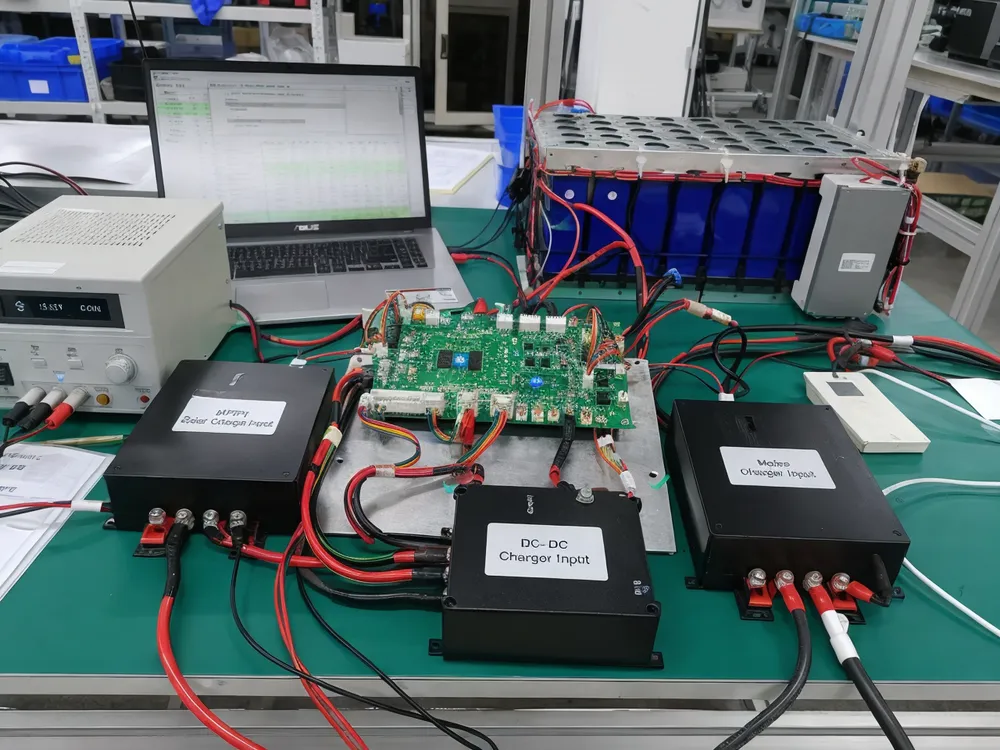
A residential battery charges from one source at predictable voltage. An RV battery might see solar input from an MPPT controller, alternator charging through a DC-DC converter, and shore power from a mains charger — sometimes simultaneously.
We program the BMS charge acceptance parameters to handle these overlapping sources without nuisance disconnects. The over-charge protection threshold accounts for the voltage spikes that DC-DC chargers produce during engine start-up.
Field-proven adjustment: We added this specific protection adjustment after a batch of warranty returns from an Australian distributor in 2019 — the alternator charging profile was triggering false over-voltage shutdowns.
Temperature Protection with Mobile Context
Our BMS includes both high-temperature discharge cutoff (typically 60°C) and low-temperature charge cutoff (0°C). The low-temp cutoff is critical for RV applications — lithium plating during sub-zero charging permanently damages cells, and RV users in northern climates will plug in shore power on cold mornings without thinking about cell temperature.
The BMS prevents this automatically, so your after-sales team doesn't field calls about sudden capacity loss.
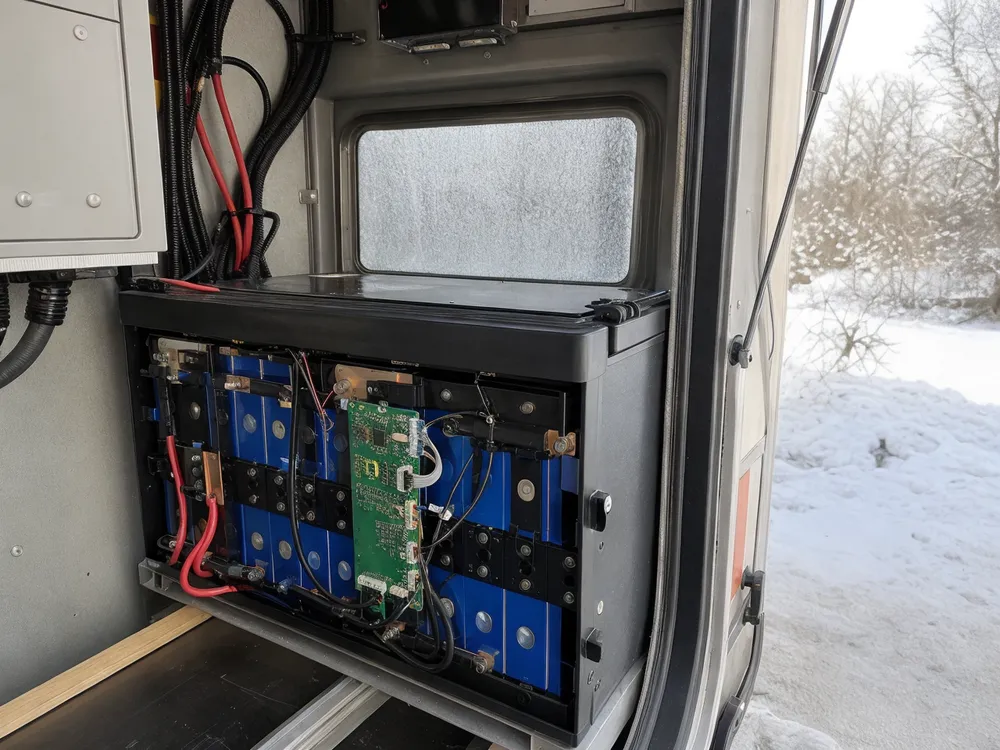
Vibration-Conscious Assembly
These are small details that don't show up on a datasheet but determine whether your batteries survive three years of road vibration or develop intermittent connection failures after six months.
Structural adhesive between cells (not just compression packing)
Wire harness connections secured with strain relief
Terminal bolts torqued to specification
Thread-locking compound on all fasteners
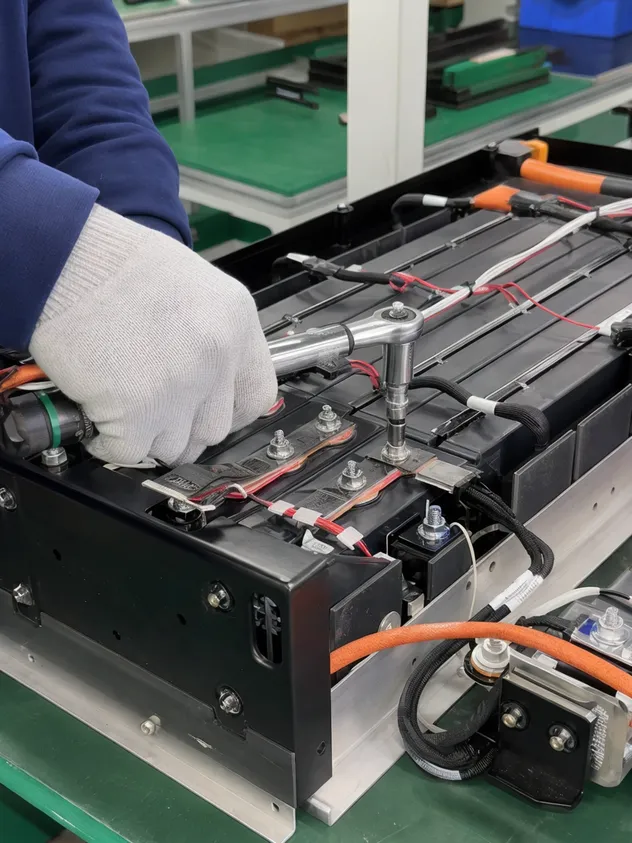
Batch Lifecycle Testing
Every production batch goes through the following verification sequence before shipment. We catch early-life cell dropout at the factory, not in your customer's RV.
Capacity Verification
Charge/Discharge Cycling
55°C High-Temp Soak
Vibration Testing
RV Solar Battery Configurations We Build
These are our standard RV configurations. Each can be adjusted for capacity, voltage, BMS parameters, enclosure style, and branding. MOQs start at 100 units for standard configs.
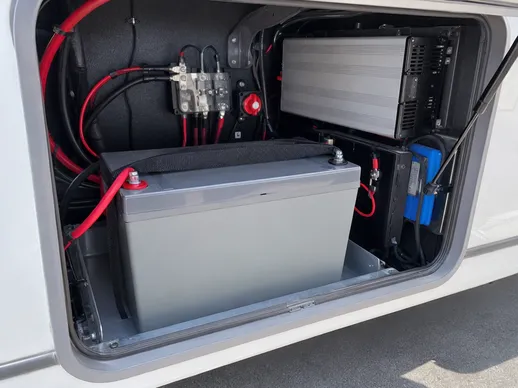
12V 100Ah LiFePO4
Drop-in replacement for Group 27/31 lead-acid. Most popular for single-battery RV upgrades and van conversions.
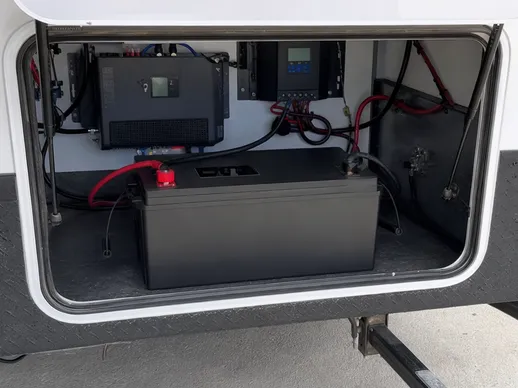
12V 200Ah LiFePO4
Higher capacity for full-time RV living. Supports air conditioning, induction cooking, and extended boondocking without shore power.
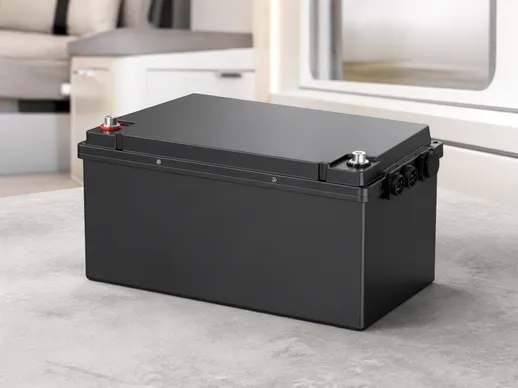
24V 100Ah LiFePO4
For larger motorhomes and expedition vehicles running 24V systems. Lower current draw at same power means thinner cabling and less voltage drop.
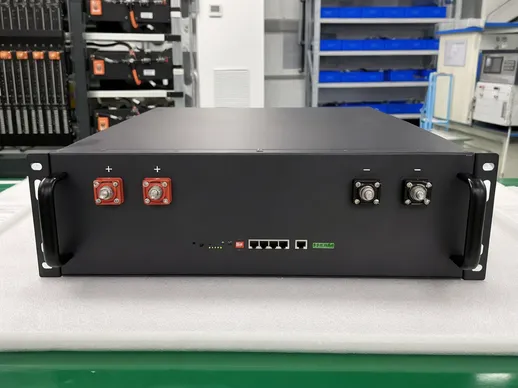
48V 50Ah LiFePO4
Growing demand for luxury RVs with 48V architecture. Pairs with high-power inverters for residential-grade appliance support on the road.
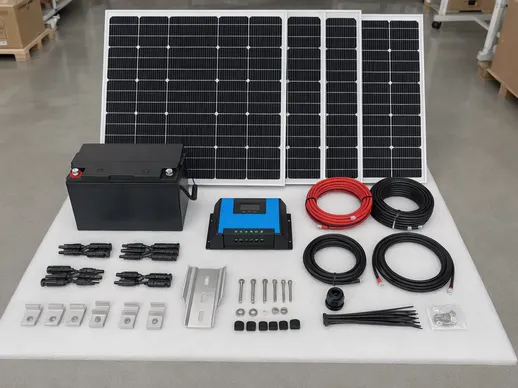
Complete Solar + Battery Kit
Bundled system: panels, MPPT controller, battery, wiring, and mounting hardware. Pre-matched components eliminate compatibility guesswork for your customers.
Custom Configuration
Need a different voltage, capacity, form factor, or communication protocol? We design to your specification with the same quality controls applied to standard products.
Discuss Your RequirementsAvailable Customization Options
Enclosure
- ABS plastic (standard)
- Metal case (IP65)
- Custom dimensions
- Color matching
Communication
- Bluetooth 5.0
- CAN Bus
- RS485 / RS232
- Wi-Fi module
Features
- Self-heating system
- LCD/LED display
- Parallel expansion
- Active balancing
Branding
- Logo printing
- Custom labels
- Retail packaging
- White-label app
From Specification to Shipment
A typical RV battery project moves from initial discussion to first production shipment in 35–50 days. Here's how the process works so you can plan your inventory timeline.
Technical Discussion
You share your requirements — voltage, capacity, form factor, BMS features, certifications needed, target market. We confirm feasibility and provide a preliminary quotation within 48 hours.
Specification Lock & Sample Agreement
We finalize the technical specification document together — cell chemistry, BMS parameters, enclosure design, labeling. Sample cost and timeline are confirmed. 30% deposit initiates sample production.
Sample Production & Testing
We build 2–5 sample units through the full production process. Each sample undergoes the same lifecycle testing as production batches. You receive samples with test data reports for your own validation.
Sample Approval & Production Order
After you approve the sample (or we iterate on adjustments), the production order is placed. We confirm the production schedule and arrange material procurement for your batch size.
Production & QC
Full batch production with in-line quality checks at each stage. We send production photos and test data at key milestones. Third-party inspection can be arranged before shipment if required.
Packaging & Shipment
UN38.3-compliant packaging with MSDS documentation. We handle DG (dangerous goods) shipping paperwork. FOB Shenzhen or CIF to your port — your choice. Air freight available for urgent orders.
Certifications That Clear Your Import Path
RV battery imports face regulatory scrutiny in most markets. We maintain current certifications and handle the documentation so your shipments clear customs without delays.
UL 2580 / UL 1973
Safety standards for batteries used in electric vehicles and stationary applications. Required for North American market entry.
CE / EN 62619
European conformity marking and safety standard for secondary lithium cells in industrial applications including RVs and marine.
UN38.3
Transport testing certification required for shipping lithium batteries by air, sea, and ground. Mandatory for all international shipments.
RoHS / REACH
Environmental compliance for hazardous substance restrictions. Required for EU market and increasingly expected in other regions.
IEC 62133-2
International safety requirements for portable sealed secondary lithium cells. Covers mechanical, electrical, and environmental testing.
MSDS / SDS
Material Safety Data Sheets provided with every shipment. Required by freight carriers and customs authorities for lithium battery imports.
Complete Documentation Package
Every order ships with: test reports, certification copies, MSDS, UN38.3 summary, packing declaration, and commercial invoice with correct HS codes. We also provide import guidance for US, EU, AU, and UK markets on request.
Common Questions from RV Battery Buyers
Answers to the questions we hear most from distributors, OEMs, and fleet operators evaluating lithium RV batteries.
What is the minimum order quantity for custom RV batteries?
Our standard MOQ is 100 units for custom configurations. For standard models from our existing range, we can accommodate orders as low as 50 units. First-time orders often start at MOQ to validate the product before scaling. Volume pricing tiers begin at 500+ units.
Can you match a specific battery size to fit an existing RV compartment?
Yes. Custom enclosure dimensions are one of our most common requests. Send us the compartment measurements (or a drawing) and we'll design the battery to fit. We can match BCI group sizes (Group 24, 27, 31, GC2) or create fully custom form factors. Tooling fees apply for non-standard enclosures.
What cell brands do you use?
We source Grade A cells from EVE Energy, CATL, BYD, and Gotion. Cell selection depends on your performance requirements and budget. All cells are tested and matched before assembly — we verify capacity, internal resistance, and voltage consistency within tight tolerances (≤5mΩ IR variance per batch).
How do you handle shipping for lithium batteries?
Lithium batteries are classified as dangerous goods (Class 9). We handle all DG documentation including UN38.3 test summary, MSDS, shipper's declaration, and proper DG packaging. We ship FOB Shenzhen or CIF to your port via sea freight (25–35 days to most destinations). Air freight is available for urgent orders at additional cost. Our freight partners are experienced with battery shipments.
What warranty do you offer?
Standard warranty is 5 years covering manufacturing defects and capacity retention above 80%. Extended warranty options (up to 10 years) are available for volume orders. We maintain a defect rate below 0.3% across all production, and warranty claims are processed within 7 business days with replacement units shipped from our regional warehouses where available.
Can I visit the factory?
Absolutely. We welcome factory visits and can arrange pickup from Shenzhen Bao'an International Airport. A typical visit includes a production line tour, QC lab walkthrough, sample review, and technical discussion with our engineering team. We recommend scheduling at least one week in advance. Video factory tours are also available for those who can't travel.
Do you support parallel battery configurations for larger RV systems?
Yes. Our BMS supports parallel expansion up to 8 units (depending on model) with automatic load balancing between packs. We can also design higher-capacity single units (up to 400Ah in standard form factors) to reduce the number of parallel connections needed. Communication between parallel packs uses CAN Bus for coordinated charge/discharge management.
Ready to Discuss Your RV Battery Project?
Tell us your requirements and we'll respond within 24 hours with a preliminary quotation and technical recommendations. No commitment required.
RV Installation Variables That Affect Your After-Sales Cost
You're not installing these batteries yourself — your customers or their installers are. But the installation experience directly affects your warranty claim rate, your dealer confidence, and your reorder volume. Here's what we address at the product design and documentation level to keep your support costs low.
Cabinet Fit and Dimensional Consistency
RV battery compartments are tight. We hold enclosure dimensions to ±1mm tolerance across production runs, so your installation guides stay accurate and your dealers don't field "it doesn't fit" calls. Every model includes a dimensional drawing with terminal position, ventilation clearance requirements, and mounting hole locations.
Terminal Position and Cable Routing
We offer multiple terminal configurations (top-mount, front-mount, side-mount) depending on the model. If your conversion customers consistently need cables routed in a specific direction, we can configure terminal layout during OEM setup. This eliminates the adapter cables and awkward bends that cause connection failures under vibration.
MPPT and Charge Controller Compatibility
Our 12V packs work with standard PWM and MPPT solar charge controllers set to lithium charge profiles (14.2–14.6V absorption, 13.6V float). We provide recommended charge parameter settings in the user manual for common controller brands. Your dealers shouldn't need to call you to ask "what voltage do I set?"
Alternator and DC-DC Charger Integration
Most RV installations include alternator charging through a DC-DC charger (Sterling, Renogy, Victron Orion, etc.). Our BMS accepts charge current from these sources without conflict, and the charge acceptance curve is compatible with standard DC-DC charger output profiles. We document the maximum charge current acceptance for each model so installers can size their DC-DC charger correctly.
Parallel Connection Guidance
For customers needing more capacity, our standard models support up to 4 units in parallel. The BMS handles parallel balancing, but we specify in the manual that paralleled units should be from the same production batch and connected with equal-length cables. This guidance prevents the imbalance issues that generate warranty claims in parallel installations.
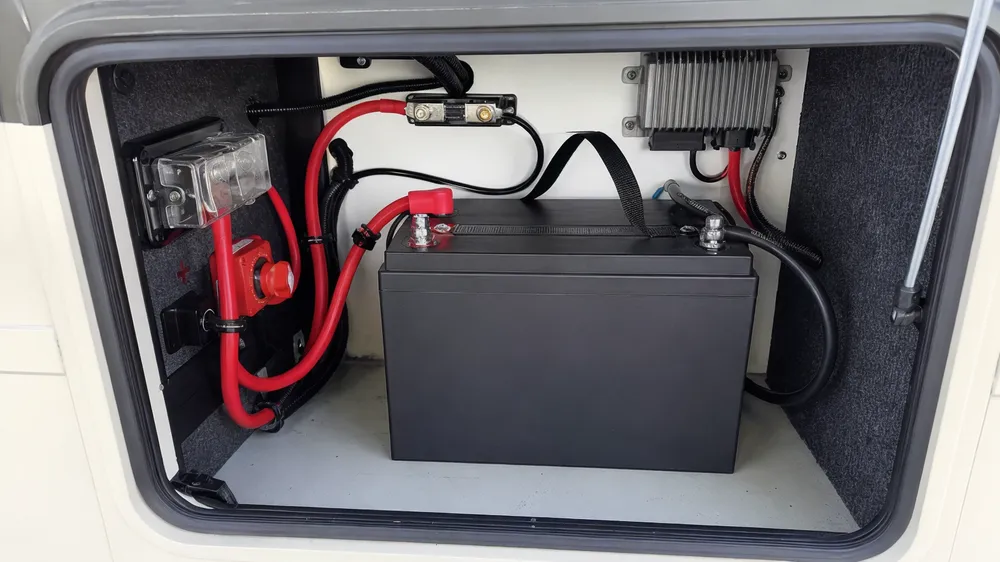
Low-Temperature Charging Protection
The BMS automatically blocks charging below 0°C. This is non-negotiable for LiFePO4 chemistry — charging below freezing causes lithium plating that permanently reduces capacity. We explain this clearly in the user manual with a visual indicator, so end users understand why the battery "won't charge" on cold mornings rather than assuming it's defective.
Industry insight: The most common RV battery warranty claim we see across the industry is capacity loss from cold-weather charging on unprotected packs. Our BMS eliminates this failure mode entirely.
OEM/ODM Options for RV Battery Brands and Vehicle Programs
We produce mobile solar battery systems under your brand. Here's what you can customize, what stays fixed, and where the MOQ thresholds change.
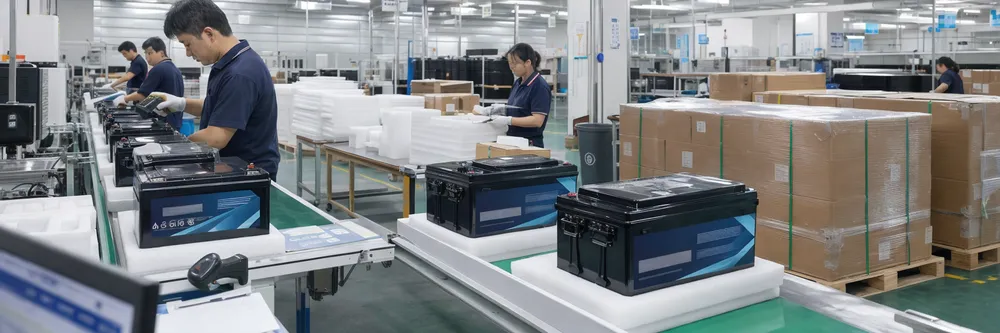
Standard Models
100-unit MOQ- Label and branding: Your logo, model number, and regulatory marks on the enclosure label
- Carton design: Your brand on outer packaging with contact information and product photography
- User manual: Your brand, language(s), warranty terms, dealer contact information
- Color: Powder coat color change on enclosure (RAL color matching available)
- BMS parameters: Charge/discharge cutoff voltages, current limits, and low-temperature thresholds adjusted within safe ranges
- Documentation package: Datasheet, installation guide, and warranty card in your brand identity
Custom Engineering
300–500+ unit MOQ- New enclosure tooling: Custom dimensions, mounting bracket design, or non-standard form factor
- Custom BMS firmware: New communication protocol, proprietary Bluetooth app integration, or non-standard protection logic
- Non-standard cell configuration: Voltage or capacity outside standard range
- Custom terminal design: Non-standard connector type or position requiring new bus bar tooling
What Stays Fixed
Non-negotiable- Cell chemistry: LiFePO4 — we don't compromise on this for mobile applications
- Core BMS safety protections: Over-charge, over-discharge, short-circuit, temperature — non-negotiable regardless of branding
- Certification compliance: The product must still pass UN38.3 and IEC 62133 requirements
18-Engineer R&D Team
Our engineering team handles the development cycle from your specification through production validation. For standard OEM (branding on existing models), lead time adds roughly 5–7 days for label and packaging production. For ODM configurations requiring engineering validation, we provide a detailed timeline at quotation stage.
Compliance, Packing, and Seasonal Reorder Planning
Lithium batteries are classified dangerous goods for international shipping. Your import process requires specific documentation, and your packing needs to survive both freight handling and last-mile delivery to dealers or end customers. Here's how we handle both as your RV solar battery system supplier.
Certification and Compliance Documents
| Document | What It Covers | Your Use |
|---|---|---|
| UN38.3 | Transport safety testing — altitude, thermal, vibration, shock, short-circuit, impact, overcharge, forced discharge | Required for air and sea freight booking; customs clearance |
| MSDS | Material safety data — chemical composition, handling, storage, emergency procedures | Required by freight forwarders and customs authorities |
| IEC 62133 | Secondary cell and battery safety performance | Market access documentation for importers |
| CE | European product safety compliance | Required for EU market entry |
| ISO 9001:2015 | Manufacturing quality management system | Supplier qualification for your procurement process |
We maintain current documentation for all standard models. For OEM configurations, we generate updated test reports after type testing on the custom configuration.
Packing for Mobile Battery Distribution
RV batteries ship to distributors, dealers, and increasingly to end customers via parcel carriers. Our packing accounts for both container freight and individual unit handling:
Inner Packaging
Custom-fit foam inserts, anti-static wrap, terminal covers to prevent short-circuit during transit
Outer Carton
Double-wall corrugated, rated for stacking 5-high on pallets, with drop-test validation
Labeling
Class 9 lithium battery marks, UN number, handling instructions, and your brand label (for OEM orders)
Palletization
ISPM-15 compliant wood pallets, stretch-wrapped, with pallet-level labeling for warehouse receiving
Container Loading
We provide a loading plan at quotation stage with exact quantities per 20GP/40HQ based on your model mix
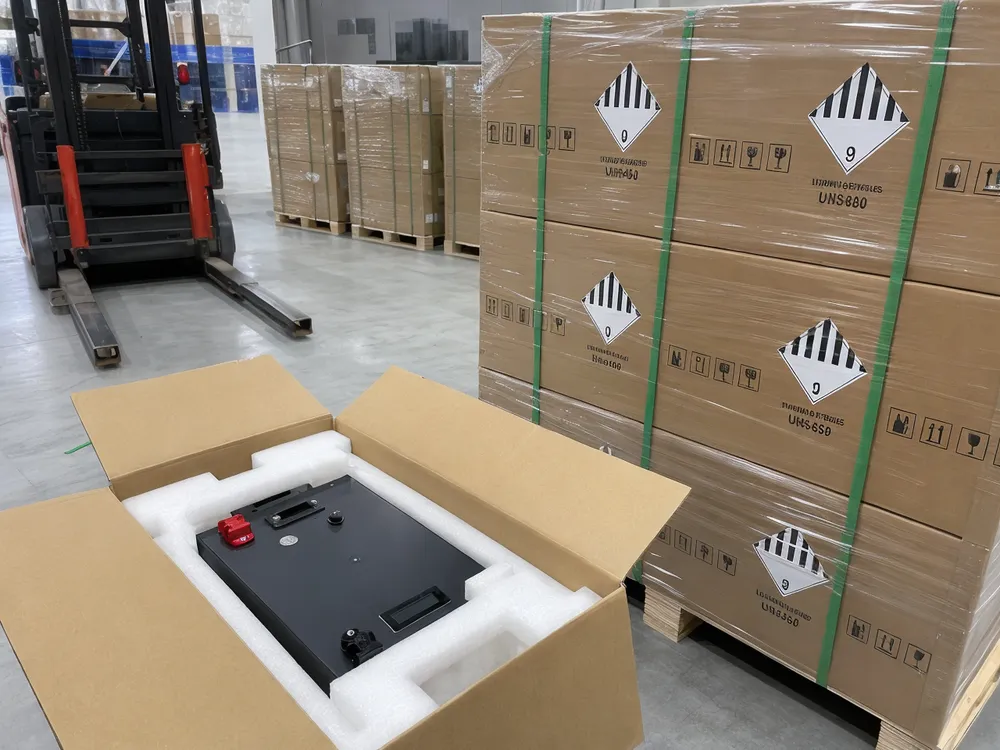
E-commerce & dealer-ready packaging: For buyers selling through e-commerce or dealer networks where individual units ship via parcel, we configure retail-ready packaging with unboxing presentation, QR-code linked manuals, and mail-order-rated carton strength.
Damage claims on parcel-shipped batteries are a margin killer — we've helped several distributors reduce their claim rate below 0.5% by upgrading from generic brown box to engineered packaging.
Seasonal Reorder Planning
The RV battery market is seasonal in most regions — demand peaks March through August in the Northern Hemisphere. Most of our mobile solar battery system buyers follow this pattern:
Oct – Dec
Test & Validate
Place initial or test orders for new models, receive samples, validate with key dealers
Jan – Feb
Main Stock Order
Place main season stock order, 15–25 day production lead time
Mar – Aug
Reorder & Replenish
Reorder as stock depletes — standard models ship within 15 days
Sep – Oct
Evaluate & Plan
Evaluate season performance, plan next year's SKU mix
Our rolling production on standard models means your mid-season reorders don't require minimum container volumes. You can top up in smaller batches as sell-through data clarifies demand.
RV System vs Other Solar Battery System Architectures
If you're evaluating whether the RV/mobile configuration is the right fit for your channel, here's how it compares to the other system types we produce under the same factory program. Each architecture targets a different buyer channel and installation environment.
| System Type | Voltage | Primary Channel | Best For |
|---|---|---|---|
| Solar Battery System for RV | 12V, 24V | RV distributors, camper converters, marine retailers | Mobile/vehicle applications, seasonal retail, brand-label programs |
| Off-Grid Solar Battery System | 12V, 24V | Rural electrification projects, solar home system distributors | Fixed-site off-grid with PWM/MPPT controllers, high-temperature environments |
| Hybrid Solar Battery System | 48V, 51.2V | Residential installer networks | Grid-tied homes with hybrid inverters, monthly reorder channels |
| Stackable Solar Battery System | 48V, 51.2V | Home storage resellers, e-commerce | Expandable residential storage, "start small" sales proposition |
| 3 Phase Solar Battery System | 48V, 51.2V | Commercial contractors, EPCs | Three-phase commercial projects, rack-mounted multi-module installations |
| DC Coupled Solar Battery System | 48V+ | System integrators, technical designers | DC-side efficiency optimization, high-voltage MPPT architectures |
When RV Is the Right Choice for Your Business
You sell into mobile/recreational/marine channels, your customers buy on features (weight, Bluetooth, cycle life) rather than pure $/kWh, and your ordering pattern is seasonal with 2–5 SKU depth. Margins in this segment are typically healthier than residential stationary storage because end users compare against heavy lead-acid alternatives rather than against commodity 48V modules.
When Another Architecture Fits Better
If your buyers install in fixed locations, need inverter communication protocols, or order in project-based volumes of 500+ units, look at the hybrid, stackable, or 3-phase options. We produce all six architectures, so switching or adding a system type to your catalog doesn't require a new supplier relationship.
FAQ for RV Solar Battery Sourcing Decisions
What voltage is best for an RV solar battery system — 12V or 24V?
For most RV aftermarket and camper van applications, 12V is the standard because the vehicle's existing electrical system runs on 12V DC. Your customers can connect lights, USB chargers, water pumps, and fridges directly without a voltage converter. 24V makes sense for larger motorhomes or work vehicles with heavier loads (2,000W+ inverters, air conditioning, power tools) because it halves the current at the same power level — meaning smaller cable sizes and lower voltage drop over longer cable runs.
If you're building a catalog, start with 12V 100Ah and 12V 200Ah as your core SKUs, then add 24V options once your dealer feedback confirms demand.
Is LiFePO4 better than AGM or gel for RV solar battery systems?
For the mobile solar battery system market, LiFePO4 has largely displaced lead-acid in the premium and mid-range segments. The commercial case: LiFePO4 delivers 60–70% weight savings at equivalent usable capacity (because you can discharge to 80–90% DOD vs. 50% for lead-acid), 4–6× the cycle life, and flat voltage delivery that keeps appliances running consistently.
Your margin opportunity is stronger because end users pay a premium for these advantages and the replacement cycle is 8–10 years instead of 2–3. We still produce gel and AGM for price-sensitive markets, but for RV distribution in Europe, North America, and Australia, LiFePO4 is where the volume and margin growth sit.
What BMS protections should an RV battery pack include?
At minimum: over-charge, over-discharge, over-current, short-circuit, and high/low temperature protection. For RV-specific applications, low-temperature charge cutoff (0°C) is critical — it prevents lithium plating damage that permanently reduces capacity.
Bluetooth SOC monitoring is increasingly expected by end users and gives your dealers a diagnostic tool for troubleshooting. Our standard RV packs include all of these. The BMS also handles cell balancing during charging to maintain pack consistency over thousands of cycles.
Can RV solar batteries charge from both solar panels and a vehicle alternator?
Yes — this is the standard use case. The BMS accepts charge current from multiple sources: solar via MPPT/PWM controller, alternator via DC-DC charger, and shore power via AC charger. These sources can operate simultaneously without BMS conflict, provided total charge current stays within the pack's rated maximum.
We specify the maximum charge current acceptance for each model so your installers can size their charging equipment correctly. The key requirement on the installer's side is a proper DC-DC charger between the alternator and the lithium battery — direct alternator connection without a DC-DC charger risks voltage spikes that trigger BMS protection.
What certifications are needed to import lithium RV solar batteries?
For international shipping: UN38.3 test report (mandatory for air and sea freight) and MSDS (required by freight forwarders and customs). For market access: CE for Europe, and potentially additional local certifications depending on your destination (FCC for US if Bluetooth-equipped, RCM for Australia).
We provide UN38.3, MSDS, CE, and IEC 62133 documentation for all standard models. If your market requires additional certification, our engineering team supports the application process with test samples and technical data.
What MOQ applies for standard and OEM RV solar battery systems?
Standard models (existing configuration, EVANBattery label): 100 units. OEM with your branding on existing models (label, carton, manual, color change): 100–200 units. Custom electrical configuration (new voltage, capacity, or BMS firmware): typically 300–500+ units to justify engineering validation.
We quote exact MOQ based on your specific requirements — send your specifications and branding needs, and we'll confirm the threshold and pricing tier within 48 hours.
Send Your RV Battery Requirements for a Factory-Direct Quote
Tell us what you need and we'll respond with a technical recommendation, pricing at your volume tier, and a production timeline.
The inputs that speed up your quote:
- Voltage and capacity — 12V or 24V, target Ah per unit
- Quantity — Initial order size and estimated annual volume
- Target channel — RV aftermarket, camper conversion, marine, fleet, or other
- Branding — Standard EVANBattery label or OEM with your brand
- Destination market — For certification and shipping documentation planning
- Charge sources — Solar only, solar + alternator, or solar + alternator + shore power
- Special requirements — Bluetooth, specific terminal type, custom dimensions, Bluetooth app branding
- Timeline — When you need first delivery
We respond with a model recommendation matched to your application, unit pricing, MOQ confirmation, and a production schedule. No generic catalog — you get a quote built around your actual program.
Factory Credentials
Ready to start?
Get a technical recommendation, pricing, and production timeline matched to your RV battery program.
Explore More Solar Battery Systems
Off Grid Solar Battery System
Standalone energy storage for off-grid installations
ProductHybrid Solar Battery System
Grid-tied with battery backup capability
ProductStackable Solar Battery System
Modular capacity expansion for growing demand
Product3 Phase Solar Battery System
Commercial-grade three-phase energy storage
ProductDC Coupled Solar Battery System
Direct DC coupling for maximum charge efficiency
CategoryAll Solar Battery Systems
View the full range of solar battery solutions