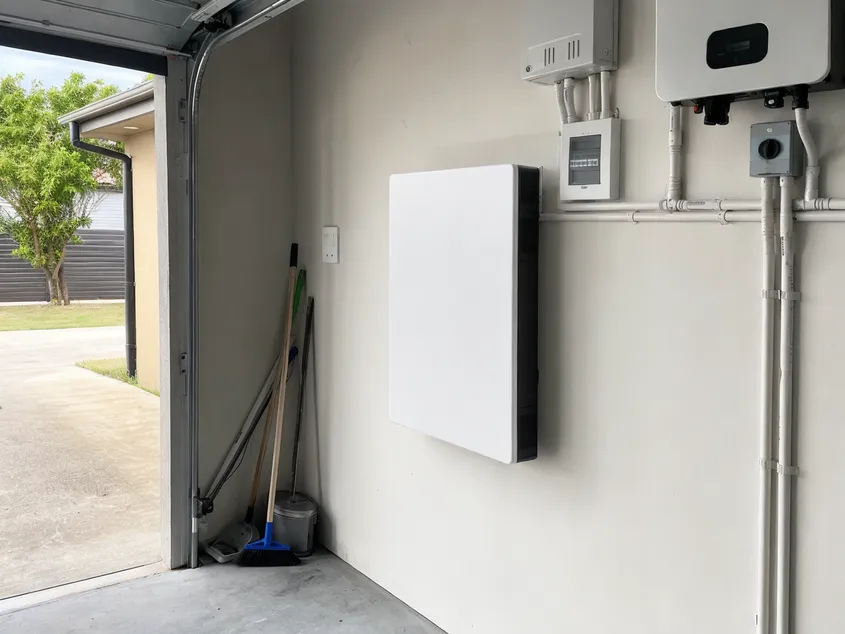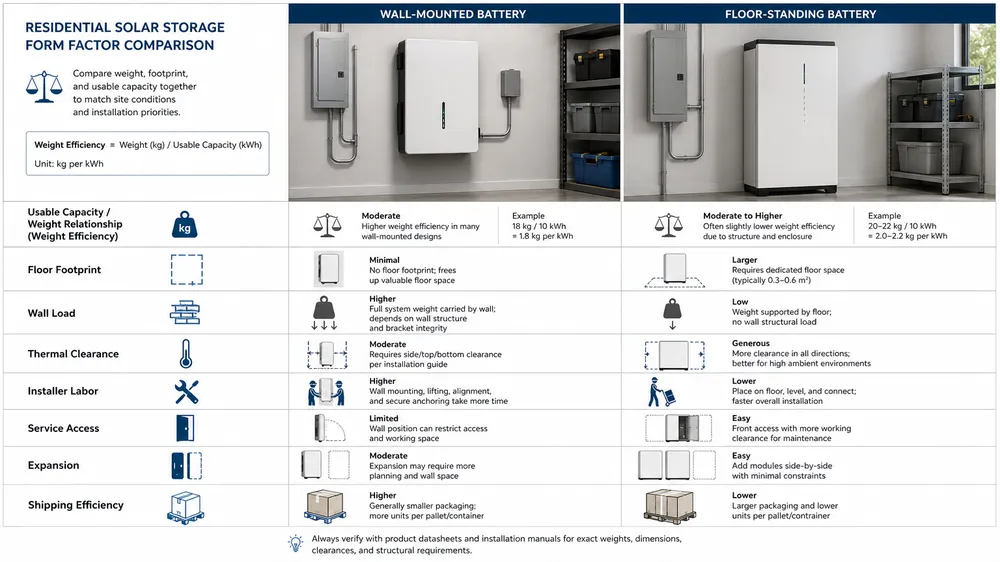
The Verdict Buyers Need Before Choosing a Residential Battery Form Factor
Your residential storage customers want compact installs. That pressure flows upstream to you as a sourcing decision: do you stock wall-mounted SKUs, floor-standing cabinets, or both? The answer depends less on the battery itself and more on the wall behind it, the installer in front of it, and the warranty exposure sitting between you and your end customer.
Here is the short version. A wall-mounted solar battery wins tight, premium retrofit spaces — but only when the wall structure, bracket specification, and airflow clearance are confirmed before the installer arrives. A floor-standing solar battery storage unit wins when capacity requirements are higher, wall conditions are uncertain, and installer speed matters more than visible floor space. If you serve mixed residential retrofit markets through your Home Solar Battery Storage program, carrying both form factors under one supplier and one BMS platform is the lowest-risk path.
The rest of this article breaks down the commercial variables behind that verdict — weight-per-kWh, structural load, thermal clearance, labor time, expansion planning, landed cost, and scenario-specific winners — so you can build your SKU plan with confidence.
Weight, Footprint, and Capacity Must Be Compared Together
Buyers often start with footprint alone. A space saving solar battery sounds like an obvious win for tight garages and utility closets. But footprint is only one variable in a three-way relationship with weight and usable capacity. A slim wall mount solar battery residential unit that weighs 52 kg on a bracket rated for 45 kg is not a space saver — it is a liability.
| Criterion | Wall-Mounted | Floor-Standing |
|---|---|---|
| Typical capacity range (48V/51.2V) | 5–10 kWh per unit | 5–15+ kWh per unit or stack |
| Installed weight (pack + bracket/cabinet) | 35–65 kg typical | 45–120+ kg typical |
| Weight per kWh | Higher bracket load sensitivity | More tolerant of heavier cells |
| Floor footprint | Near zero (wall area used) | 300–600 mm depth, 400–600 mm width typical |
| Enclosure depth | 150–220 mm typical | 300–500 mm typical |
| Handling during install | Often one-person if under 45 kg; two-person above | Usually two-person or dolly |
| Service clearance needed | Side + top + bottom gaps | Front access + rear/side gaps |
The key planning number is weight per kWh relative to your bracket and wall specification. A 10 kWh wall-mounted pack at 5.5 kg/kWh puts 55 kg on the bracket before you add the enclosure and BMS board weight. That is the threshold where many residential walls and standard mounting hardware start to need engineering review.
For your Wall Mounted Solar Battery SKU planning, confirm the finished pack weight against the bracket rating and the wall substrate before promising "fits any tight space" in your sales materials.

Wall Load and Bracket Specification Decide Whether Wall-Mount Protects Margin
This is where most failed wall mount solar battery residential installations start — not with the battery, but with assumptions about the wall. We see it regularly: a distributor promotes a compact wall-mounted unit, the installer arrives, discovers the wall is lightweight block or aged plaster over timber frame, and the job stalls. The callback, the rescheduling, the possible return freight — that erases whatever margin the compact form factor was supposed to protect.
What you should verify before committing to wall-mounted SKUs for a market:
- Finished pack weight including enclosure, BMS, wiring harness, and any integrated disconnect. Not just cell weight.
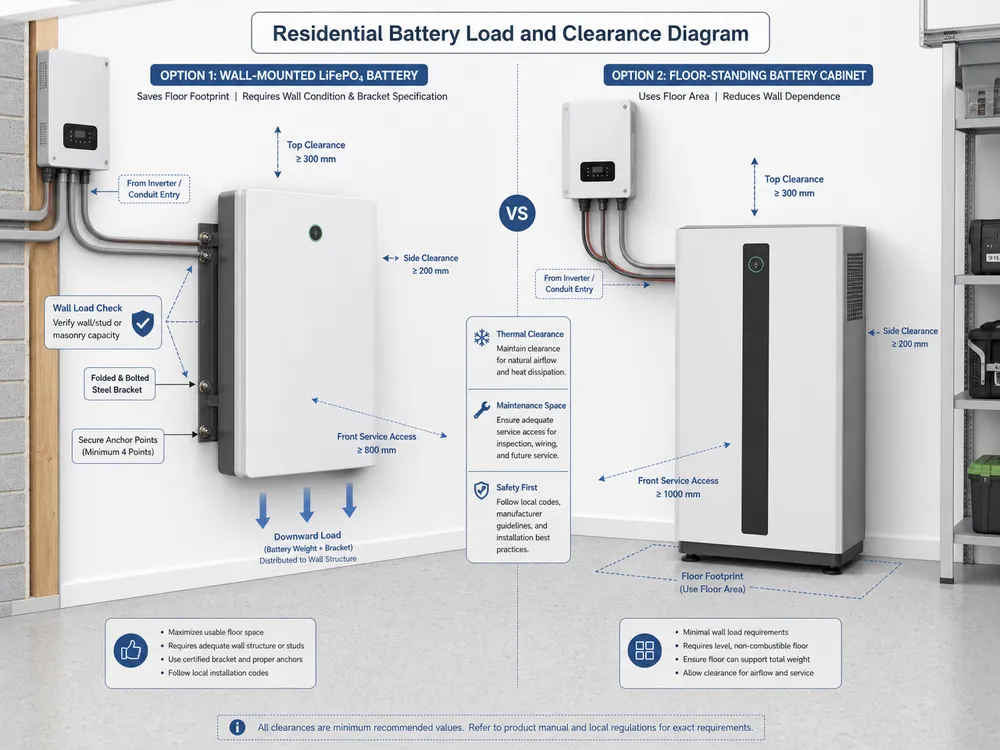
- Bracket material and gauge — we use 3 mm cold-rolled steel brackets for our heavier residential packs. Thinner stamped brackets flex under sustained load and vibration.
- Anchor type matched to wall substrate — expansion bolts for solid concrete, toggle bolts or specialized anchors for hollow block, through-bolts with backing plates for timber frame. Each substrate has a different safe pull-out rating.
- Cumulative load if multiple units are stacked vertically — two 50 kg units on one wall section doubles the point load on the lower anchors.
- Anti-vibration consideration — residential walls transmit door slams, HVAC vibration, and seismic micro-movement. Bracket design should include rubber isolation pads or lock washers at minimum.
(We switched from welded bracket tabs to folded-and-bolted bracket assemblies in 2021 after field reports of weld fatigue on units installed near garage doors — the repeated vibration from the door motor was enough to crack thin welds over 18 months.)
The commercial risk is straightforward: a failed wall installation costs you the installer's return trip, possible wall repair, customer confidence, and sometimes the sale itself. If your target market has mixed or older housing stock, either confirm wall conditions in your installer documentation or default to floor-standing for uncertain substrates.
For detailed installation planning, see our guide on Wall-Mounted Solar Battery Installation.
Thermal Clearance and Service Access Are Warranty Variables
A space saving solar battery claim only holds if the unit can actually breathe in the space you put it. Both form factors need clearance — the difference is where and how much.
Wall-mounted clearance planning:
- Minimum 100–150 mm top clearance for convective airflow (heat rises along the wall surface behind and above the unit).
- 50–100 mm side clearance to avoid trapping heat between the enclosure and adjacent walls or cabinets.
- Bottom clearance for cable entry, disconnect access, and drip protection.
- The wall surface itself becomes a heat sink or insulator depending on material — concrete dissipates; insulated drywall traps.
Floor-standing solar battery storage clearance planning:
- Front access is critical for BMS status LEDs, communication ports, breaker/disconnect, and terminal connections.
- Rear clearance from the wall prevents heat buildup against the cabinet back panel.
- Side clearance matters if the unit uses side-panel ventilation slots.
- Floor surface should be level, dry, and away from water heaters, washing machines, or HVAC condensate lines.
The warranty consequence is real. Thermal derating — where the BMS reduces charge/discharge current because internal temperature exceeds safe limits — is the most common performance complaint in tight residential installs. It is not a defect. It is the BMS doing its job because the installer did not leave enough clearance. But your customer does not see it that way; they see reduced performance and call you.
(We include minimum clearance diagrams in every product datasheet now. It added one page to the document but cut our thermal-related support tickets by roughly a third across European distributor accounts.)
Plan ventilation and wiring layout before promising "fits any tight space" in your marketing. The certification inspector will check it even if the installer does not.
Capacity Expansion and BMS Consistency Change the SKU Strategy
Form factor is not just a one-time installation decision — it shapes your buyer's upgrade path and your own SKU architecture.
Wall-mounted expansion limits: Wall area is finite. A typical residential utility wall might support one or two wall-mounted units before you run out of structurally suitable mounting space. Cumulative weight on a single wall section compounds the load concern. For markets where homeowners commonly start at 5 kWh and expand to 10–15 kWh over time, wall-mounted units can hit a ceiling.
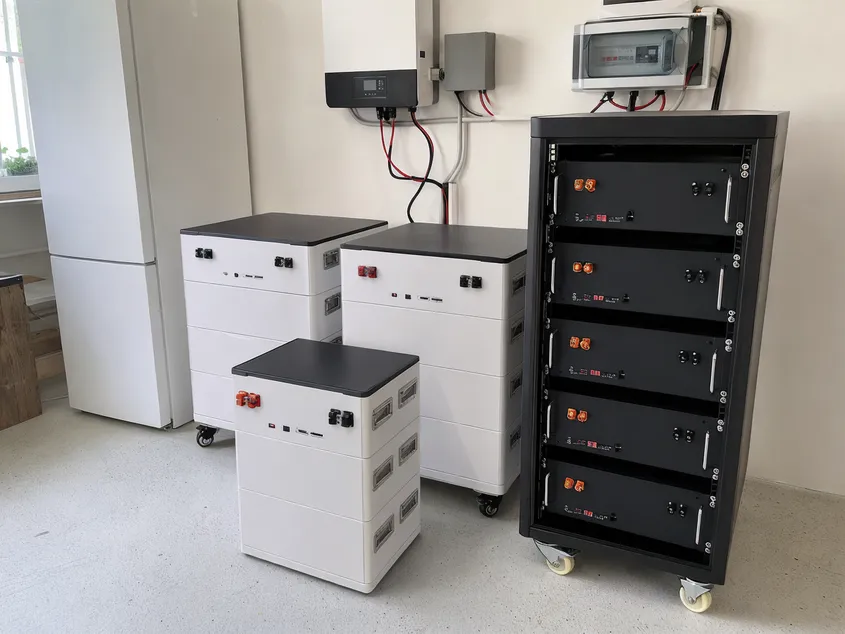
Floor-standing expansion advantages: Stackable floor-standing modules or larger single-cabinet systems handle the 10–20 kWh range more naturally. Adding capacity means adding another module to the stack or swapping to a larger cabinet — no wall assessment, no new anchors, no structural questions.
BMS consistency across form factors: This is where single-supplier sourcing pays off. We design the BMS in-house for both our wall-mounted and floor-standing residential lines. Same protection parameters — over-voltage, under-voltage, over-current, over-temperature, short-circuit, and cell balancing logic — regardless of whether the pack sits on a bracket or on the floor. Same communication protocol to the inverter. Same installer configuration interface.
For your distribution business, that means one training program for installers, one set of inverter compatibility documentation, and one warranty framework across both SKUs. When a customer upgrades from a wall-mounted 5 kWh unit to a floor-standing 10 kWh system, the inverter handshake and monitoring platform stay the same.
Container Loading and Landed Cost Can Reverse the Obvious Choice
Unit price on the proforma invoice is not your landed cost. Packaging, pallet configuration, container utilization, and damage risk during transit all factor into what you actually pay per kWh delivered to your warehouse.
Wall-mounted units — shipping considerations:
- Slim carton profile can pack efficiently in rows, but brackets and mounting hardware need internal protection (foam inserts, corner guards) to prevent enclosure dents and terminal damage.
- Screen or LED panel faces need face-down or face-protected orientation.
- Lighter individual cartons mean more units per layer, but stacking height is limited by bracket protrusion and carton crush strength.
Floor-standing solar battery storage — shipping considerations:
- Deeper cabinet dimensions reduce units per container row, but heavier units palletize more stably.
- Stackable modules often ship as individual units and assemble on-site, which can improve packing density versus shipping a pre-assembled tall cabinet.
- Heavier gross weight per carton means fewer units before hitting container weight limits (especially relevant for 20GP containers on weight-sensitive routes).
Mixed-SKU container planning: If you order both wall-mounted and floor-standing units from the same supplier, container space can be optimized by mixing slim wall-mount cartons into gaps around floor-standing pallets. We run this calculation for buyers regularly — 6 production lines and shared export documentation mean your mixed order ships as one consolidated container, not two half-empty ones.
(For Southeast Asian and African routes where 20GP is standard and weight limits are strict, we often recommend splitting heavier floor-standing units across two shipments rather than overloading one container. The freight savings from avoiding overweight surcharges usually exceed the second-shipment cost.)
Your landed cost comparison should include packaging material, pallet configuration, container utilization rate, and damage claim history — not just FOB unit price.
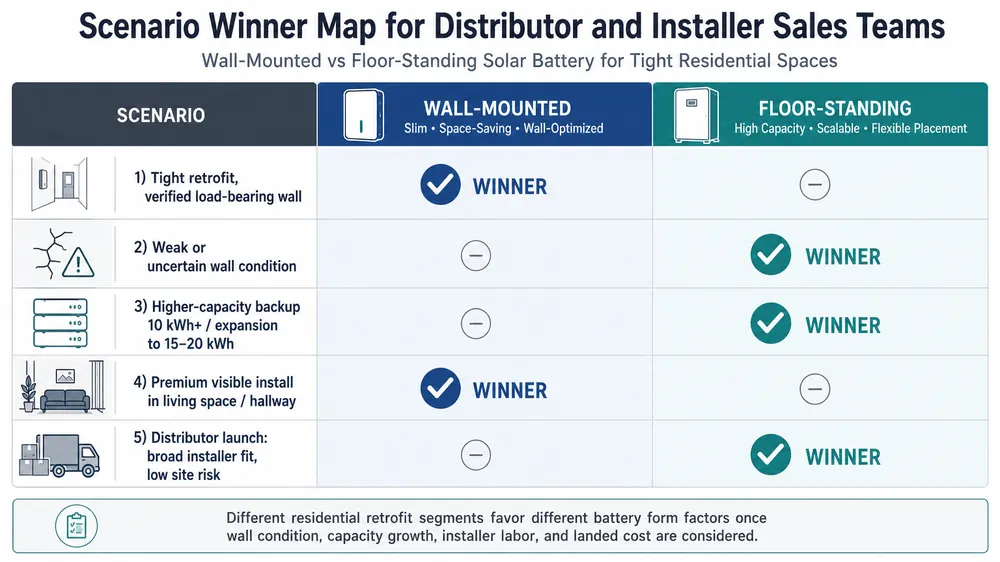
Scenario Winner Map for Distributor and Installer Sales Teams
Stop thinking about wall-mounted vs floor-standing solar battery as a product preference. Think about it as a market-segment decision. Each residential retrofit scenario has a winner based on commercial logic, not aesthetics.
Scenario 1: Narrow garage or compact utility room with verified load-bearing concrete or brick wall. Winner: Wall-mounted. The installer confirms the wall, mounts the bracket, and the homeowner keeps their floor space. Your margin is protected because the install goes smoothly and the unit performs within thermal spec. This is the premium urban retrofit segment where visible floor space is a selling point your installers can use to close deals.
Scenario 2: Older housing stock with lightweight block, timber frame, or unknown wall composition. Winner: Floor-standing. Unless the installer is prepared to assess and potentially reinforce the wall (adding labor cost and liability), a floor-standing cabinet eliminates the structural question entirely. Fewer callbacks, fewer warranty arguments about bracket failure.
Scenario 3: Higher-capacity backup package — 10 kWh and above, or planned expansion to 15–20 kWh. Winner: Floor-standing. Stackable modules or larger cabinets handle the weight and volume without multiplying wall-load concerns. Your upsell path from 5 kWh to 15 kWh stays clean.
Scenario 4: Premium new-build or architect-specified project where the battery is visible in a living space or hallway. Winner: Wall-mounted. The slim profile and clean wall integration justify the extra bracket specification work. These projects typically have known wall construction and professional installation teams.
Scenario 5: Distributor launching a residential storage line across mixed housing types in a new market. Winner: Carry both. Matched BMS logic, shared inverter compatibility, and one supplier relationship. Your installers learn one system, your support team handles one documentation set, and your container orders consolidate under one purchase order.
Supplier Validation Checklist Before Adding Either SKU
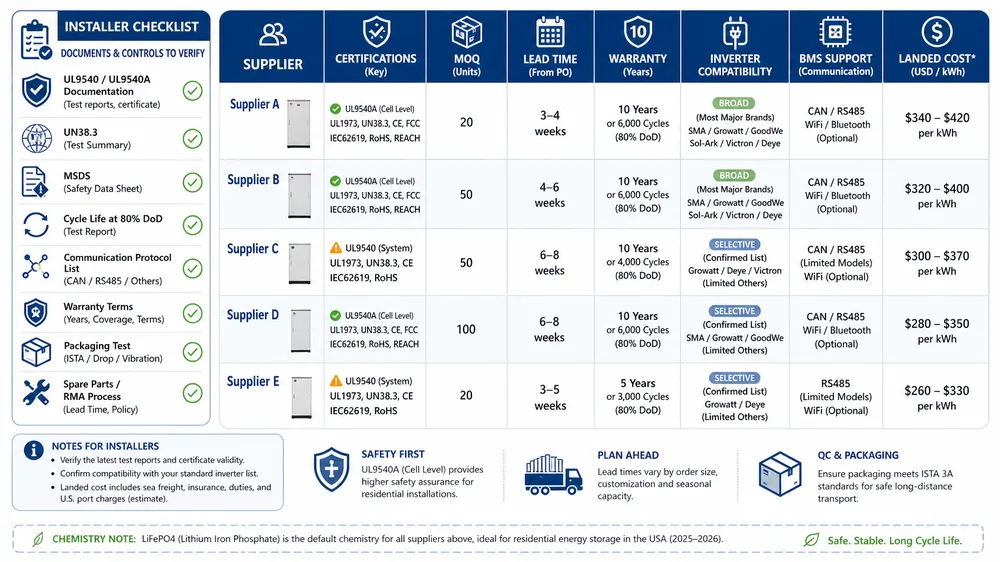
Before you add a wall mount solar battery residential unit or a floor-standing solar battery storage cabinet to your catalog, verify these items in the supplier's documentation and sample:
Technical documentation:
- Complete datasheet with net weight, gross weight (packed), and bracket/hardware weight listed separately.
- Bracket engineering drawing with material specification, gauge, and maximum rated load.
- Enclosure dimensions including protrusions (terminals, cable glands, ventilation grilles).
- Minimum clearance diagram — top, sides, bottom, and front service access.
- BMS protection function list: OVP, UVP, OCP, OTP, short-circuit, cell balancing method, and communication protocol (CAN, RS485, or proprietary).
Compliance and certification:
- UN38.3 transport test report (mandatory for lithium battery shipping).
- IEC 62133 safety test report.
- CE declaration of conformity for your target market.
- MSDS for customs and freight documentation.
- ISO 9001:2015 manufacturing quality system certificate.
Sourcing and production:
- MOQ for standard models (ours starts at 100 units).
- OEM/ODM lead time and minimum order for custom bracket, enclosure color, or capacity configuration.
- Cell sorting and matching method — automated sorting ensures consistent capacity and internal resistance across packs in your batch.
- Packing method, carton dimensions, and pallet configuration for container planning.
If your supplier cannot provide bracket drawings, clearance diagrams, and BMS protocol documentation alongside the battery datasheet, you are missing the information your installers need to avoid field problems. Send your project specifications — voltage, capacity, preferred form factor, target market, and expected volume — through a Request Quote with those details, and the engineering team can confirm feasibility and provide complete technical packages.
FAQ: Form-Factor Selection for Residential Solar Battery Sourcing
Is a wall-mounted solar battery always better for small residential spaces?
No. "Small space" does not automatically mean "wall-mount." If the wall cannot support the pack weight, or if clearance around the unit is too tight for proper airflow, a slim floor-standing cabinet with front access may actually fit better and install faster. The decision depends on wall substrate, pack weight, and available clearance — not room size alone.
How heavy can a wall mount LiFePO4 battery be before floor-standing is safer?
There is no universal cutoff, but in practice, residential wall-mounted packs above 50–55 kg start requiring engineered bracket solutions and verified wall substrates (solid concrete or reinforced masonry). Above that range, the bracket cost, anchor specification, and installation liability often make floor-standing the more commercially sensible choice — unless the project specifically requires wall mounting and the structure is confirmed.
Does floor-standing solar battery storage need more ventilation clearance than wall-mounted?
Not necessarily more, but in different locations. Floor-standing units need rear and side clearance from walls, plus front clearance for service access. Wall-mounted units need top clearance for rising heat and side clearance from adjacent surfaces. Total clearance volume is comparable; the geometry is different. Check the manufacturer's clearance diagram for each specific model.
Which form factor is better for installers trying to reduce labor time?
Floor-standing is generally faster to deploy when wall conditions are unknown. No wall assessment, no anchor drilling, no bracket leveling — place, level, connect. Wall-mounted installs are fast when the wall is pre-verified and the bracket template is provided, but they add steps (and risk) when the installer has to assess the wall on-site.
Can distributors source wall-mounted and floor-standing batteries with the same BMS settings?
Yes, if the manufacturer designs the BMS in-house for both form factors. We use the same BMS platform across our wall-mounted and floor-standing residential lines — same protection parameters, same communication protocol, same inverter compatibility list. That means one installer training program and one technical support framework for your entire residential storage catalog.
What should be checked before quoting a space saving solar battery project?
Confirm three things before quoting: (1) the actual wall substrate and load capacity at the proposed mounting location, (2) the available clearance envelope including cable routing space, and (3) whether the homeowner's capacity target can be met within the wall area and weight limits available. If any of those three are uncertain, quote the floor-standing option as the primary and wall-mounted as the conditional alternative.